
GEORGE Whitefield (1714-1770) first came to Abergavenny in 1739 and expected much opposition to his style of preaching from the local people.
He wrote in his journal: “But God impressed a divine awe upon all, so that though there were many opposers present when I preached (to around 2000 people), yet not one dared to utter a word.”
At some time, he met Mrs. Elizabeth James, a widow who lived at Hillcrest, 19 Nevill Street, and they married on the 14th of November 1741 at St. Martins Chapel near Caerphilly.
Mrs. James was wholeheartedly involved with the Methodist movement and her new husband described her as, “About 36 years of age, neither rich in fortune nor beautiful as to her person, but, I believe, a true child of God and one who would not, I think, attempt to hinder me in His work for the world.” Before they married, Mrs James was very much in love with a friend of George Whitefield named Howell Harris. He was a school teacher who had begun to preach the gospel with uncompromising zeal in Wales.
But Harris was convinced that God would want him to remain a bachelor and he came to the conclusion that his friend, George Whitefield, would be an ideal husband for Mrs. James.
She was understandably put out by this proposal but despite her anger and disappointment, she agreed to become the wife of George Whitefield even though she was ten years older than him.
Their marriage was not entirely a happy one and Elizabeth was often left alone whilst George went on his religious travels. She suffered several miscarriages and a son was born in 1743 but he died in infancy. Elizabeth accompanied George on his third journey to America (1744-1748). Altogether, George made seven such trips but Elizabeth never went with him again. She died of fever two years before George. He died on his last visit to America and is buried in the local church at Newbury Port, Massachusetts.
George Whitefield preached around 18,000 sermons in his lifetime to an estimated audience of 10,000,000 people and was one of the most famous religious figures of the 18th century.

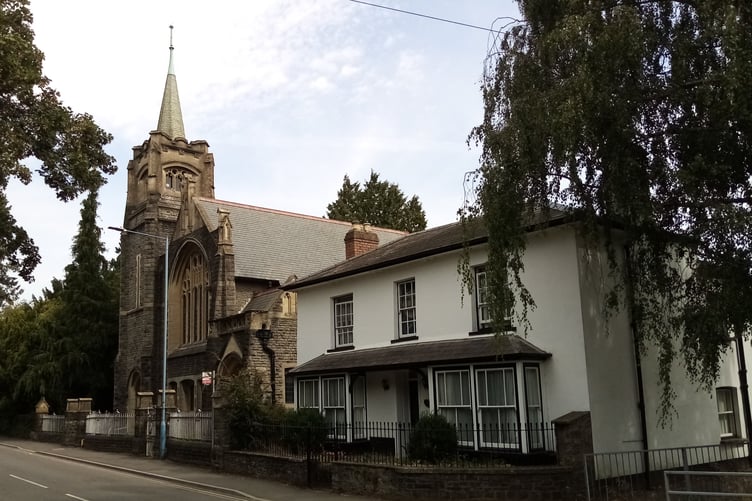
The beginnings of an institution
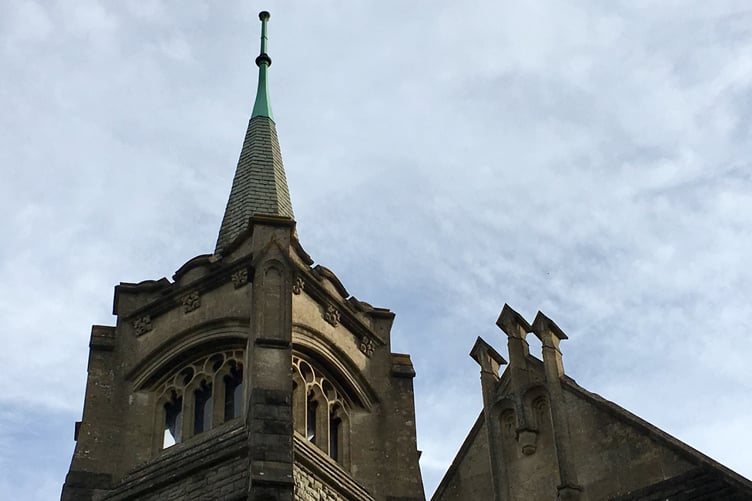
The Presbyterian Church was started at Abergavenny, under the direction of the Rev. W. Williams, in the year 1869 when the old church known as Whitfield was built in Frogmore Street at a cost of something under £1000. According to the 1903 Burrow’s Guide to Abergavenny there was a disagreement amongst members of the Independent Chapel in Castle Street and a certain number of them withdrew and formed a separate congregation.
The new church had seating for 350 people and opened in November 1871 and given the name Whitefield Presbyterian.
In 1906 it was recorded that the pastor was the Reverend William Sylvanus Jones. Later on, permission was sought from the Monmouth Presbytery to build schoolrooms alongside the church.
The Presbytery, after careful consideration, refused on the grounds that the strongest Protestant Church in the world should have better buildings in a town like Abergavenny and urged the church to not only build new school rooms, but a new church at a different location.
A site in Pen-y-Pound was bought for £1000 in 1905 and the contract price for the building was £4190. (The old building in Frogmore Street remained a church until the early 1970’s but was then converted into three separate units. It is still in use today and is currently the home of ‘Dance Blast.’)
The new site adjoined the Grammar School, erected in 1898, and provided accommodation for 470 church-goers and 270 scholars in the Sunday school.
A Gothic kind of style
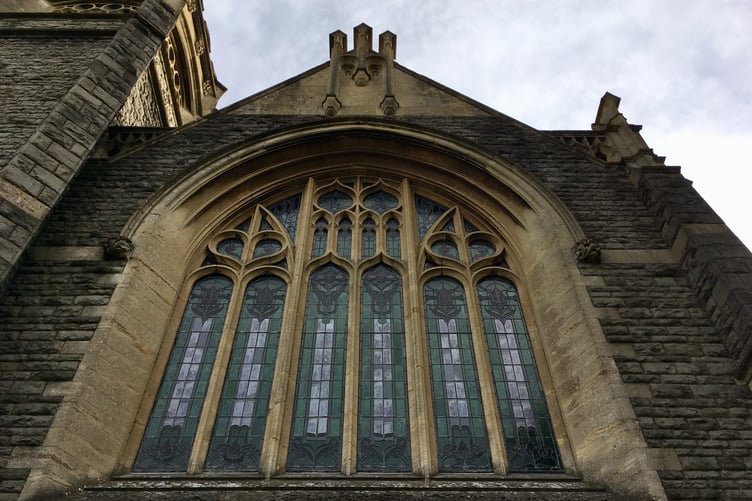
The style of architecture adopted was a free treatment of Perpendicular Gothic and was designed by E. A Johnson, FRIBA, and built by J. G. Thomas & Son of Abergavenny.
Considerable difficulty was experienced in the foundations as they discovered traces of an old water-course but the new church was completed and opened on the 1st of October 1908.
A new organ had been installed and Andrew Carnegie had contributed half of the £800 cost.
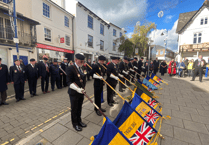
The Right Hon. Reginald McKenna, MP for Monmouth, and his wife had been invited to perform the opening ceremony and crowds gathered around the junction of Frogmore Street and Pen-y-Pound to see the couple arrive. A guard of honour composed of 42 members of the Territorial Cadets (Abergavenny detachment), in their neat khaki uniforms, had marched down from the Drill Hall accompanied by three buglers.
At the appointed hour for the opening, four o’clock, the buglers and the guard of honour swung into action and a crowd of over 500 gave a warm welcome to the distinguished visitors who were met by the Pastor, the Rev. William Sylvanus Jones and officers of the church.
Miss Dolly Jones, daughter of the Pastor, presented Mrs. McKenna with a handsome bouquet of flowers and Mr. Mckenna was given a souvenir silver key to unlock the door of the new church.
After numerous speeches and readings, the prayer of Dedication was given by the Rev. William Sylvanus Jones who then gave a cordial welcome to the congregation to have tea in the assembly room.
A small token of affection
The proceedings were interrupted at their height by Mr. Robert Anderson Gardner, a local JP and church elder, who stood up and announced, “I have been called upon to relieve Reverend Jones of his duties as Chairman for a few minutes as we wish to present him with a small token of our affectionate regard for him.
"Testimonials are often given when ministers leave a church but this is given because Reverend Jones is staying with us.”
The gift consisted of an album containing the names of every member of the church. In accepting the gift, the Pastor expressed his thanks to his flock, and his pleasure at receiving it from the hands of one of the oldest members of the congregation.
It was very cheering to his heart to receive such a token of appreciation.
Mr. McKenna, in response to a call from the Chairman for an address, said he was sure they would all be glad that it was not his intention to do more than say how pleased he and his wife had been to accept the kind invitation to attend the proceedings and to take tea. He had to get away to Pontypool and so begged leave to depart.
The death of a Reverend
The Abergavenny Chronicle of the 17th of February 1911 recorded the death and funeral of the Reverend William Sylvanus Jones, the genial and very popular pastor of the Whitefield Presbyterian Church in Pen-y-Pound, Abergavenny.
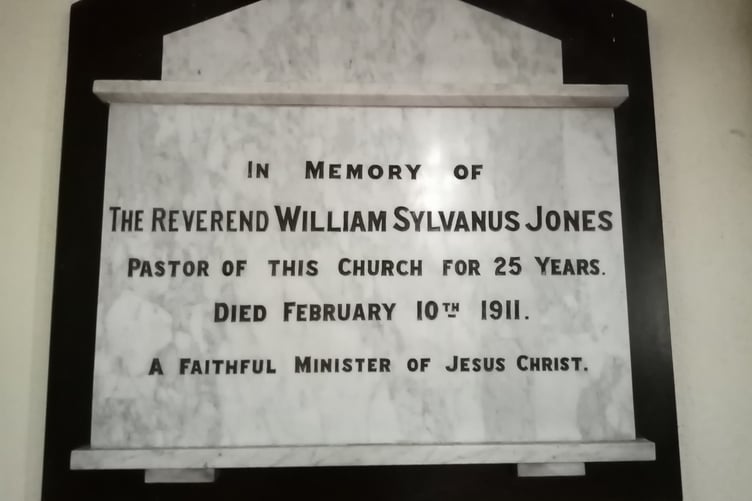
William was only 56 years of age and he had been suffering from a severe form of pernicious anaemia for over two years. He was just three months short of celebrating 25 years of his ministry and there is a plaque in the church to commemorate this.
William was originally from Carmarthenshire and was educated at the Trefecca Theological College. He came to Abergavenny in 1886 where he became very popular with his congregation which rapidly increased until it was three times the size it had been on his arrival. His geniality and unfailing good humour made him very popular with all shades of religion.
William took a keen interest in school affairs. He became one of the managers and correspondents of the British school in Victoria Street and he was one of the principal figures on the old School Board of Abergavenny of which he was vice-chairman.
When that Board was done away with by an Act of Parliament in 1902, he was appointed onto the local committee governing the elementary schools of the town and he was also a governor of the Girls’ County Intermediate School in Harold Road.
William was also the Non-conformist Chaplain of the Monmouthshire Asylum. William and his family lived in tied accommodation at the Manse in Mount Street. He also took a keen interest in the newly built YMCA as well as being chairman of the ‘Cwmreigyddion-y-fenni Society’ which was trying to revive Welsh nationalism through local Eisteddfods.
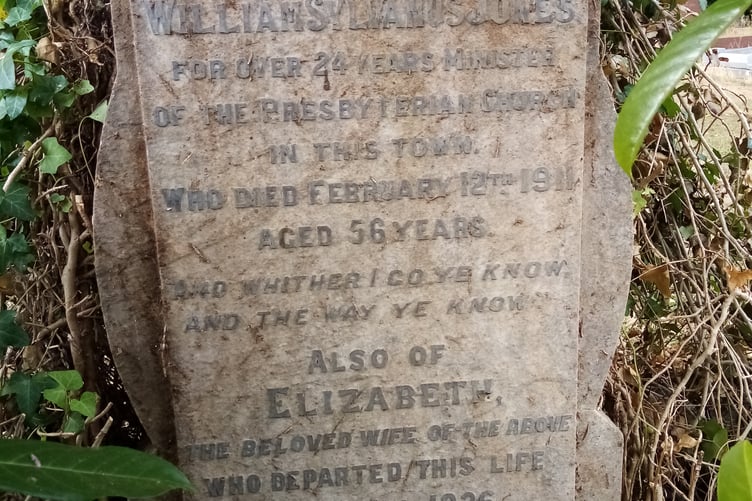
William’s funeral cortege left the Manse at 3 o’clock in the afternoon for a memorial service at the Presbyterian Church in Pen-y-Pound where a large congregation were waiting. Many clergymen from around the county attended the service as well as local dignitaries. William was buried in the New Cemetery at Llanfoist. His widow, Elizabeth, moved to Weymouth where she died in 1926 after a short illness, aged 65 years. She is buried alongside her husband in the New Cemetery.
The Reverend's Children
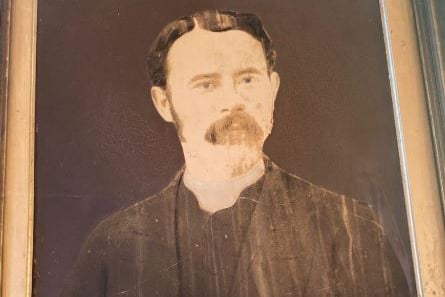
William and Elizabeth Jones had five children. Eleanor, born in 1886 and also known as Cissie, died in childbirth. Abel, born in 1884, received his BA degree in 1904 from the University of Wales, Aberystwyth and took up teaching as a profession and went on to become the headmaster at Bishop Vesey Grammar school in Birmingham.
In 1916 he received a commission in the Army Service Corps. He died in Birmingham in 1965. Dolly, born in 1889, became an elementary school teacher. Gwladys, born in 1892, married Leslie Jenkins who was badly gassed in the First World War and died within a few years.
She had a diploma in Domestic Science and taught home economics in a school in the east end of London. She also took up dressmaking in her spare time.
Ceridwen, born in 1894, went as a boarder to Canton High School for girls in Cardiff but escaped one night by getting out through a bathroom window.
She trained as a nurse and was in sole charge of a small-pox hospital whilst still in her early twenties. She married John Murray Jessiman who was a fluent Russian speaker and went to Russia with him and their daughter during the Russian Civil war.
The Red Army were communist Bolsheviks and led by Lenin and Trotsky. The opposing White Army had international support from countries such as Great Britain, France and the United States.
Jessiman was liaising between the White Cossacks and the British army when Lloyd George decided to end British support.
The Red Army won the war and created the Soviet Union. Ceridwen and her family were caught up in the turmoil but they managed to catch the last train out of Vladivostok before the Reds blew up a vital bridge.
They escaped via China and ended up in San Fransisco before eventually returning to England.
A native of Dumfries
One of the bearers at William’s funeral was Peter Telford who had just become an elder of the church and had held the high office of Moderator of the Presbyterian Church of Wales.
He was instrumental in raising enough money to send William on a six-week cruise to see if that would improve his health. A native of Dumfries in Scotland he had come to Abergavenny in 1897 and had got involved with town affairs from the start.
On the 27th of October 1900 he married Gertrude Smith in the Presbyterian Church.
She was the youngest daughter of Thomas Smith, a furniture dealer, whose father was a cabinet maker. The 1901 census shows Peter and Gertrude living with her parents at 12 Nevill Street in Abergavenny. By the following census they are living at Lidstone on the Monmouth Road.
They have three children and Peter’s occupation is a ‘credit draper’ with a shop at 21 Cross Street. A credit draper allows his merchandise to be bought on a hire purchase arrangement.
Peter put himself forward to the Town Council in 1912 and won a seat in the Priory Ward. He sat on, or was chairman, of numerous committees and other organisations throughout the town.
A thorn in the side of the Gas Committee
In 1919 the Chronicle reported that, “He had always been a strong critic of the Gas Works Administration, and, at times, a thorn in the side of the Gas Committee. Now some artful members of the Council have given him the chance of his life to put things right. He has been appointed Chairman of the Gas Committee, and his colleagues who have thus got their own back will no doubt enjoy the spectacle of the erstwhile critic being bombarded with questions and having to assume the role of defender instead of attacker.”
As chairman, he had charge during very difficult times when owing to a shortage of supplies, it was a struggle to keep the gas flowing. Peter heard that there was a boatload of foreign coal coming in to a south Wales port, and with his usual energy he secured enough coal to carry on the production of gas without closing down. Peter Telford became Mayor in 1924 and again in 1949.
Peter was also President of the Abergavenny & District Horticultural Society as well as being a member of the Free Libraries Committee.
But he really made a mark in 1918 when he formed an Abergavenny Attractions Association with himself as Hon. General Secretary and the Mayor as Chairman.
The idea got off to a slow start but thanks to Peter’s drive and enthusiasm the Association was putting on events all year round in various locations as well as performances on the stage at the Borough Theatre.
A flying display at Llanfoist and the All Blacks at Bailey Park
There were fetes, concert parties and military tournaments but the high spot was probably a flying display by officers of the RAF during the Easter Bank Holiday in April 1919.
This was part of a weekend of events and it is no exaggeration to say that the flying display proved to be the finest attraction ever seen in this part of the country. The RAF had promised to send six aeroplanes but only four arrived because of demobilisation issues.
They were 275 horse power Rolls Royce Bristol fighters and the demonstrators gave the crowd an idea of the work they carried out during the war.
The flying ground was an eighteen-acre field on the farm of Percy Denner at Llanfoist. All the latest aerial evolutions were shown to the crowd that included formation flying, nose-diving, near vertical climbing, looping the loop, rolling and spinning.
One mishap occurred when a runner came off on landing and caused the aircraft to topple forward and smashed its propeller. At the end of the display the three remaining machines flew over Bailey Park on their way back to Bristol.
Six thousand spectators in the park were watching a rugby match between a team from Cross Keys and the New Zealand All Blacks. Needless to say, the All Blacks won by twenty points to nil. This match had also been organised by the Abergavenny Attractions Committee.
By 1939, the Telford family were living in Claremont on the corner of Monmouth and Station Road where his wife, Gertrude, died on the 25th of September. Peter married again in 1948 to Lillian Rachel Henry. Peter died in the Cottage Hospital on the 12th of January 1961 aged 90. He is buried with his first wife in the New Cemetery at Llanfoist. His estate was valued at £22,000 which is around £440,000 in today’s money.
Comments
We've recently changed our login process. If you have an account for commenting, you will need to re-register on the login window.
This article has no comments yet. Be the first to leave a comment.