
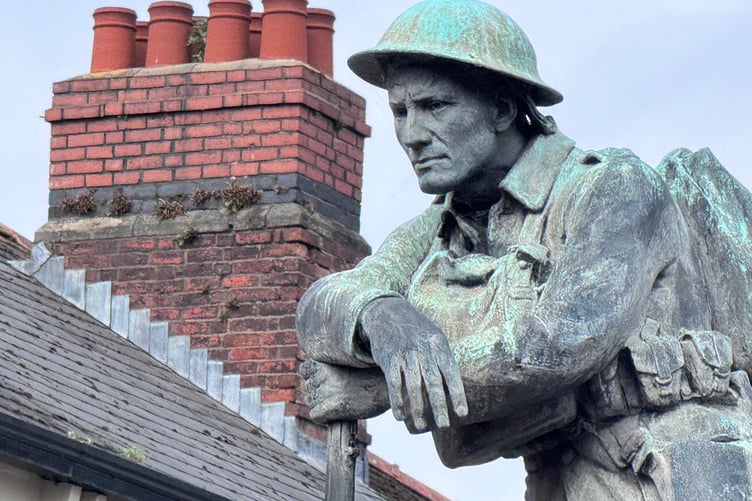
THEY might be made of bronze or stone and rendered eternally mute, but that doesn’t mean Abergavenny's statues don’t have a tale to tell.
Let’s look past their weathered demeanours and dig deep into the history of these stoic monuments we pass every day but barely give a moment’s thought to.
The War Memorial
We’ll start at Frogmore Street and one of Abergavenny’s most famous landmarks - the Cenotaph.
Unveiled by the Lord Lieutenant of Monmouthshire, Major-General Treowen in front of a huge crowd of 50000 plus, the cenotaph has since become a part of the fabric of Abergavenny.
The timeless tribute to the soldiers of the 3rd Battalion Monmouthshire Regiment has been here for so long people forget it once wasn’t.
Created by sculptor Gilbert Ledward OBE, who also sculpted the The Guards Memorial, at Horse Guards Road in London and the Great Seal of the Realm and the 1953 crown coin for the coronation of Elizabeth II, the lone and battle-hardened ‘Tommy’ resting wearily on his rifle has been keeping a watchful eye on Abergavenny since 3.30 pm on October 29, 1921.
A lot has changed since the town’s stoic guardian took up his first and never-ending watch.
Horses and carts have disappeared into the sunset of times gone by, and with the pedestrianisation of Frogmore Street, the old soldier has turned his back on the motor car as well.
Yet the seasons of change and tides of time are unrelenting, and only a fool would swim against them. For one distant day in a far-flung future the old soldier knows he too will also be little more than the stuff dust and dreams are made of.
But that day is not this day. So let’s remember the dedication which was read aloud by the Rev. Connop L. Price when Abergavenny eyes first set sight on this inspiring piece of art and memorial to the fallen.
“We dedicate this Memorial in loving memory of those who have fallen in the Great War. May their example inspire us to courage in the greater war against all evil; may their memory ever burn brightly in those who, here or elsewhere, remember their deeds, and strengthened by their fellowship, look forward to reunion with them in the inheritance of the Saints in light. They whom this memorial commemorates were numbered among those who, at the call of King and Country, left all that was dear to them, endured hardness, faced danger, and finally passed out of the sight of men by the path of duty and self-sacrifice, giving up their own lives that others might live in freedom. Let those who come after see to it that their names be not forgotten.”
The Calvary Statue
Only a year before the unveiling of the stone soldier we all know so well, there was another war memorial in Abergavenny and that was the Calvary statue situated in the garden of Our Lady and St. Michael’s Roman Catholic Church.
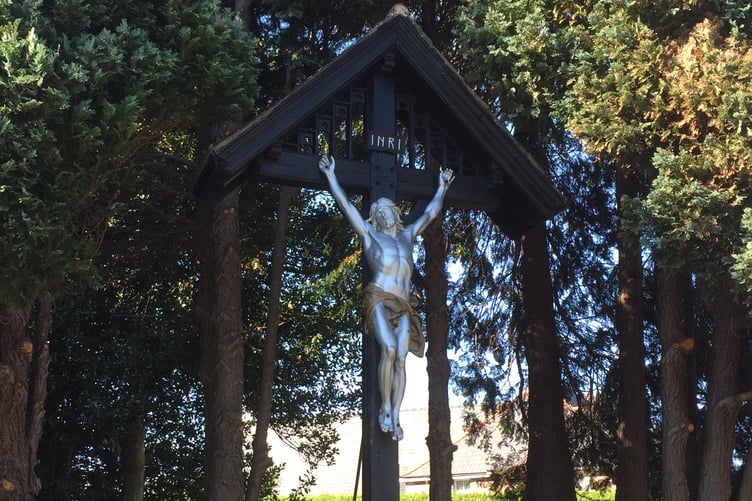
The Figure of Christ was sent to the parish sometime between 1878-80 by John Baker Gabb Junior and came from Rome. It was originally situated at the west end of the Church.
The cross is made of oak, donated by Lord Treowen and designed and built by Mr. Charles Hill.
The rockery was laid using stone taken from the Church garden by Mr. J. Watkins, Mr. W. Griffiths, Mr. T. Lloyd and Mr. Walsh.
On Good Friday (April 2), 1920, Abergavenny’s first war memorial was officially unveiled at a special service.
It began in the church with the stations of the cross, and the congregation, led by the choir and the town band, passed in procession through lines of ex-servicemen to the memorial.
Between 1,500 and 2,000 people attended, with many lining the roadside of Pen-Y-Pound. The space in front of the memorial was reserved for family members of the fallen and ex-servicemen.
Also joining the congregation were Lord Treowen, the Honourable Mrs. Herbert, and Colonel Bleddian.
The service was led by the Parish Priest, Fr. Hilary Wilson OSB, and began with the hymn “Man of Sorrows.”
It was followed by a short address on the meaning of the memorial.
Following the “Roll Call,” the blessing of the cross took place, and wreathes and flowers were laid at the foot of the cross, during which the hymn, “Soul of my Saviour,” was sung.
The De Profundis was then recited, followed by the prayer and blessing.
The service concluded with the hymn, “Crown him with many crowns,” the Last Post and the National Anthem.
The Cibi Walk Shepherd
This brings us nicely to the last of the three most prominent statues in the town.
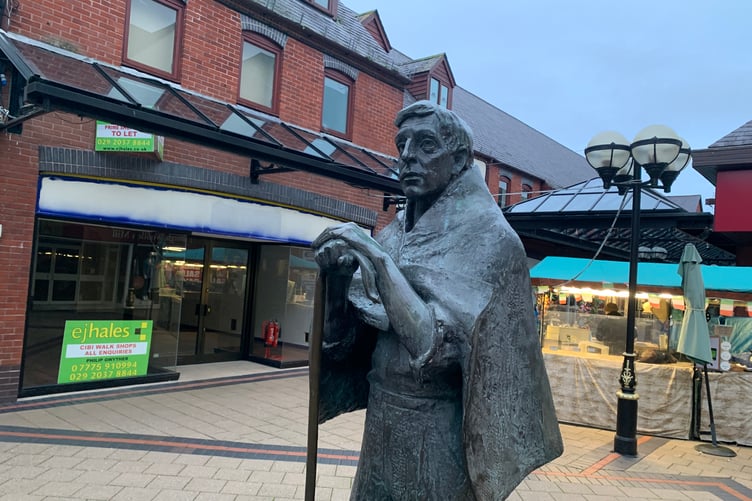
The one of a young Michael Caine looking moodily into the distance in Cibi Walk!
Only joking, it’s no cocky thespian, but a traditional shepherd with a sheep and a lamb.
The statue was created by British sculptor David Backhouse to honour Abergavenny’s time-honoured agricultural history.
And that is by no means the end of the story when it comes to Abergavenny’s statues.
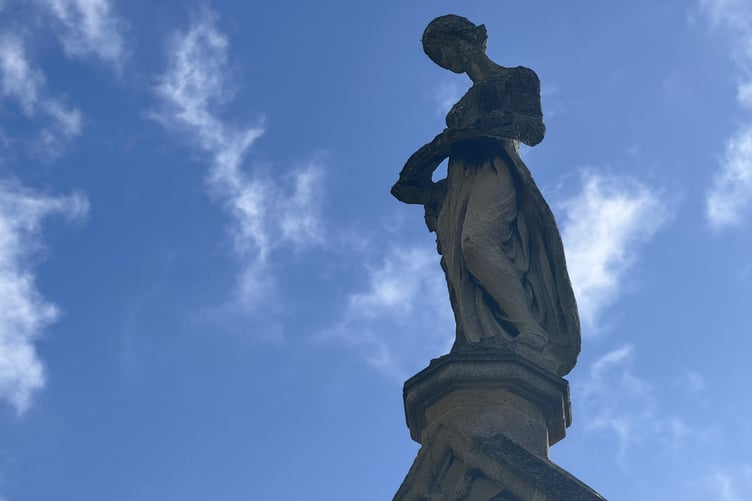
On top of the old Carnegie Library, we have the Lady of Learning holding a book, and like a lot of avid readers, she has her head in the clouds.
St Mary’s is also a relative treasure trove of monuments to another time and place.
You have effigies of various knights and ladies, and of course the famous Tree of Jesse, carved from a single 400-year-old oak tree and the only surviving major medieval wooden Jesse figure in the world.
 Abergavenny's world famous Jesse figure moves into new home at St Mary's Priory Church
 Prince Charles visits Abergavenny
 The most important piece of religious art in Wales since World War II will be unveiled in Abergavenny
 Conservation work on world famous Jesse figure
 St Mary's is named as one of the country's 'most significant' churches
There’s also the wooden statue in Linda Vista depicting Owain Glyndwr’s entry into Abergavenny.
So now we’ve journeyed through the past; let’s look to the future.
Which famous son or daughter of Abergavenny would you like to see immortalised in stone?
Comments
We've recently changed our login process. If you have an account for commenting, you will need to re-register on the login window.
This article has no comments yet. Be the first to leave a comment.