
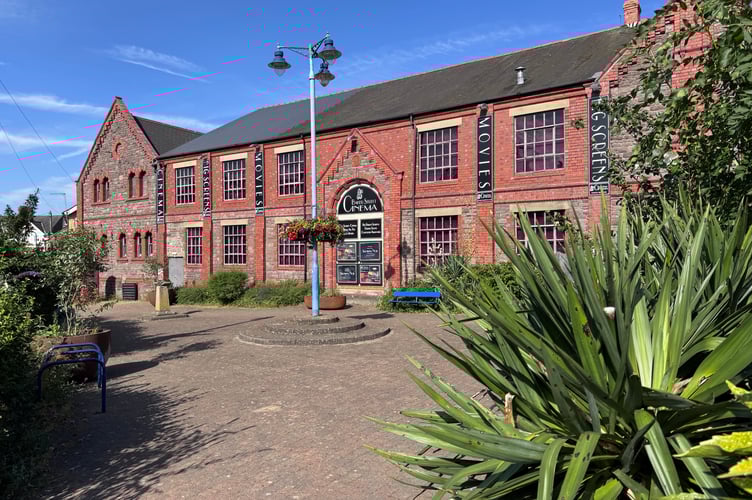
MR. Johnson appeared to be sleeping in his chair when his housekeeper went to tell him that his dinner was ready. She tried to wake him but found that his body was lifeless. At the age of 58, the foremost architect of Abergavenny had died peacefully of heart failure.
Edwin Arthur Johnson was a native of Leicester, born in 1855, and was the youngest of five children of Sarah and James Hill Johnson. His father was shown on the 1861 census as a builder, master stonemason, employing 24 masons, four apprentices, 10 sawyers and 11 labourers. When his father died 20 years later, his personal estate had a surprisingly low value of £121.
Edwin Arthur Johnson was articled to Thomas Barnard of Leicester, a well-known architect, between 1870 and 1874 where he also attended the local art school. He moved to Abergavenny in 1880 and set up an independent architect’s practice.



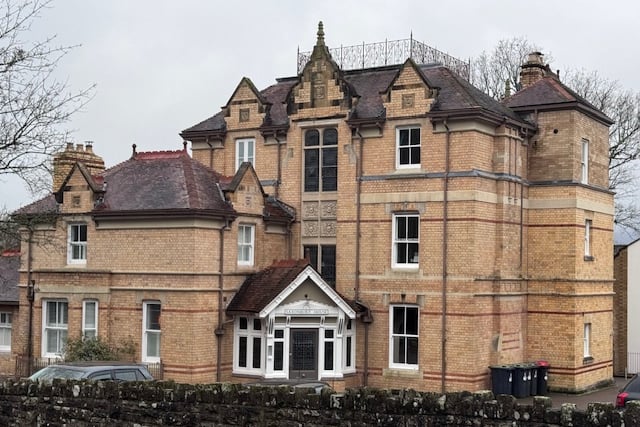
The 1881 census shows him living in lodgings in Monk Street. He went on to marry the daughter of an eminent surgeon, Fanny Ellen Pearce, in London in 1890 and they set up home in a large house called Derrystone in Chapel Road, Abergavenny.
Around this time, he designed and had built a bespoke architect’s office at St. Mary’s Chambers next to the Tythe Barn lane in Monk Street which is now a solicitor’s office.
Shortly afterwards, he was involved in a controversy with the Board of Improvement Commissioners as he apparently approached them with an idea to widen Monk Street before its junction with Cross Street. The Commissioners rejected the idea for reasons of cost and he wrote a letter to the Chronicle saying that the report: “scarcely conveyed a correct impression of what was termed ‘Mr. Johnson’s proposition’ with regard to this improvement.”
He went on to say: “Perhaps I am not the only one who has witnessed some hair-breadth escapes, and considerable inconvenience to traffic by the narrowness of this important thoroughfare and its outlet to Cross Street, and I must admit that I thought I had secured a boon to the town, when with the generous permission of the owner, I was enabled to offer, on his behalf, to give the necessary ground for the proposed widening of the street gratis, and with compensation, asking only that the Commissioners should bear the expense of setting back part of the buildings. I gather that the expense of acquiring frontages for similar improvements and compensation claims in respect thereof have so far exhausted the means at command that an improvement of this character cannot be entertained now, although the ground costs nothing and no compensation is required. It is not for me to criticise these economical principles, for, I am an interested party. After this, one would really be glad to have the opinion of someone who is not an ‘interested party’ upon this opportunity lost of eventually securing what I venture to think one of the most desirable, and certainly the least expensive, improvements our Commissioners have before them.”
He was elected into FRIBA in 1899 and went on to open another office in Merthyr Tydfil known as Johnson and Richards. Although he had never served on public bodies, Edwin Arthur Johnson was much interested in public matters, and was a keen critic of the policies expounded by public men. He was also a member of the local Freemason’s lodge.
During his 34-year career, he had been entrusted with much important architectural work and most of his designs are still part of the Abergavenny landscape.
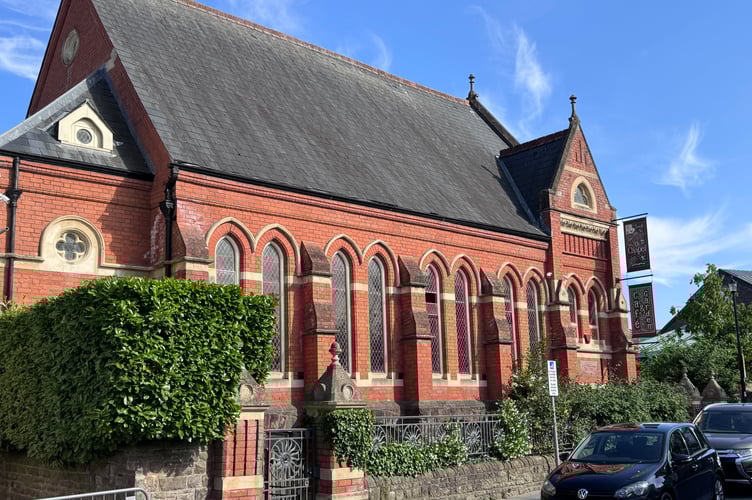
The following buildings are just some of his work: King Henry VIII grammar school in Pen-y-Pound, Girl’s Intermediate school in Harold Road, Park Street school, The Victoria Cottage Hospital, United Counties Bank (Barclay’s Bank), the ‘new’ Post Office in Frogmore Street, Bethany Baptist church in Market Street, Presbyterian Church in Pen-y-Pound, Haverang House (Saxonbury nursing home in Lansdown Road), The Old Fountain Inn in Frogmore Street (later to become part of the Richard’s building), The Drill Hall and numerous alterations to existing buildings such as the Town Hall, Pen-y-fal Hospital and Trinity Church.
When Crawshay Bailey Junior had the idea for a public space in Abergavenny, he engaged the services of Mr. Johnson to design the layout of a park, that came to be known as Bailey Park, and they both appeared before the Abergavenny Improvement Commissioners in February 1883 to present their proposals which were accepted as there was no financial outlay required by the Board of Commissioners.
Mr. Bailey stated that Mr. Johnson has my orders to proceed at once and I am in hopes that by the first of May all should be completed. Although not finished, the park was in use from May as promised. The main gates at the Hereford Road entrance were designed as a show piece and Edwin’s drawing shows a Gothic lodge on the left of the gate but this was never built.
It also shows an outline of a large statue, which was presumably to honour Crawshay Bailey as the benefactor of the park, but this was also never erected. Crawshay Bailey disappeared two years later and died in 1887 leaving the local council in a bit of a quandary over the lease arrangements of the land and this is perhaps why the statue was never commissioned. The gates are now Grade II listed for: “their special interest being a well preserved and imposing composition of entrance gates and attached walls and railings to a Victorian urban park presented by a noted local resident and philanthropist.”
The park was formally opened on the Bank Holiday dated the 6th of August 1883 but Mr. Bailey was unable to attend. The proceedings started with an 8-mile drive around the Sugar Loaf Mountain at 9 o’clock. The formal opening was timed for 12:30 to be followed by pony races and then athletic sports. At dusk there was to be a grand display of fireworks. Admission to the park was one shilling and special trains were laid on to Merthyr and Hereford.
The local newspaper articles of the laying of foundation stones nearly always reported that Edwin Arthur Johnson was on hand to present a silver trowel to the dignitary who was performing the ceremony. This was the case in the laying of the foundation stone for the new Volunteer’s Drill Hall in Abergavenny.
The Chronicle of the 3rd of January 1896 reported the following: “Mr E. A. Johnson presented a silver trowel to Mrs W. D. Steel, who performed the ceremony of cementing the stone, which was lowered into its proper position under the personal direction of Mr J. G. Thomas (the builder) who first deposited in a prepared cavity beneath it a large bottle containing a copy of the Abergavenny Chronicle and some new coins. When this had been done, Mrs Steel applied the mallet, and the stone was duly laid.”
Edwin Arthur Johnson and John Gearing Thomas seemed to work hand in hand on most of the large new buildings in Abergavenny but the only foundation stone that I can find that has both their names on is at the Bethany Baptist chapel in Market Street.
Another joint venture was the new Post Office in Frogmore Street that is currently the Nicholl’s store. The Abergavenny Chronicle of the 9th of April 1915 reported the following: “The new Post Office at Abergavenny, which is to be opened shortly, is an imposing looking structure and is an asset to the town. The building does credit to the architect, Mr. Edwin Arthur Johnson, and to Messrs J. G. Thomas & Sons, who bought the site and erected the building which they have leased to the Post Office.” Sadly, Mr Johnson never lived to see the official opening of the new Post Office as he had died shortly after he had drawn up the plans.
One of the first recorded instances of their joint working relationship is in 1894 when Park Street school was officially opened as the Abergavenny Chronicle of the 7th of September reported: “The school is situated in Park Street, in a healthy position on high ground, and was erected by Messrs J. G. Thomas &Sons, builders, Abergavenny, the architect being Mr E.A. Johnson. The school is designed on the most modern principles and the newest kind of fittings have been provided throughout, while the system of ventilation is the best known. The school will accommodate 250 children and the building is very attractive in appearance.”
The school has since become a Community Centre.
A very fine building which has since found a new use is the Victoria Cottage Hospital in Hereford Road. The foundation stone was laid by the Marquess of Abergavenny on Friday the 28th of June 1901 and he went on to place a cheque for £200 on the stone as a contribution towards the cost of the building. The Weekly Mail newspaper of the 11th of October 1902 reported: “The building has an imposing frontage to the Bailey Park. Accommodation is provided for nine beds in the hospital, and there is also an outdoor department, comprising a large waiting-room, consulting-room and a dispensary. The operating room has a north light, and has been fitted up with the most modern appliances. The work has been carried out by Messrs J. G. Thomas & Sons and under the superintendence of Mr. E. A. Johnson, architect of Abergavenny and Merthyr.”
The hospital was given the name ‘Victoria’, in perpetuation of the memory of the late Queen and the overall cost was £1925. The opening ceremony was performed by Lord Tredegar and this was his first visit to the town since his election to the high and important office of Lord Lieutenant of the county. During the speeches, Mr. Johnson commented that “the hospital could hardly be called a cottage hospital because the hospital which was being erected for Monmouth at a cost of £6000 odd would only accommodate 3 more beds.” The builder, J.G. Thomas, was also in attendance in an official capacity as he was now the Mayor of Abergavenny.
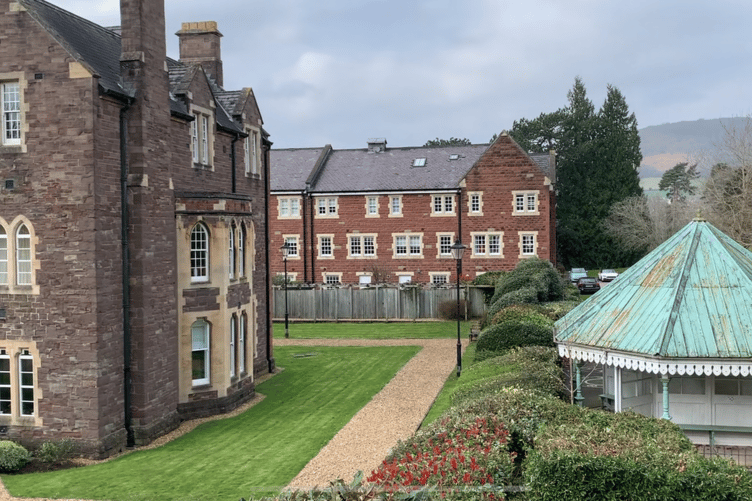
Also present was Lady LLangattock, members of the Herbert families and Sir Henry Mathers and Lady Jackson. Lord Tredegar said in his opening speech that: “He was quite certain, knowing a good deal about hospitals as he did – not through having been a patient himself, but through having had something to do with the large institution at Newport – that Abergavenny’s new hospital was, so far as he could see, a perfect little hospital.”
This hospital was a long time in the making as a report in the Chronicle dated the 23rd of February 1883 said: “The public will be pleased to learn that there is every probability that the erection of the proposed hospital will be commenced during the ensuing spring. The site which will most likely be selected is in one of the principal entrances to the town, and as the building will be of a somewhat ornate character, it will improve the appearance of the street at that spot immensely. It remains, however, for Mr. Crawshay Bailey to decide upon the spot, but we think the place suggested will meet his approval. In connection with the hospital, there will be a pleasure garden of about an acre in extent.
When built, it is intended to make the hospital, as far as possible, self-supporting.” (It is not clear where this site was but this is the same time as Crawshay Bailey is outlining his plans for a public park with the Board of Improvement Commissioners). Mr. Johnson left £50 in his will to the hospital.
See next week's Chronicle for the concluding part of Mr. Johnson's story
Comments
We've recently changed our login process. If you have an account for commenting, you will need to re-register on the login window.
This article has no comments yet. Be the first to leave a comment.