

MENTION Nashville and most people immediately think of country music: the Grand Ole Opry, the Ryman Auditorium, Hank Williams, Johnny Cash and Dolly Parton. It is one of America’s most recognisable cities and, around the world, simply calling it “Music City” is usually enough for people to know exactly where you mean.
But there is something rather extraordinary about Nashville that comparatively few people in Wales seem to know: the city was named in honour of the son of two Welsh emigrants from Tenby.
I discovered that remarkable fact not while researching in a Welsh archive or reading a history book, but thousands of miles from home during a chance conversation with an American historian in Tennessee. I had visited Nashville many times over the years, attracted by both its history and its music. I have seen numerous concerts there, including a memorable joint-headline show by Bad Company and Lynyrd Skynyrd, while seeing Robert Plant at the historic Ryman Auditorium was another particular favourite. Yet anyone who knows my fascination with American history will understand that I was never likely to spend an entire visit inside Nashville’s bars and concert halls.
The countryside surrounding the city contains reminders of a very different America. Tennessee was bitterly contested during the Civil War, and I had ventured out to explore some of the battlefields around Nashville when I got talking to a local historian. During our conversation I mentioned that I was from Wales. He looked at me and asked a question that has remained with me ever since: “Did you know Nashville was named after a Welshman?”
I didn’t. In fact, part of my surprise was that the American standing in front of me not only knew something about Welsh-American history that I didn’t, but knew exactly where Wales was. That might sound amusing, but during years of travelling throughout the United States I had met many Americans who knew Britain principally through England and London. Some had little idea that Wales was a separate country, struggled to place us on a map and knew almost nothing of the extraordinary contribution Welsh people and their descendants had made to their own nation’s history. Yet here I was in Tennessee, thousands of miles from home, with an American teaching me about Wales.
The man whose name eventually became Nashville was Brigadier General Francis Nash. Born in Virginia in 1742, he was the son of John Nash and Ann Owen Nash, both natives of Tenby in Pembrokeshire, who had emigrated from Wales to Virginia during the first half of the eighteenth century. Their American-born son became a lawyer, politician and soldier and, when Britain’s thirteen colonies rebelled against the Crown, committed himself to the revolutionary cause, eventually rising to brigadier general in George Washington’s Continental Army.
His career ended violently at the Battle of Germantown on 4 October 1777. Nash was mortally wounded during the fighting, his horse killed beneath him and his thigh terribly shattered. He survived the battlefield but died from his injuries several days later. The emerging United States had lost one of its senior fighting commanders, but it did not forget him. His name began appearing across the landscape of the new nation and, in 1779, Nash County, North Carolina, was named in his honour. Settlers establishing a community beside Tennessee’s Cumberland River subsequently called their settlement Nashborough after the fallen general. Nashborough eventually became Nashville, Tennessee.
Think about the legacy of that for a moment. Every time someone buys an airline ticket to Nashville, watches a television programme broadcast from the city, attends the Grand Ole Opry or sees “Nashville” emblazoned across a country-music T-shirt, they are repeating a name placed on the American landscape in memory of a general whose mother and father had left Tenby, Pembrokeshire, for the New World almost three centuries ago.
For a small country, Wales has left some remarkably large fingerprints on America. That was precisely what I began to discover. The more I looked, the more Wales appeared: in the American Revolution, among its presidents and generals, in its universities and industries, in the development of American sport and in towns and cities scattered across the continent. The Welsh crossed an ocean, but their names, descendants and influence did not simply disappear into America. In many cases, they helped build it.
 Pupils refusing to sit is causing 'congested' conditions for school transport
 Heads of the Valleys road gridlocked due to fire between Brynmawr and Abergavenny
 Under-fire housing association changes its name to reflect 'new vision' for the group
 Woman 'froze' as man launched unprovoked verbal attack on her in Abergavenny
That chance question in Tennessee — “Did you know Nashville was named after a Welshman?” — became one of the catalysts for the years of research that eventually resulted in my book, The Fighting Welsh.
And wonderfully, Nashville’s Welsh story did not finish with Francis Nash. The city carrying his name would eventually acquire another name recognised throughout the world: Music City USA.
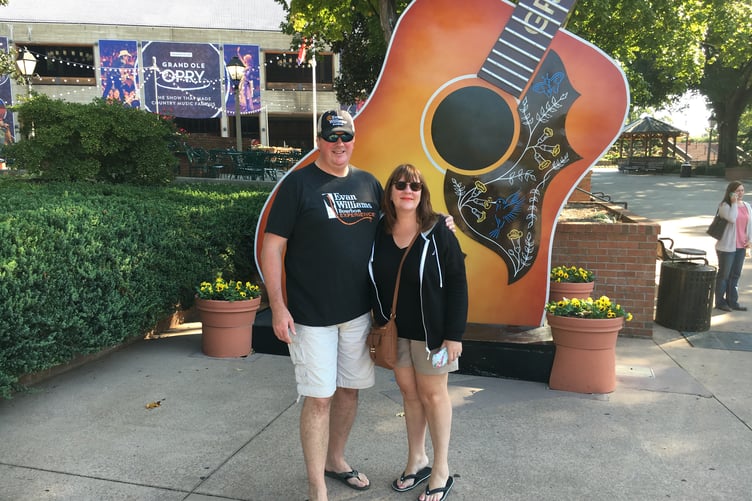
The Grand Ole Opry began life in 1925, when Nashville radio station WSM started broadcasting the programme originally known as the WSM Barn Dance. Radio transformed country music. WSM’s powerful 50,000-watt clear-channel signal could carry the sounds being made in Nashville far beyond Tennessee, bringing fiddlers, singers and country performers into homes across enormous distances. What had often been regional music suddenly possessed a national audience.
By the late 1940s Nashville was becoming the centre of an industry rather than simply the home of a radio programme. Songwriters came looking for publishers, performers came looking for songs and record companies increasingly recognised the commercial possibilities of the music emerging from the South.
Into that world walked Hank Williams.
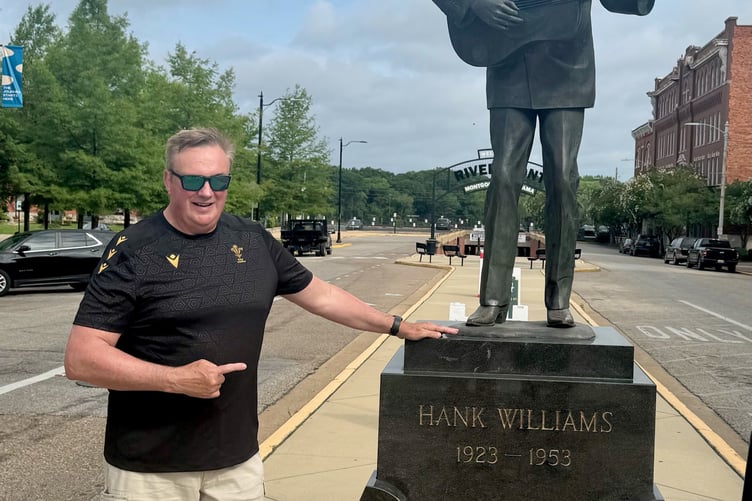
Williams made his Grand Ole Opry debut on 11 June 1949. His performance of Lovesick Blues was a sensation and he quickly became one of the defining voices of post-war country music. He was not one of the Opry’s original stars — the programme was already nearly a quarter of a century old — but he became one of the great performers associated with the period in which Nashville was emerging as the undisputed capital of country music.
Then, in 1950, WSM announcer David Cobb found the words that would help define the city.
While announcing The Red Foley Show, Cobb departed from his customary introduction and described the programme as coming from “Music City, U.S.A., Nashville, Tennessee.” It was not the creation of an advertising agency or some carefully planned tourism campaign. Cobb later recalled that the description simply felt right.
It certainly did.
The phrase stuck, spread across America and ultimately around the world. The settlement that had once been named Nashborough in honour of a Revolutionary general born to Welsh emigrants had become Nashville — Music City USA.
And there is another fascinating Welsh strand running through this story.
Wales has long called itself the Land of Song. Music, poetry and storytelling have travelled through our chapels, mines, institutes, rugby clubs and communities for generations. Welsh people sang about faith, work, love, loss and the lives unfolding around them.
There is something strikingly familiar in the musical culture that emerged in the American South.
Hank Williams was born in Alabama in 1923 and became what would later be called the “Hillbilly Shakespeare”, a songwriter capable of taking heartbreak, loneliness, love and ordinary human experience and reducing them to a few unforgettable minutes of music.
Elvis Presley regarded Williams as an important influence, while generations of country singers who followed him treated his songwriting almost as sacred ground. George Jones regarded him as the greatest country singer of them all.
Williams’ family tree has also been reported in genealogical research as containing Welsh ancestry through some of the early families who settled North Carolina and Virginia. Such distant ancestral lines should always be distinguished from the much clearer documentary connection of Francis Nash or Dolly Parton’s own acknowledgement of her Welsh heritage. Nevertheless, the reported connection is another intriguing strand in the wider story of Welsh migration into the American South.
Williams’ music certainly contains an emotion that Welsh readers might recognise instantly. I’m So Lonesome I Could Cry, Your Cheatin’ Heart and other Williams classics are songs filled with yearning, loneliness and loss. It is tempting for a Welsh ear to hear something resembling hiraeth within them — that almost untranslatable Welsh sense of longing for a person, place or something that may never quite be recovered.
His life was desperately short. Williams suffered chronic health problems and became dependent upon alcohol and medication, yet maintained a punishing performance schedule. On New Year’s Day 1953, aged just 29, he died while travelling to another engagement. His pale blue Cadillac, associated forever with that final journey, is now preserved at the Hank Williams Museum in Montgomery, Alabama.
His son, Hank Williams Jr., would eventually create a very different musical identity. After surviving a catastrophic mountain fall in 1975, he rebuilt both his face and his career and emerged with the harder Southern-rock-influenced style that made “Bocephus” a star in his own right.
As Hank Jr. would famously sing, “It’s a family tradition.”
Family tradition is also an appropriate description of another remarkable Nashville story, because one of the greatest stars ever to emerge from Tennessee openly acknowledged that part of her own family tradition led back across the Atlantic to Wales.
Dolly Parton is far from the only giant of American country music to have been associated through biographical or genealogical accounts with Welsh ancestry. Hank Williams, Johnny Cash, George Jones, Merle Haggard, Sara Evans, Tim McGraw and Faith Hill have all been reported as possessing some Welsh ancestry, although the strength and documentation of those individual genealogical connections varies considerably.
We should not exaggerate those links. Wales does not need to claim every American who once had a Welsh great-great-grandparent as one of our own. Nor should we pretend that country music was somehow created by the Welsh. It grew from a remarkable mixture of cultures — including African-American musical traditions and generations of European immigrants — that came together in the American South.

But neither should Wales be reluctant to celebrate its part in that much bigger story.
That is one of the lessons I have learned while researching The Fighting Welsh.
Wales is a small nation of little more than three million people, yet its historical footprint extends astonishingly far beyond our borders. Welsh emigrants and their descendants became soldiers and statesmen, industrialists and inventors, musicians and sportsmen and several American presidents. Their names became attached to towns, counties and institutions across the United States. Some became famous. Others disappeared almost completely from popular memory.
Francis Nash is a wonderful example.
The millions of visitors who arrive in Nashville each year may know every word of a Hank Williams song or queue to enter the Ryman Auditorium. They may visit the Grand Ole Opry, walk along Broadway beneath its neon signs or make the pilgrimage to Music Row. Yet how many realise that the name Nashville takes us all the way back to a family who left the little Pembrokeshire harbour town of Tenby for Virginia almost 300 years ago?
I certainly didn’t.
Had that American historian not asked me one simple question on a visit to Tennessee, perhaps I still wouldn’t.
But that conversation also made me question how much of our own history we in Wales have forgotten.
For generations our people crossed the Atlantic looking for religious freedom, land, work and opportunity. They carried their language, surnames, Nonconformist traditions, music, skills and values with them. Their children became Americans, but traces of Wales remained.
Sometimes those traces are buried in family trees.
Sometimes they survive in music and stories.
And sometimes they are written in letters several feet high across one of the most famous cities in America.
NASHVILLE.
I travelled to Tennessee fascinated by American history and came away having learned something remarkable about my own country. An American historian had told a Welshman a Welsh story that the Welshman didn’t know.
That stayed with me.
It helped send me on a journey of research that eventually became The Fighting Welsh — an attempt to rediscover some of those extraordinary men and women and put Wales back into parts of the American story from which our contribution has too often faded.
So the next time you hear Dolly Parton on the radio, listen to Hank Williams singing of loneliness, watch the Grand Ole Opry or see the bright lights of Nashville on television, spare a thought for a Welsh couple who left Tenby, Pembrokeshire, for the New World nearly three centuries ago.
Their son fought beside the revolutionaries who created the United States and died from terrible wounds received in battle.
America remembered him.
It placed his name on its map.
And the city that eventually grew around that name became the country-music capital of the world.
From Tenby to Tennessee, from Francis Nash to the Grand Ole Opry and from the Welsh mountains to Dolly Parton’s beloved Smokies, there is a little more Wales in Music City USA than most of us ever realised.
And perhaps we Welsh should be just a little bit proud of that.
Comments
We've recently changed our login process. If you have an account for commenting, you will need to re-register on the login window.
This article has no comments yet. Be the first to leave a comment.