
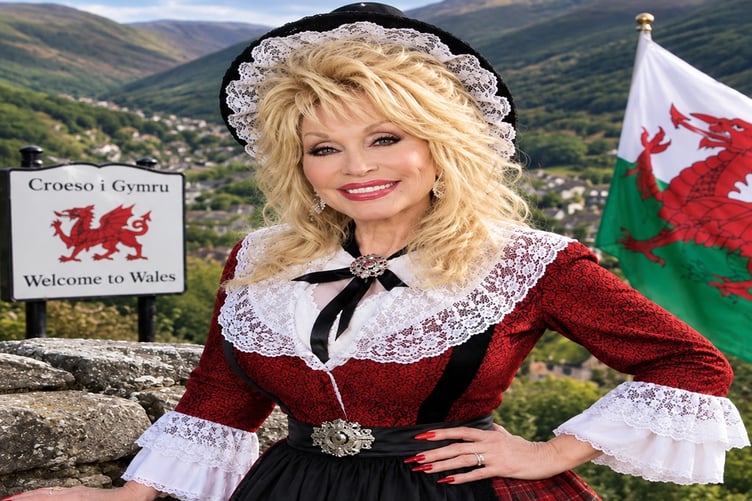
Author of the Fighting Welsh, Andrew Sutton, takes a deep dive into the Welsh ancestry of the late, great Dolly Parton.
Dolly Rebecca Parton was born in Sevier County, Tennessee, on 19 January 1946, the fourth of twelve children of Robert Lee Parton and Avie Lee Owens.
Raised in poverty in the foothills of the Great Smoky Mountains, she rose from an extraordinarily modest childhood to become one of the greatest figures in American popular culture: singer, songwriter, actress, businesswoman and philanthropist, with more than 100 million records sold worldwide.
Yet international fame never made Dolly ashamed of where she came from. On the contrary, she built much of her identity around family, poverty, the mountains and the people who raised her.
And part of that family story, according to Dolly herself, was Welsh.
It was through her mother, Avie Lee Owens, that Dolly acknowledged her Welsh ancestry. Speaking about Wales, she explained, “Some of my mother’s people, the Owens, are from there. I’ve been there about three times and it always feels good because it feels like family.”
There is something rather wonderful about one of America’s most famous women describing our small country in those terms.
Her cousin and fellow musician Richie Owens even spent time in Wales investigating the family ancestry and returned with a Welsh stone which Dolly kept on her mantelpiece.
For me, that little detail is almost more evocative than a family tree. Thousands of miles from Wales, in the home of one of the most successful entertainers in American history, sat a small piece of our country.
 Tom Fletcher's There's a Monster in Your Show at Abergavenny's Borough Theatre
 Free CPR training in Crickhowell hosted by couple affected by cardiac arrest twice
 McFly band member's show set to hit the stage in Abergavenny this month
 Star Players pick Sondheim classic for final show before new incarnation
More recent genealogical research has attempted to take the Owens line considerably further. Some accounts associate the family with William Owen, reportedly born at Machynlleth in 1584, who is said to have subsequently settled in colonial Virginia. A genealogical chain extending more than four centuries must obviously be treated cautiously unless every generation can be supported by documentary evidence, but the possibility creates a fascinating connection between two very different mountain landscapes.
Machynlleth itself occupies a special place in Welsh history. In 1404, Owain Glyndŵr, the last native Welshman to hold the title Prince of Wales, summoned a Welsh parliament there during his struggle for an independent Wales. There is no evidence that Dolly Parton descended from Glyndŵr himself, and it would be wrong to suggest otherwise, but the reported association of her Owens ancestry with this historic Welsh town adds another fascinating dimension to her family’s story.
The cultural similarities are perhaps even more compelling than genealogy.
The Appalachian world into which Dolly was born had been shaped partly by generations of immigrants from Wales and elsewhere in the British Isles who carried songs, hymns, ballads, stories and traditions into the American mountains.
Dolly’s mother filled their Tennessee home with traditional songs and storytelling. Those influences helped shape the extraordinary musical imagination of her daughter.
The parallels with Wales are difficult to miss. Two mountain cultures, separated by an ocean, in which families without great material wealth possessed something money could not buy: music, community, storytelling and identity.
From the mountains surrounding Machynlleth to the Great Smoky Mountains of Tennessee, thousands of miles and generations separated those worlds. Yet family and song remained central to both.
Dolly never forgot where she came from. Wealth never made her ashamed of poverty; international fame never erased Tennessee; and success never diminished the importance she attached to family and ancestry.
Perhaps that is why her description of Wales seems so fitting:
“It always feels good because it feels like family.”
Comments
We've recently changed our login process. If you have an account for commenting, you will need to re-register on the login window.
This article has no comments yet. Be the first to leave a comment.