
THE American Revolution is usually told as a struggle between thirteen colonies and the British Crown. King George III is remembered as the tyrant monarch, the distant ruler who imposed taxes, laws and authority upon people who believed they had the right to govern themselves.
But that familiar story hides an older one.
Many of the colonists who resisted the Crown were not simply “British” in the broad imperial sense. They were descended from peoples whose own histories included conquest, religious pressure, land seizure, military domination and political exclusion. Among them were many families of Welsh ancestry whose story has too often been hidden beneath the labels “English” or “British”.
That is partly because Wales had already been legally absorbed into England long before America declared independence. Welsh emigrants often sailed from English ports, lived under English law and were recorded in English categories. Yet beneath those labels remained Welsh bloodlines, Welsh surnames, Welsh memory and an inherited suspicion of rule from above.
To understand why the cry “No more kings” would have mattered to those of Welsh descent, one must first understand the history of Wales itself.
Wales, known to its own people as Cymru, was the land of the ancient Britons long before England existed as a nation. Its people endured Roman occupation, Anglo-Saxon pressure, Viking raids, Norman invasion and the later domination of English kings. Yet Welsh identity survived through language, faith, landscape, family and memory.
The conquest of Wales was not achieved easily. The country became one of the most heavily fortified landscapes in Europe. Castles were raised across Wales in extraordinary numbers, not as romantic monuments, but as instruments of control. They were built because the Welsh resisted. They were stone machines of conquest, placed above towns, rivers, passes and borders to remind the people who ruled them.
The death of Llywelyn ap Gruffudd in 1282 marked a devastating blow to Welsh independence. Edward I’s conquest attempted to break native Welsh power, yet the spirit of resistance endured. In the early fifteenth century, Owain Glyndŵr rose against English rule and was proclaimed Prince of Wales. His revolt ultimately failed militarily, but it survived in Welsh memory as a symbol of unfinished freedom.





Then came the Tudors. Henry VII, born at Pembroke Castle and of Welsh descent, carried the red dragon of Wales at Bosworth and appeared to many Welsh people as a sign of restored hope. Yet that hope was later betrayed by his son, Henry VIII, who enacted the Laws in Wales Acts of the sixteenth century. These laws incorporated Wales into the English legal and administrative system.
From that point, Wales was politically hidden inside England. Its national identity survived, but its constitutional visibility was diminished. This is one reason Wales does not appear on the Union Jack. By the time the flag developed, Wales had already been treated in law as part of England.
When Welsh people crossed the Atlantic, they did not leave history behind. They carried with them the memory of conquest, castle rule, imposed law, chapel dissent, land hunger and cultural survival.
Some came seeking religious freedom. Some came for land. Some came as farmers, craftsmen, ironworkers, teachers, preachers, labourers or servants. Some were poor and undocumented. Others became part of rising colonial families. By the time of the American Revolution, many of their descendants had become planters, lawyers, soldiers, politicians and thinkers.
But behind their colonial success lay older family memories. Their ancestors had known what it meant to be governed by others. They had known kings who ruled from afar, landlords who took wealth from the land, and laws imposed without the full consent of the people.
The Welsh contribution to America has often been overlooked because it was quiet. It did not always arrive under a national banner. It appeared in surnames, estates, family traditions, religious habits, literacy, local leadership and political instinct. It appeared in men and women who may have called themselves Americans by 1776, but whose ancestry carried an older Welsh experience of survival under domination.
The Welsh Bible of 1588 had helped preserve both language and literacy in Wales. Chapel culture later encouraged reading, argument, conscience and independence of mind. These traditions travelled well. The American Revolution was not fought only with muskets; it was fought with pamphlets, petitions, sermons, letters and legal arguments. A people trained to read, question and remember were not easily trained to bow forever before kings.
Most Americans know King George III as the monarch against whom the colonies rebelled. Yet, through the Welsh lens, George III was not an isolated villain. He belonged to a longer pattern of distant power imposed upon people who had little say over their own future.
Before him came George I and George II, the first Hanoverian kings. The Hanoverian dynasty itself came from the German House of Hanover, placed on the British throne through Protestant succession after Catholic claimants were excluded. The Crown that demanded loyalty from Americans was therefore not some ancient, unbroken native line, but a monarchy shaped by elite settlement, religion and dynastic politics.
Wales knew what such power looked like. It had been ruled, absorbed and used. Its coal, iron, copper, slate, gold, labour and invention would later help drive Britain’s industrial and imperial expansion, while much of the wealth flowed to landowners, industrialists and distant elites.
So when colonists began to resist taxation without representation, many Welsh-descended families would have recognised more than a new political dispute. They would have recognised an old problem: power without proper consent.
No figure better captures the hidden Welsh thread in the American founding than Thomas Jefferson.
Jefferson is remembered as the principal author of the Declaration of Independence, the third President of the United States, the founder of the University of Virginia and one of the most influential political thinkers in American history. But his family story also carries one of the most fascinating Welsh traditions among the Founding Fathers.
Jefferson family tradition held that his ancestors came from the region of Snowdon in North Wales. His father, Peter Jefferson, named one of his Virginia estates “Snowden”, a name many believe reflected that ancestral memory. Thomas Jefferson later built his famous home, Monticello, on a hilltop in Virginia. For a family said to have come from the land of Snowdon, the symbolism is striking.
Snowdon, now more commonly known in Wales by its Welsh name Yr Wyddfa, is not merely a mountain. It is part of the landscape of native Welsh memory, associated with ancient identity, princes, resistance and survival. Through that lens, Jefferson’s story becomes more than a Virginia planter’s tale. It becomes the story of a man whose family memory pointed back to Wales, yet whose pen would help free a new nation from monarchy.
Jefferson wrote the words that transformed the world:
“We hold these truths to be self-evident, that all men are created equal.”
He declared that rights were not gifts from kings, but belonged naturally to mankind. He wrote that governments derived “their just powers from the consent of the governed” and that people had the right to alter or abolish a government that became destructive of those rights.
Those words did not come from Wales alone. Jefferson was shaped by Enlightenment thought, classical learning, colonial experience and the contradictions of Virginia society. But through the Welsh lens, one can see an older inheritance: the descendant of a people long denied full self-rule helping to write the document that rejected rule by distant monarchy.
Jefferson’s Welsh links are strengthened further by marriage. His wife, Martha Wayles, carried a surname associated with Wales. In earlier naming traditions, names such as Wayles or Wales could indicate a person from Wales or a family connected with Wales. Through family, naming and tradition, Jefferson’s world was surrounded by Welsh echoes.
Jefferson was not simply Welsh. Like many colonial families, his ancestry was mixed. But that is precisely the point. Welsh bloodlines were woven into wider colonial families and then hidden beneath broader identities. The Welsh thread survived as memory, surname, place name and political instinct.
Madison, Monroe, Adams And The Welsh Republican Mind
Jefferson was not alone. The early American republic was shaped by several leaders whose families carried Welsh ancestry, Welsh associations or Welsh-descended lines.
James Madison, often called the Father of the Constitution, is central to this story. His ancestry, like that of many colonial Virginians, was mixed, yet his family lines have long been associated with Welsh descent. If Jefferson gave America its moral argument against kings, Madison helped design the system that would stop kings returning under another name.
Madison understood that liberty could not depend on trust alone. Power had to be divided. Ambition had to check ambition. A president could not become a monarch. Congress could not become absolute. Courts could not become tools of rulers.
The Constitution created three branches of government: legislative, executive and judicial. It divided power between national and state authority and placed limits on government action. Madison warned in Federalist No. 47 that the accumulation of legislative, executive and judicial powers in the same hands may justly be called “the very definition of tyranny.”
That warning should resonate deeply with anyone who knows Welsh history. Wales had seen what happened when land, law, military force and royal authority were gathered in the hands of others. Madison’s genius was to build resistance to such concentration into the structure of government itself.
James Monroe, the fifth President of the United States, also carried Welsh ancestral associations through family lines. He fought in the Revolution, served as diplomat, governor, secretary of state and president. His presidency became associated with the Monroe Doctrine, warning European powers against further colonisation in the Americas. Through the Welsh lens, there is something fitting in a president of Welsh-descended connection helping to declare that the New World would not remain a playground for Old World empires.
The Adams family also belongs in this wider Welsh-connected story. John Adams, the second President, and John Quincy Adams, the sixth, came from deep colonial New England stock. Their ancestry was mixed, but Welsh lines and traditions have been associated with parts of the wider Adams family story, while Abigail Adams is often linked to Welsh ancestry through her own family lines.
These founders were Americans, not Welsh nationalists. But America itself was made from inherited peoples. In their bloodlines were strands of Welsh, English, Puritan, dissenting, frontier and colonial experience. The Welsh element mattered because it brought into the American founding the memory of a people who had endured domination and survived.
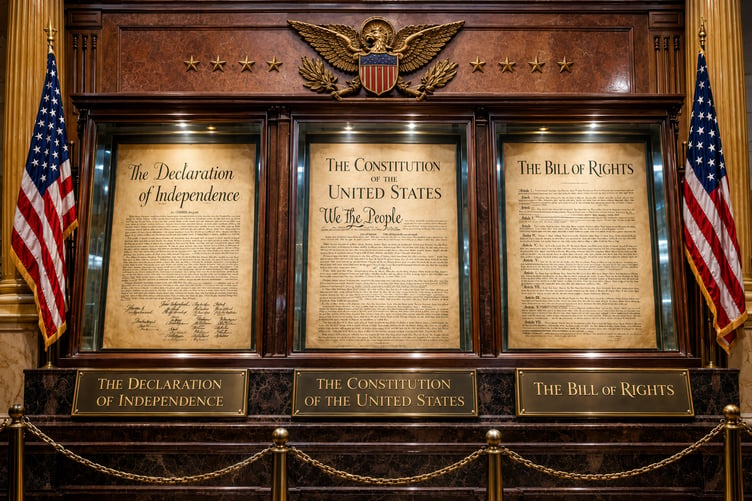
At the National Archives in Washington, D.C., in the chamber known as “The Shrine”, three parchments rest at the heart of American identity: the Declaration of Independence, the Constitution of the United States and the Bill of Rights.
Together, they form America’s sacred trilogy of liberty.
Through the Welsh lens, these documents carry a deeper meaning. They are not merely legal papers. They are the written answer to centuries of rule by kings, empires and elites. They declare that no ruler, however powerful, should govern a people without consent. They establish that rights do not flow downward from monarchs, but belong to the people.

The Declaration, written principally by Jefferson, announced the right of a people to separate from oppressive government. The Constitution, shaped profoundly by Madison, built a republic designed to prevent tyranny. The Bill of Rights, also strongly influenced by Madison, protected speech, religion, press, assembly and other liberties from government interference.
For descendants of Wales, whose ancestors had seen their country legally absorbed and their identity pressured by outside rule, these documents were revolutionary in the deepest sense.
They were the opposite of conquest.
They were the opposite of imposed law.
They were the opposite of castles.
They were the architecture of consent.
The cry of 1776 was not only a rejection of George III. It was a rejection of the idea that any one man, family or elite class had a natural right to rule over others.
But the American founders also faced a danger from within. It was one thing to defeat a king abroad. It was another to ensure that a new king did not emerge at home.
This was where Jefferson and Madison became so important. They believed the presidency should not become royal, hereditary or permanent. The President of the United States would not be born to rule. He would be elected, limited, accountable and removable. The government would be formed by the people, not imposed upon them.
Alexander Hamilton, brilliant and indispensable in many ways, held a different vision for America. He favoured a much stronger central government, national finance, industrial strength, a standing army and a more elite-led structure. His fear was disorder and weakness. Jefferson and Madison feared concentrated power and the return of monarchy in another form.
The debate between Jefferson, Madison and Hamilton was not merely a personal rivalry. It was a struggle over the soul of the new republic. Would America become a nation governed by citizens, or by a powerful ruling class? Would it be a republic of limited government, or a centralised system led by elites?
Through the Welsh lens, this was a familiar warning. Wales had seen distant rulers, landowners and powerful interests control the lives of ordinary people. It had seen how quickly law, wealth and military authority could combine against a nation’s freedom.
Madison’s constitutional design was therefore not abstract theory. It was a defence against the oldest political danger of all: unchecked power.
No more kings also meant no new kings.
The founders understood that democracy could not survive on documents alone. A constitution is only as strong as the people willing to understand and defend it.
Jefferson warned that a nation expecting to remain ignorant and free expected something that never had been and never would be. Madison wrote that knowledge would forever govern ignorance, and that a people who mean to be their own governors must arm themselves with the power knowledge gives.
Through the Welsh lens, this is especially important. Wales survived because memory survived. Language preserved identity. Chapel preserved conscience. Family stories preserved grievance and pride. A people who forget their past become easier to rule. A people who know their past become harder to deceive.
That is why history matters.
It is why informed citizens matter.
It is why the Welsh story in America is not merely ancestry trivia. It is part of the larger question of how liberty is won, how it is defended and how it can be lost.
In today’s divided world, this lesson is urgent. Across the globe, many nations are still ruled by dictators, princes, oligarchs, military regimes or governments designed to protect the rich and powerful few. Even in democracies, freedom can be weakened when citizens stop understanding their own systems of government.
Kings do not always wear crowns. They may appear as dictators, oligarchs, unelected elites, political dynasties, corporate powers or self-anointed rulers. The form changes, but the danger remains the same: concentrated power without true accountability.
The Fighting Welsh by A. J. Sutton is now available to purchase on Amazon.
Comments
We've recently changed our login process. If you have an account for commenting, you will need to re-register on the login window.
This article has no comments yet. Be the first to leave a comment.