
FOR over five centuries, the conventional wisdom has held that the name America derives from the Italian navigator sailing under Spanish and Portuguese crown flags -Amerigo Vespucci. This attribution is based largely on a single event: the German mapmaker Martin Waldseemüller’s decision in 1507 to inscribe the name “America” on his world map.
This naming happened however more than a century after Vespucci was said to have made landfall in North America and after fellow Italian navigator John Cabot made his own documented landfall in North America sailing under the Tudor Kings flag and financed through a Welshman.
Challenging the Vespucci Attribution
Upon closer examination, Vespucci’s claim as America’s namesake appears far from certain. Historians have cast doubt on the authorship and authenticity of several letters attributed to Vespucci, particularly those detailing his supposed early voyages. Some of these may have been embellished or even forged. Vespucci himself never suggested that the continent be named after him, and the name “America” does not appear on any map directly linked to him. Instead, the name’s entry into history can be traced to third-party mapmakers, whose decisions were swayed by the timing of publications and incomplete information.
While Vespucci undoubtedly influenced Europe’s understanding of the New World, the naming of America likely resulted more from the politics of the map maker than any act of definitive discovery.
The Case for Richard Amerike
In contrast, John Cabot reached the North American mainland earlier than Vespucci, setting sail from Bristol in 1497 under the authority of King Henry VII the first Tudor monarch of Welsh heritage. Cabot’s expedition was financed and supported by Bristol’s maritime elite, notably Richard ap Amerike. Amerike was a wealthy merchant of Welsh descent who held land in Wales and served twice as Sheriff of Bristol, and twice as the King’s Customs Officer for the port.
Amerike was no ordinary backer. Historical research by Bristol historians such as Rodney Broome and Alfred E. Hudd identifies Amerike as a principal financial supporter of Cabot’s voyage. He is credited with providing the largest share of funding and supplying timber from his Welsh estate for Cabot’s ship, the Matthew. Amerike also played a crucial role in securing royal approval, allowing Cabot to claim new lands on behalf of the English Crown.
The Mystery of Lost Charts and Surviving Evidence
Unfortunately, Cabot’s original charts and logs potentially containing the name he bestowed upon the newly discovered lands have not survived. Fires and poor record-keeping in medieval Bristol likely led to their loss, creating a vacuum later filled by speculation. Nonetheless, Cabot’s voyage itself is confirmed by a wealth of contemporary sources, including diplomatic reports, royal payments, and port records. By comparison, Vespucci’s reputation rests largely on letters whose authenticity has long been in question.




Naming Conventions of the Age of Discovery
The naming practices of the 15th and 16th centuries overwhelmingly favoured surnames over first names—examples include Columbia (after Christopher Columbus), New York (after the Duke of York), Hudson Bay (after Henry Hudson), Tasmania (after Abel Tasman), and Bermuda (after Juan de Bermúdez). New territories were routinely named after patrons, financiers, monarchs, or influential supporters—those who bore the financial risks of exploration. Naming an entire continent after the forename of a relatively obscure navigator such as Vespucci would have been highly unusual. By this standard, the evolution from Amerike to America fits well within the linguistic and cultural practices of the time.
A Plausible Transmission
Alfred E. Hudd proposed that Cabot’s original charts may have been returned to Bristol, bearing a dedication naming the new lands after Amerike. These charts—before their loss—could have been seen or copied by Continental mapmakers. This theory is supported by a telling fact: Waldseemüller later omitted the name America from a subsequent world map, suggesting he may have doubted the original attribution to Vespucci.
The Tudor-Welsh Context
The broader political context further strengthens the case. King Henry VII openly celebrated his Welsh heritage and entrusted important roles to Welsh officials. Amerike’s repeated royal appointments in Bristol—a leading port—attest to his influence. During the early Tudor era, Bristol was closely connected to South Wales and became a hub for Atlantic exploration, laying the groundwork for England’s maritime expansion. In this setting, a connection between Cabot, Amerike, and the naming of new lands appears not only plausible but historically consistent.
The Balance of Evidence
Definitive proof may never be recovered, as crucial documents have been lost to time, fire, or neglect. History, however, often turns on probability. Here, the convergence of evidence is striking: Cabot’s confirmed voyage, Amerike’s financial support, the established naming conventions, the absence of the name America on Vespucci’s maps, and the political realities of a Welsh Tudor monarchy all point in the same direction.
Waldseemüller’s eventual abandonment of the name America on his 1513 Carta Marina underscores the uncertainty of the original decision. The name America appears on no map before 1507, and many scholars now believe Waldseemüller’s use of it was a mistaken attribution, possibly arising from a misunderstanding of earlier sources.
Conclusion: Who Named America?
Although absolute proof remains elusive, the convergence of evidence is compelling.
Consider the following points:
• Cabot’s 1497 voyage was financially supported by Amerike, who also supplied timber from his Welsh estate.
• The established pattern was to name territories after patrons and surnames, not first names.
• If Vespucci visited America at all, it was years later, and explorers under foreign flags were neither known nor permitted to name places after themselves.
• Cabot’s original charts have disappeared, likely destroyed in Bristol’s repeated medieval fires, though his journey is verified by credible contemporary sources.
• Vespucci left no surviving original charts or maps, and the authenticity of his supposed accounts is widely questioned.
• Waldseemüller’s retraction of the name America just six years after his initial use suggests doubt or controversy.
• No map by Vespucci ever used the term America.
• The political climate was shaped by a Welsh king whose patronage enabled the voyage by Cabot and funded by Amerike.
• Amerike’s prominence as twice Sheriff and Chief Customs Officer of Bristol Port is well documented.
Taken together, these threads form a coherent and historically consistent narrative. Among the possible namesakes of Vespucci, Columbus, Cabot, and Amerike it is only Richard Amerike that fits both the documented naming conventions and the political realities of the age.
While certainty is impossible, the balance of evidence points convincingly to one conclusion.
It is far more likely that the name America originated not from an Italian forename, but from the Welsh surname of Richard Amerike.
In the ongoing debate over who named the New World, the Welsh merchant of Bristol remains the most plausible and historically grounded answer, a reminder that the legacy of a single influential Welshman may be written across the world’s largest continent.
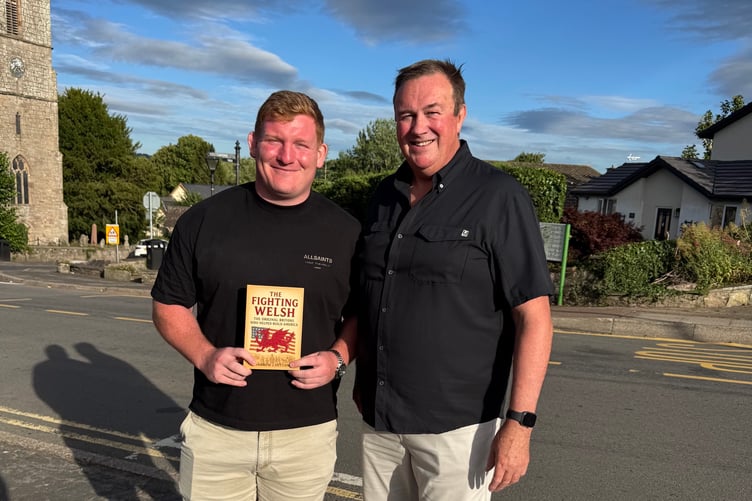
The Fighting Welsh by Andrew J Sutton launched officially on 4 July 2026 in recognition of America’s 250th year of Independence and is now available on Amazon.com.
Comments
We've recently changed our login process. If you have an account for commenting, you will need to re-register on the login window.
This article has no comments yet. Be the first to leave a comment.