
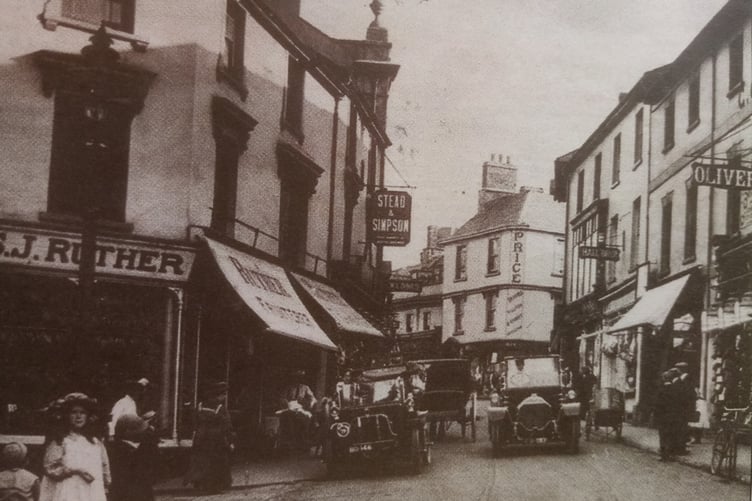
IN November 1937, the Abergavenny Chronicle announced, “The busy crowds that come daily into Abergavenny have watched with interest the growth of the impressive building at Nos. 16-17-18 High Street, until now it stands like a cathedral of commerce, adding dignity to Abergavenny’s shopping centre.
"The past week has been one of great activity: workmen have been busy putting finishing touches to this magnificent building in readiness for the opening. Out of chaos comes order: and out of the entertainment provided by the workmen balancing dizzily on narrow parapets, has come Abergavenny’s latest business premises.
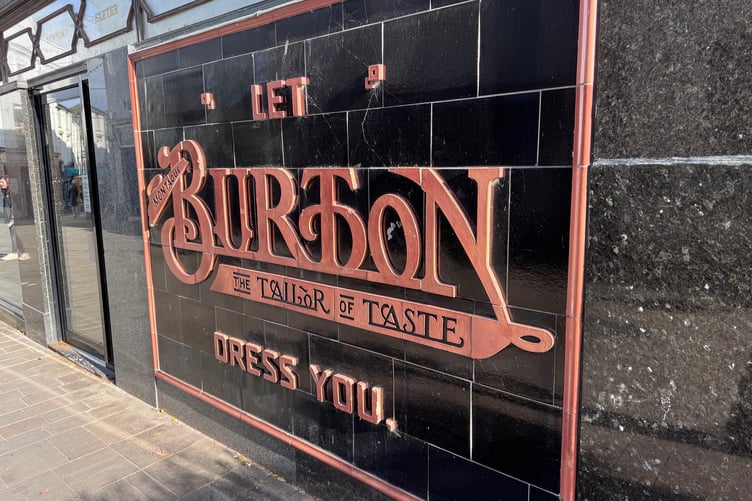
Everyone already knew what the finished building would look like as Montague Burton buildings are easily recognised by their originality and beauty of design.
"The building in Abergavenny was just part of the ever-increasing chain of tailoring establishments throughout Great Britain. Much of the ornamentation of the building belongs to the upper windows and this is known as “The Chain of Merit” that bear the name of numerous towns where Montague Burton shops are to be found.
"The extensive frontage is further enhanced by an inviting interior, spacious in extent, elegantly appointed and completely equipped. The imposing new structure is situated in the area of the old walled town and remains of the wall can be seen in nearby Nevill Street. "Montague Burton’s palatial establishment is therefore a substantial contribution to the local trading facilities of the future. Once in the showrooms, the customer can choose from over 500 patterns of cloth and he will be astonished by the excellence of the material and the subsequent low price. All the cloth and trimmings used in their garments are manufactured in Great Britain.
"There is a separate measuring room where the utmost care is given to providing a perfect individual fit to every customer. This attention to detail has given the firm an enviable reputation throughout the country. It is to be hoped that the Montague Burton example will be emulated by enterprising tradesmen in the town and thus add to the civic pride of the people of Abergavenny. It is believed that this sort of establishment would attract customers from elsewhere into the town."
Prior to this, Nos. 16-17-18 High Street had been empty for a number of years before being demolished to make way for Burtons. According to the Abergavenny Street Survey, Nos. 16 and 17 had been a draper’s shop from around 1850 and run by Edward Price and followed by his son Edward James Price. E. J. Price was very much involved in the local entertainment scene and appeared in many shows at the Town Hall.



Two of his daughters were talented singers and musicians and one of them, Madoline Mary Price, said she was a ‘professor of music’ on the 1911 census at the age of 21. She married a school teacher, John William Holiday Thomas, in 1917 but he died in 1942.
She then devoted the rest of her life to follow her acting career. She went on to become a well-known actress and starred in many plays, films and most notably in the 1960 television production of ‘How Green Was My Valley’. Madoline died in Weston-Super-Mare in 1989 just three days short of her 100th birthday.
Montague Burton, whose real name was Meshe David Osinsky, was born in Lithuania in 1885 and came to the UK in 1900 to escape the Russian pogroms.
He started off as a pedlar before setting up as a general outfitter in Chesterfield selling ready-made suits. By 1913 he had five men’s tailor shops and a manufacturing facility in Leeds. He was excused military service in World War One but in 1916 won a lucrative government contract to make uniforms.
During the Second World War his firm made a quarter of the military uniforms as well as a third of the famous de-mob suits.
Montague Burton was knighted in 1931 and died in 1952 aged 67. This was the same year that the number of Burton shops reached their peak at 616.
From very humble beginnings the company grew into the largest chain of retail tailoring ever known. Fifteen thousand people were now working in the world’s largest tailoring workshop with a further 100,000 workers in the supply industry. At its peak in 1960, 1.7 million garments were produced and this is equivalent to around 850,000 suits. The shops offered one of the most efficient tailoring services in the country.
Eminent social reformers and statesmen commented at the time that Montague Burton were model employers and leaders in welfare work amongst their employees.
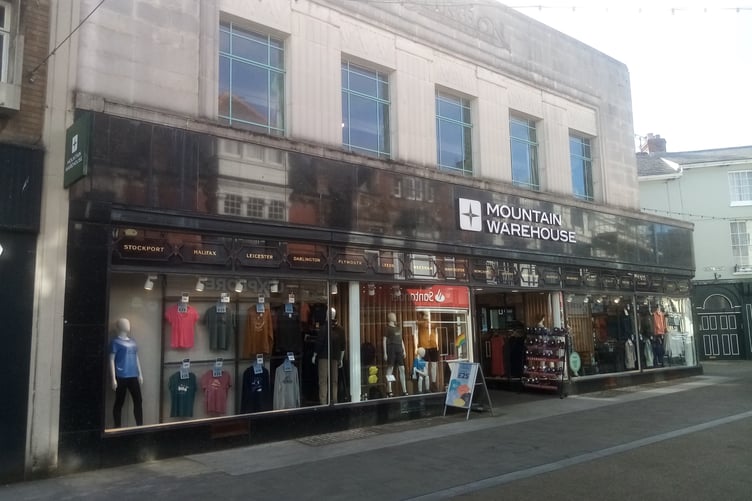
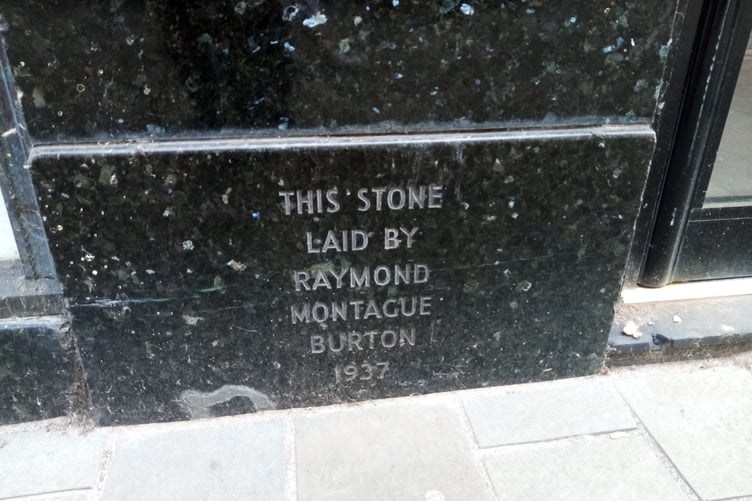
Many construction firms were involved in the erection of the new building that has a structural steel framework supplied and erected by Dorman Long of Middlesborough. (This is the same company that supplied the steel and constructed the world-famous Sydney Harbour bridge in Australia.) Montague Burton himself laid the foundation stone which is to be found at pavement level adjacent to the side door in Nevill Street.
The company had their own in-house architect, Nathaniel Martin, who was responsible for the similarity of design with all the shop fronts. Not many have survived and the Abergavenny shop was given Grade 11 listed building status in 1994. The shop ceased being Burton’s in 2018 and the new landlord started to carry out work on the building ready for new tenants. Contractors started working on the windows until passers by realised that damage was being caused to the “chain of merit” and immediately informed the council who had the work suspended. The art-deco exterior of the store was being seriously degraded and the building had a higher grade of listing due to its exceptional interest and rarity as a “Well-preserved Burton’s store which retains almost all of its external detailing.”
The store’s exterior was almost unchanged since it was built in 1937 and, as such, represented a rare survival of a commercial style that was once common through the United Kingdom. It’s Cadw listing describes it as: “A classic Burton store with all the characteristic design features which used to be displayed in every British town and have now gone almost completely.” A council spokesman said our Heritage officers are dealing with the issue and will be addressing the restoration in due course. Mountain Warehouse moved in shortly afterwards.
An advert in the Chronicle dated the 12th of November 1937 announced: “The new Montague Burton Tailoring Establishment opens TODAY giving you the opportunity to cut your tailor’s bill in half. This new shop is an event of first-class importance to every young man in particular and to every man in general. Come and see the arrangement of this new shop and inspect the choice of fabrics. Note the style and distinction in every garment and the perfection of craftsmanship and quality.”
Montague Burton gave a guarantee on every garment that proved unworthy of his name if returned within six months, subject to fair wear and tear.
"To be supremely well-dressed was once the privilege of the few but now it is the joy and privilege for all. Montague Burton is proud to add this new shop to their list of establishments throughout the British Isles."
The advert went on to say that a four-guinea value suit, made to measure, could be yours for 45 shillings. Ironically one of their rivals, Bradleys of Chester at no. 6A Frogmore Street, was advertising men’s suits (made to measure) for the same price, 45 shillings.
The Origins of The Chevron
Sir Montague Burton was a teetotaller who believed that providing clean, respectable recreation spaces would keep young men away from alcohol and rowdy public saloons. He was instrumental in providing such facilities above his shops in the form of “Lucania Temperance Billiard Halls” and the Abergavenny venture duly opened on the 14th of February 1938.
It promised that "A hearty welcome would be extended to ladies and Gentlemen!" In reality, the Lucania became something of a smoky and dreary establishment with a somewhat shady reputation. Being alcohol free, the available drinks were usually tea and Bovril. Snooker was probably more popular than billiards and the club had a team that played in local competitions.
The 1970’s saw many changes and one such change was the demise of the Lucania with the premises converted to a nightclub by local businessman, Louis Carpanini.
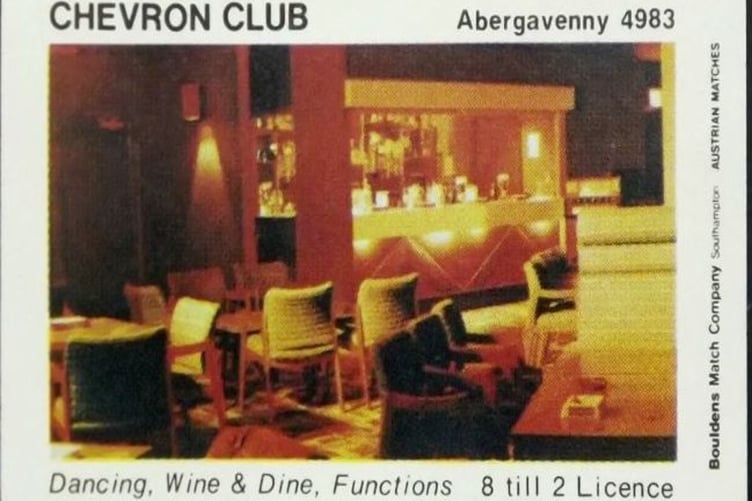
The original idea of a ‘gentleman’s nightclub’ never quite took off as it became more of a late-night drinking establishment with live music. This led to numerous complaints from Nevill Street residents about the ‘diabolical row’ until the club shut at 2 o’clock in the morning. Then the residents had to put up with the noise made by the revellers leaving the building.
A petition was presented to the Abergavenny Borough Council but the situation had not improved despite an assurance from the owner that the club would be sound-proofed by provision of special windows from Belgium. The club had recently changed hands as it had been bought by a Mr. Kevin Marriot, owner of the Cardiff nightclub “Baker’s Row.” He commented that he had been told that the club was adequately sound-proofed and he did not know of any recent complaints and apart from a few structural alterations, he intended to leave it as it was.
In March 1975 the question of noise was once again put before the Council and their ‘noise readings’ showed the complaint to be substantiated. It was felt that the new owner should be given the opportunity to carry out remedial work. The question of noise and other nuisances caused by people leaving the club were not within the province of the Council. Two years later the police in Abergavenny opposed an application for the renewal of the licence at the Chevron, Abergavenny’s only nightclub, amid claims by the owner that the club was being blamed for any incidence of rowdiness or hooliganism!
Some well-known names appeared at the Chevron as adverts in the Chronicle read: Wednesday the 26th of March 1975, Marty Wilde, admission £1.25: Wednesday the 2nd of April 1975, The Searchers, admission £1.50: Wednesday the 10th of September 1975, Dave Berry & the Cruisers. One advert announced that the Chevron would be holding a ‘Champagne Party’ on Christmas Eve 1973 and the admission fee of £1.50 would include free champagne for an hour!
More controversy came in 1999 when the Chevron’s public entertainment licence renewal was being held up by the landlord. The existing licence covered Monday to Saturdays, from 9 PM until 1 AM, for a maximum capacity of 200 people. But the local council and fire service were recommending that the number should be reduced to 130 until work is carried out to widen the existing fire exit. The council renewed the licence for Monday to Saturdays, 9 PM until 2 AM, but as the widening of the fire door had not been done the limit of 130 people would take effect.
Three months later, Eugene Caparros (the current owner of the Chevron) applied for an extension of his licence to cover Sunday evenings as the new limit of 130 people was having a financial impact on the club. The council agreed that the club could open from 7 PM until 10:30 PM on Sundays and reminded Mr. Caparros that the 200 capacity would be restored if work to the fire exit was completed to their satisfaction.
The Chevron club carried on for a few more years but nightlife habits were changing and its doors closed for the last time in 2006. A new company tried to revive the club in 2011 under the name Love Nightclub but had an incident a month later when one of its customers started to brandish a pistol. The club closed temporarily but the subsequent security concerns could not be overcome and the club closed for good.
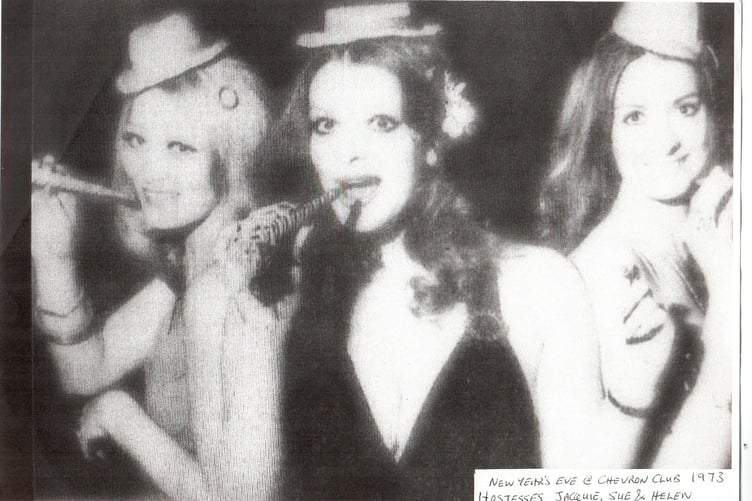
There is a rumour that Helen Morgan worked for a time at the Chevron. She became famous in 1974 as she won the Miss Wales beauty competition followed by Miss United Kingdom and ultimately Miss World. But she was forced to resign as it became known that she was an unwed mother to an 18-month-old son. Although this was not a breach of the rules, the resulting publicity became too much for her to bear.
Comments
We've recently changed our login process. If you have an account for commenting, you will need to re-register on the login window.
This article has no comments yet. Be the first to leave a comment.