
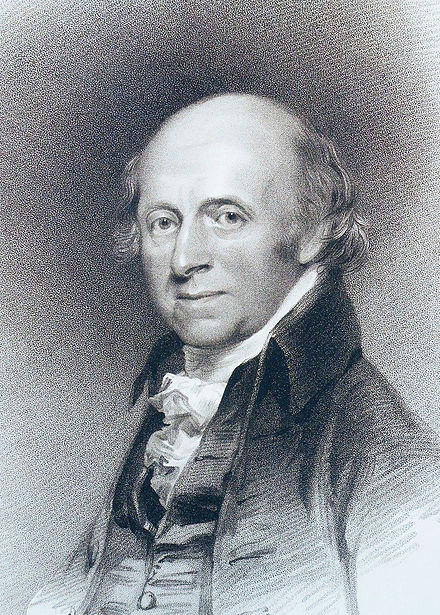
Archdeacon William Coxe, was an eighteenth century writer who really appreciated the magic of Monmouthshire and paved the way for other scholars who wrote about its fascinating history. His book Historical Tours in Monmouthshire first appeared in two volumes in 1801 and has been republished on two occasions.
Born in 1747, the son of a physician to King George II, William Coxe was educated at Eton and King’s College, Cambridge. Shortly after being ordained a deacon in 1771 he was appointed travelling tutor to the son of the Earl of Pembroke. In 1788 he became the Rector of Bemerton in Wiltshire and in 1800 he was presented with the living of Stourton, the parish church of Stourhead. In addition to these two livings, Coxe was also Prebendary of Salisbury Cathedral and a few years later was appointed Archdeacon of Wiltshire.
Apart from religion, his great passion in life was travelling and before taking an interest in Monmouthshire he visited Switzerland, Poland, Russia, Sweden and Denmark. These journeys resulted in eight substantial volumes which describe his experiences.
William Coxe first visited Monmouthshire in the autumn of 1798 and 1799. He was 52 years of age, a bachelor and has been described as ‘short, stout, erect. Healthy and active.’ His companion on these journeys was the famous antiquarian Sir Richard Colt Hoare, and travelling from England in a horse drawn carriage, they crossed the Severn via the New Passage Ferry. This brought them to Black Rock where they spent their first night at a historic coaching inn which was demolished in the 1970s.
.jpeg?width=209&height=140&crop=209:145,smart&quality=75)


.jpeg?width=209&height=140&crop=209:145,smart&quality=75)
During their travels in Monmouthshire they stayed at many grand houses owned by Monmouthshire gentry, such as Llansantffraed Court, near Abergavenny. It was there that Coxe conceived his plan of writing a book detailing his tour of Monmouthshire. He mentions that this mansion was open to him at all times and that he was at liberty to use it as a base for his excursions as his fancy took him
The compiling of his book involved a total of 5 months travelling, covering a total distance of 1,500 miles by carriage and on horseback. It is important to understand that they did not have the advantage of Ordnance Survey maps or other publications to give them information on where to go and what they should see. They could not speak or understand Welsh which was widely spoken in Monmouthshire at that time, and most local people were unable to speak a word of English. To have covered so much ground and researched so much historical detail about the county was a remarkable achievement.
Two volumes of An Historical Tour in Monmouthshire ’were published in 1801, with 200 illustrations by his friend and patron, Sir Richard Colt Hoare, to whom the book is dedicated.
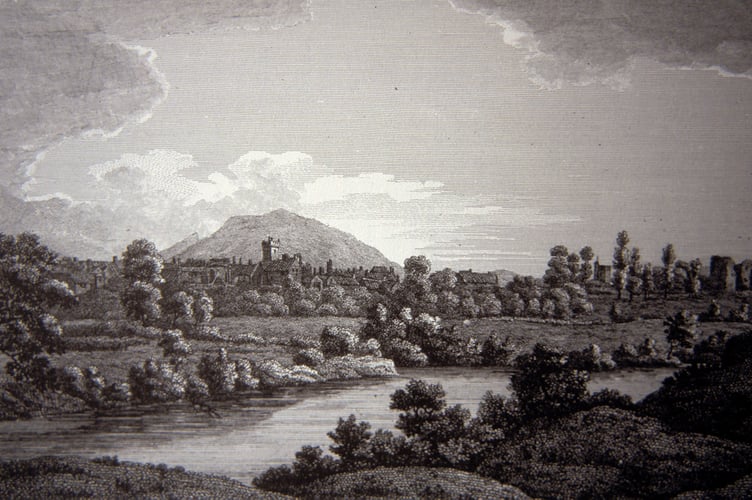
Coxe had a particular interest in antiquarian subjects and he gives in detail the early history of Roman and Norman occupation of this area. His intention to describe the beauties of Monmouthshire and its picturesque ruins is impressively fulfilled in his writing.
He comments that: ‘It was not long before I was delighted with the beauties of the scenery, struck with the picturesque ruins of the ancient castles, memorable in the annals of history, and impressed by the mansions where many illustrious persons resided. My companion, Sir Richard was equally impressed with what he saw and employed his pencil to great effect rendering the scenes even more impressive.’
When they stayed at Pontypool Park, the home of Sir John Hanbury, they visited Pontypool Folly and praising the view, Coxe commented: ‘No traveller should quit Monmouthshire without enjoying the singular and almost boundless prospect.’
His description of Abergavenny and its history is particularly interesting and he describes how the town ‘occupies a gentle slope, from the foot of the Derry to the left bank of the Usk. The town is long and straggling, and the streets are in general narrow, although within a few years it has been much improved in appearance.’ He laments the decline of the flannel trade in Abergavenny and its transfer to Montgomeryshire, but comments that ‘solid and substantial benefits are expected to flow from the recent establishment of iron foundries in the neighbouring towns of Blaenafon and Pontypool’.
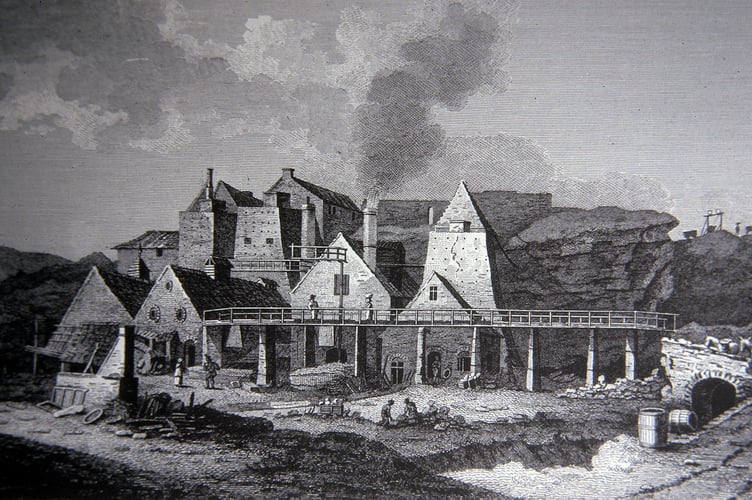
Two visits were made to Blaenavon, which was then in its early beginnings and Coxe described the place as ‘a new and interesting object in the tour of Monmouthshire’. Whilst there they stayed at Ty Mawr, the newly built home of the ironmaster Samuel Hopkins.
We are provided with a fascinating description of the multi furnace ironworks as it appeared after ten years of operation. A detailed sketch made by Sir Richard Colt Hoare shows how three blast furnaces were built against a cliff to enable easy charging from above. Between two of the furnaces is the blowing house , where a steam engine provided the blast and smoke can be seen rising from a tall round chimney. Coxe comments that ‘The works are still rapidly increasing in extent and importance and appear likely to surpass the other iron manufactories throughout the kingdom.’
In 1802 an abridged version of Coxe’s book was published and it was written by ‘A Lady’ who does not give her name., but gave it the long title: ‘A Picture of Monmouthshire or an Abridgement of Mr Coxe’s Historical Tour in Monmouthshire.’
Three years after his visit to Monmothshire , Archdeacon William Coxe married the widow of the owner of a British factory at St Petersbourg, whom he had met during his travels in Russia. They had no children and he died at his home in Breverton in 1828, aged 81. He is buried in the chancel of the church where he was rector for 40 years, and his grave in front of the altar,, is marked by a floor tile bearing the unfortunate initials ‘WC’.
Years ago, I used to visit reference libraries in order to study Coxe’s ‘Tours in Monmouthshire’ and longed to have a copy of his work myself, but they were hard to come by and also very expensive. Fortunately, a limited edition of 500 copies in two volumes was published in 1995 by the Merton Priory Press, with a new introduction by Jeremy Knight, the well known historian. I immediately purchased the two volumes in the Abergavenny bookshop that was, once owned by Ken Lockyer.
Comments
This article has no comments yet. Be the first to leave a comment.