
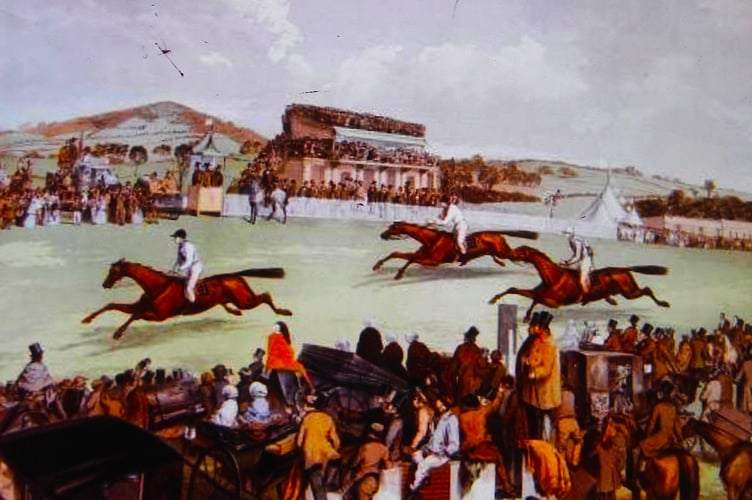
It is interesting that Monmouthshire used to have three Racecourses, but now there is only one. The oldest racecourse in the UK is Chester which held its first event during the time when Henry VIII was on the throne.
Abergavenny Racecourse was established in 1834 and the first recorded meeting was on Wednesday, October 29. It was organised by the Abergavenny and Monmouthshire Hunt Race Committee, and at the end of the first day a Ball was held at the Angel Hotel. Races were first held in the Ynys-y-bwa fields, owned by Thomas Hill of Blaenavon, and then for one year in the Chapel Meadows which adjoined Chapel Road. The Racecourse was then relocated to the meadows on Company Farm opposite the Castle.
Land was given by the Squire of Coldbrook, on which extensive gardens and fish ponds were converted into a racecourse, soon regarded as the most beautifully situated course in the country.
The grandstand used to be near the sixth tee of the present day golf course and there was a ferry service introduced to transport racegoers from the town across the River Usk to the racecourse. One day, some hooligans pelted the occupants with sods and in the confusion the boat capsized causing two men and a girl to drown. The body of the girl was picked up below the racecourse; the body of one of the men was discovered several days later below Llanellen bridge, and that of the other man further on.

.jpeg?width=209&height=140&crop=209:145,smart&quality=75)

It was a flat course, a mile round, oval in shape, with a run in of nearly a quarter of a mile. The last 150 yards were on the incline. The steeple-chase course was three miles and 150 yards, all grass, except three ploughed fields, and one wheat field.
In shape it resembled a human ear, and there were 23 jumps in the three miles, including a brook 13ft wide within sight of the grandstand, and a couple of walls 4ft and 2ft high. The fences were mostly laid, some with a ditch on the taking off side, and others vice versa; one of the most difficult being the last of all, within a quarter of a mile of the finish, because its uphill approach, required much effort for a tired horse.
A man by the name of Cook was once the patron of Abergavenny Races, and one of his mares was a magnificent animal called ‘Fanny’. During one race, she stumbled at the water jump and before she could recover herself a horse named ‘Bold David’ jumped upon her and broke her back. She had to be destroyed on the spot.
By 1864, the Abergavenny meeting was considered one of the best in Monmouthshire and South Wales. In December 1871 the Grand National Hunt Club decided to hold the Welsh Grand National there. This proposal had the backing of the Duke of Beaufort, Lord Coventry, Lord Abergavenny and many other sportsmen of the district.
It was held in April 1872 with seventeen races over a period of three days. There were nine runners in the National itself, which was won by ‘Red Nobb’, owned by Reginald Herbert of Clytha, and ridden by Captain Hollyoak.
At one time these races were the chief event in this locality, and the town took a lively interest, but one by one the organisers and patrons nearly all passed away, and their places were not filled. The interest of the townspeople diminished, and by 1900 ceased altogether. Spasmodic efforts from time to time were made to resuscitate the sport, but eventually the promoters had to yield to the inevitable and races at Abergavenny came to an end.
In 1906 the racecourse and clubhouse became the site of Monmouthshire Golf Club, and initially they established a nine hole course. Today, the 18 hole course is recognised as one of the most beautiful in Britain.
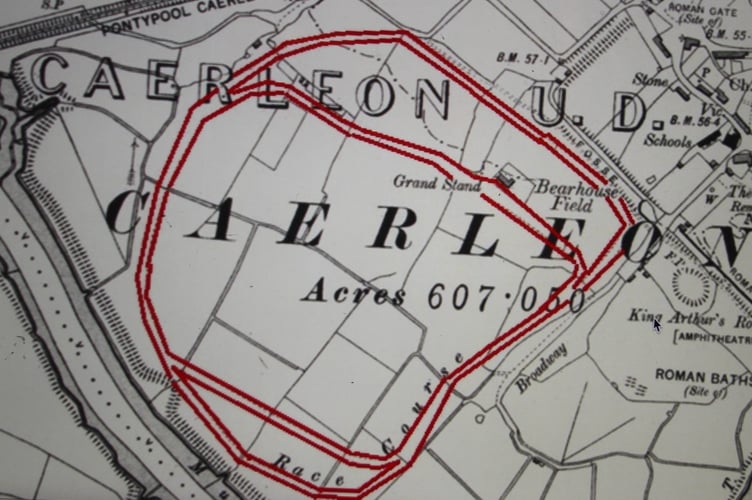
Caerleon Racecourse was situated near where the golf course, club and school is now, and the first events were held there in August 1845. This caused a large influx of visitors to Caerleon, who were all intent on seeing races in such beautiful surroundings. A grandstand was built, and wealthy people drove up in their horse-drawn carriages to take their seats there. Hundreds of other people stood behind barriers to watch and enjoy the ‘Sport of Kings’.
Meetings stopped in 1913, prior to the outbreak of World War I, and did not start again until 1919. The course closed again for World War II and reopened in May 1946. On Saturday June 14, the Queen Mother’s jockey and celebrated racing author, Dick Francis, rode ‘Wenbery Sahib’. It was one week before his wedding, and when the horse fell, Dick broke his collar bone. The final meeting took place on Monday, May 17 1948, the loudspeakers giving a commentary could be heard in Newport.
The Welsh Grand National was first run at Ely Racecourse in Cardiff, and remained at that venue until the course closed in 1839. In 1948, it was transferred to Caerleon Racecourse and was won by ‘Bora’s Cottage’ which was owned by Captain Ryan Price’. In the following year, the event was moved to Chepstow, and held on Easter Tuesday, it was won by Dick Francis on ‘Fighting Line.’
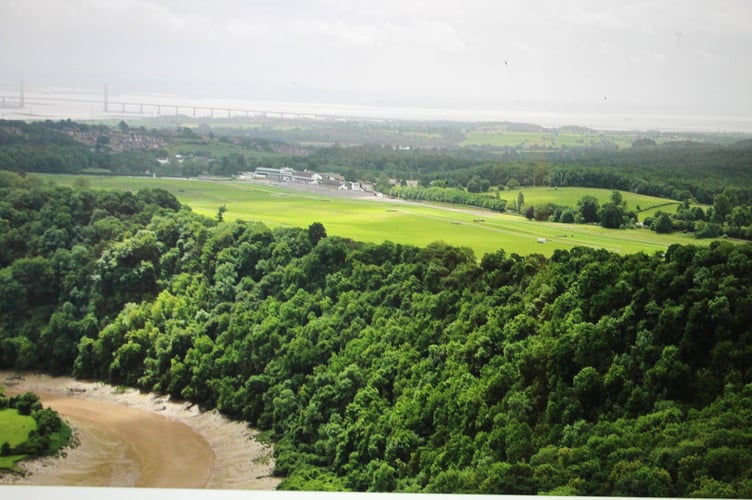
This Racecourse is beautifully situated within a natural amphitheatre below the Wyndcliff, and well above the River Wye. An oval course of just under 2 miles, with a finishing straight 1,000 metres in length was established in 1925 by a group of ten South Wales gentry and businessmen. They had formed a company to purchase Piercefield House and then laid out a new racecourse on the estate.
Eighty men worked for three years to construct the course and it proved very successful, for in the summer of 1926 about, 20,000 spectators turned up for the inaugural race meeting. The first jump racing took place in March 1927 and six years later at a two-day meeting, the multiple champion jockey Gordon Richards won eleven consecutive races on the first day and the first five races on the next day. This course is now the permanent home of the Welsh Grand National.
In 1969, the Welsh Grand National was held in February, despite the risk of bad weather forcing a possible cancellation. Then in 1979 the month was changed to December, and it is now held the day after Boxing Day. Sponsored by bookmakers Coral since 1973, it is now the longest running sponsorship in jump racing. The course covers a distance of 3 miles, 6.5 furlongs and 130 yards with twenty-thee fences to be jumped. In 2025 it was won by ’Haiti Couleurs’ ridden by Sean Bowen, a very successful Welsh Jockey
Comments
We've recently changed our login process. If you have an account for commenting, you will need to re-register on the login window.
This article has no comments yet. Be the first to leave a comment.