
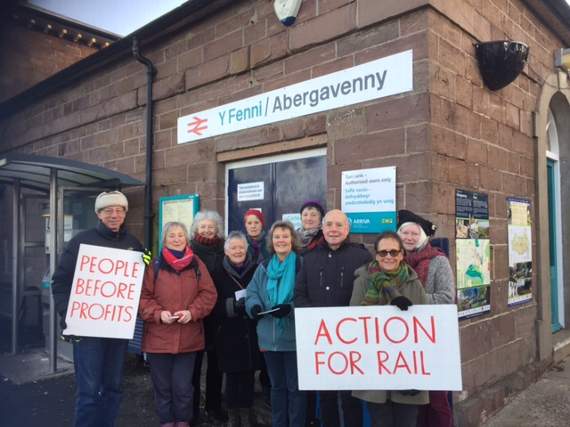
Twenty local campaigners protested the ballooning cost of rail fares with a ‘day of action’ at Abergavenny train station last week.
Frustrated scenes unfolded across the UK as commuters angry with increasing fares picketed stations in freezing conditions, demanding cuts to ticket prices.
Train fares in the UK — Europe’s most expensive — were hiked by an average 2.3 percent for this year.
Action for Rail, a pressure group, organised the countrywide protest to coincide with the post-Christmas return to work.


The campaign’s local organiser, Rosie Godfrey-Davies, spent the day outside Abergavenny station handing out information highlighting the ‘rip-off’ fare increases, and encouraging locals to write to local MP David Davies.
“We are expected to pay more, but get less. Passengers want a railway that is safe, punctual, reliable and accessible for all,” she said.
“Women, older people and those with disabilities are particularly concerned about cuts to staffing and services. We believe that the best way to deliver these is through a return to a publicly owned railway which is not based on the need to make profits for shareholders,” added Mrs Godfrey-Davies.
Campaigners, twenty-strong on the day, said the public reaction was positive, with many commuters stopping to discuss the issue with group members.
The protest mirrored events across the UK, with demonstrators demanding a return to nationalised rail, a system they claimed would cut ticket prices and improve services for hard-pressed commuters.
Action for Rail said in a statement that rail prices had risen twice as fast as wages, and a return to public-owned railways would save the taxpayer £1.5bn per year. The group also claimed costs since privatisation had bloated to more than double, at a cost of £5.4bn per year.
“We need to return to a system which is a truly national service, run by rail staff for the benefit of travellers, not shareholders, and meeting the needs of local communities. We need to respond to the ever growing demand for an effective rail system across the country and recreate the publicly-owned network that is able to deliver at a price that people can afford alongside safe and punctual services,” added Mrs Godfrey-Davies.
Comments
This article has no comments yet. Be the first to leave a comment.