
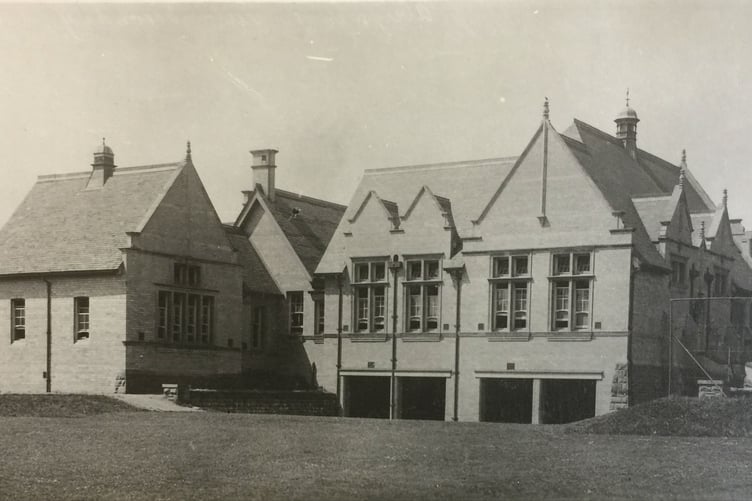
ONE building that Mr. Johnson had a personal interest in was the Masonic Hall on the site of the original St. John’s Church that had become King Henry VIII grammar school in 1542. The school was moved to new premises in Pen-y-Pound in 1898.
He had drawn up the plans for the conversion of the old school premises and once again J. G. Thomas & Sons were the builders. There were so many alterations that it would have been difficult to recognise it as a former school.
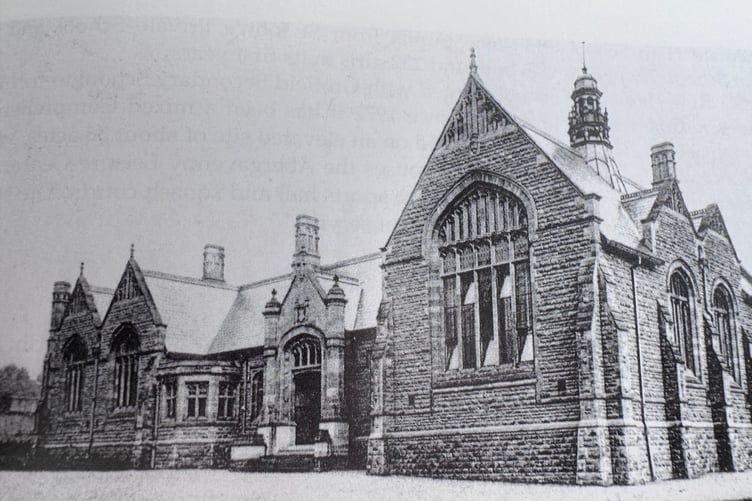
The new King Henry VIII school in Pen-y-Pound was also designed by Mr. Johnson and the foundation stone was laid by Mrs. Bury Capel in June of 1897 and was officially opened by the Marquess of Abergavenny on the 29th of September 1898.
There had been an open competition for the design of the new school and Mr. Johnson’s entry had been chosen from 15 submissions. The architecture was known as “Gothic Tudor” and the building had cost around £5000. Mr. Johnson personally supervised the work but J. G. Thomas & Sons were not given the building contract. The Girls’ Intermediate School in Harold Road, also designed by Mr. Johnson, was opened on the same day by the Marquess of Abergavenny.



The original tender had attracted 13 designs and first place went to one submitted under the motto “A Prophet” which was subsequently found to be from E. A. Johnson. The opening ceremonies were preceded by a grand luncheon in the large assembly-room at the Angel hotel attended by 140 local dignitaries.
When it was time for the new Grammar School’s headmaster, Mr. T. H. Sifton, to make a speech he said: “I congratulate the town, the architect and the Governors on the handsome buildings that his Lordship (the Marquess of Abergavenny) was going to open that evening. My aim would be to fill all those buildings as soon as possible, and render unnecessary the extension that Mr. Johnson had shown in his plan.”
The Girls’ Intermediate School had been built on land donated by the late Mr. William Jenkins, and Mr. George Jenkins, brother and trustee of William Jenkins, was called on to address the gathering. He said: “I would like to propose the health of Mr. E. A. Johnson, our worthy and able architect. He did it with much pleasure for Mr. Johnson had taken great interest in the schools. I have watched the erection of the buildings, and noted the care and time devoted to the work, to ensure every part of its being carried out properly. Mr. Johnson was to be congratulated on the very effective manner in which he carried out the work entrusted to him. The town would be proud of the result of Mr. Johnson’s efforts.”
Mr. Johnson responded by saying: “It gave him great pleasure to hear that his efforts in connection with the buildings met with approval and appreciation. With regard to the Girl’s School, the design had come from a model by the Intermediate Education Department.
Unfortunately, the funds available did not allow the suggested scheme to be carried out in its entirety. He would only hope that the sphere of usefulness would not be crippled owing to the lack of funds. It had been a matter of consideration in the first place whether a knowledge of cooking and the use of the kitchen range was not, perhaps, of as much importance as a knowledge of music and the ability to play the piano. But the kitchen range had to go to the wall for the time being, but some day they would see not only the music room but the kitchen range.
Passing on to the Grammar School, the troubles and vicissitudes of the scheme were so well known that he need not enter into the details. On the plan, provision had been made for further extensions, including the master’s house, which, if carried out, would make the school a complete and satisfactory scheme in every respect. It was well known that however well considered an architect’s plans might be, his efforts were of small avail without the assistance of a competent builder and he would not like to allow the opportunity to pass without expressing his satisfaction in the way in which his plans had been carried out by Messrs. Morgan & Evans of Pontypool” (who had the contract for both buildings).
After the luncheon, the party moved on to Harold Road where the Girls’ school was officially opened by the Marquess of Abergavenny before proceeding to Pen-y-Pound to open the new Grammar School. Both buildings are Grade II listed; Harold Road is still a school while the Pen-y-Pound building is now the Melville Theatre.
Staying in Pen-y-Pound, another Grade II listed building is the Whitfield Presbyterian Church also designed by Mr. Johnson and built by Messrs. J. G. Thomas & Sons at a cost of £5000 in 1908. The style of architecture was known as Perpendicular Gothic and the church could accommodate 470 people with a Sunday School able to hold 270 children.
A letter to the editor of the Chronicle appeared on the 29th of January 1909 with a headline: “Castle Street School and its Glorified Coal-hole – Sir, my attention has been called to the criticism of the Town Council and others of the ‘extravagant and senseless architectural features’ in the recent alterations to the entrance, etc, of the above schools. Kindly permit me to say that although I acted as architect for the Abergavenny schools for over 20 years, my professional connection ceased before the work in question was commenced. Yours truly E. A Johnson.”
The Bethany Baptist Chapel was originally on the corner of Market Street and Lion Street but was demolished in 1882 in order to widen the entrance to Market Street. Mr. Johnson was commissioned to design a new chapel that was then erected further up Market Street and built by Messrs J. G. Thomas & Sons at a cost of £1240 and is now Grade II listed.
The new building was opened in May of 1883 and the Chronicle reported that: “The building has been erected substantially in accordance with the description which we published when the foundation stone was laid, and although it is not yet thoroughly complete, presents a pretty appearance, which would have graced a better site than which it occupies. The acoustic properties of the building appear to have been carefully studied, and the architect, Mr. E. A. Johnson, may be congratulated on his success in this, one of the most difficult and uncertain, yet important of his duties.”
The building remained a chapel until 1990 and has had several changes of use ever since. A very prominent building in Frogmore Street was Barclay’s Bank. This was originally the home of Robert Morgan Kinsey, attorney and sheriff, before he moved to Nevill Street. His grandson, Dr. Elmes Yelverton Steele then lived there, as well as having a surgery, until his death in 1881. The Birmingham District & Counties Bank took an interest in the building but it was not suitable as a bank in its present condition.
There was a set of steps between the pavement and the front door. An article appeared in the Chronicle dated 18th of March 1837 that said: “A very clever pen and ink sketch, the work of our talented townsman, Mr. Johnson, architect, may be seen in the shop window of Mr. Daniel, Market Buildings. It represents the residence of Dr. E. Y. Steele, in Frogmore Street, as it is at present, and as it would be if the suggestions of Mr. Johnson to improve the street at that point were adopted. In the sketch the inconvenience of the present narrow pavement is shown.
The passage of the pavement which is only wide enough for one person, seems to be disputed by two parties who happen to meet; one of whom is a sweep, and the sweep’s brush, either accidentally or intentionally, becomes placed against the other parties’ eye. Two ladies are stepping hurriedly off the pavement and a nurse is nearly overtaking a perambulator in her haste to avoid being swept off by the sweep. The wagon of Messrs Morgan & Evans is galloping by at a furious pace and the hand cart of the Steam Bread Factory is being pushed along leisurely by a boy. Opposite the building in its improved state stand an admiring couple, and the advantages and comforts of a wider pavement are shown. If the proposed alterations are carried out, they will certainly be an improvement in the street.”
The building was subsequently knocked down and Mr. Johnson designed a new structure for the Birmingham District & Counties Bank which went on to become Barclay’s bank around 1920. The building’s new façade was finished in 1892. The building is Grade II listed with the following description: “It has special interest as a well-preserved late 19th Century purpose-built bank building of definite character that has a strong group value with other historic buildings in the centre of Abergavenny.”
Another building in Frogmore Street that Mr. Johnson worked on was No. 47 and which was then known as the Old Fountain Inn. In 1905, the old pub was demolished and rebuilt to Mr. Johnson’s design and renamed the George Hotel. The building was subsequently taken over by Mr. Richards in the 1930’s and he went on to develop the neighbouring properties to form Abergavenny’s very own department store. Sadly, the whole of the Richard’s store was destroyed by fire in 2024.
In 1890, Crickhowell made huge preparations for the visit of His Royal Highness the Duke of Clarence who was visiting the town as the guest of Sir Joseph Bailey of Glanusk. One of his duties was to lay the foundation stone of the new Public-hall to be erected from the design of Mr. E. A Johnson, architect and surveyor of Abergavenny. The ceremony took place on the 18th of September and the Clarence Hall is still a popular venue in the town.
There are many fine private houses around Abergavenny, such as Haverang House in Lansdown Road, that was built in 1884 and designed by Mr. Johnson. The house became Saxonbury Nursing Home for a number of years and was given Grade II listing status in 2005. Mr. Johnson was also involved in the development of the houses around the Western Road area of the town. There are numerous adverts in the Abergavenny Chronicle that seem to be offering houses for sale. One such advert reads: “Semi-detached villas: Riverdale, Brecon Road; and Ravenscroft, Western Road: E. A. Johnson, architect, Abergavenny”. He also placed adverts requesting tenders from builders and painters to put his designs into practice.
Whilst much of his work is in and around Abergavenny, he also designed numerous buildings in the area around Merthyr Tydfil from which he had a partnership business with Mr. Edwin William Gruffydd Richards. One of his most notable designs is the Town Hall in Merthyr Tydfil and his name, Mr. Johnson Abergavenny, appears on the foundation stone. There was a subsequent controversy over his fees for the work.
The Council called a meeting at which a further letter from Mr. Johnson was read out with reference to his outstanding account. Mr. Johnson: “expressed surprise at the attitude taken up by the Council as to his charges, and he considered he was very badly used. It would be with the greatest reluctance that he would take extreme measures against the Council Without prejudice, he was willing to accept £230 to settle his account, and to hand over formally the furniture in the Mayor’s parlour to the Council.” This offer was moved by one of the councillors but it was countermanded by another councillor who said the Council should adhere to its original offer to pay Mr. Johnson £200. The original motion was carried by seven votes to five.
Other designs he worked on in that area were a new church in Fleur-de-Lis, a new Victoria Hall and market hall in Brynmawr, a new church in Aberbeeg, a new library and Unitarian Chapel in Merthyr Tydfil, a new workhouse infirmary at Merthyr, Dowlais infants’ school and many more. A new cottage hospital In Tredegar was opened in 1904 by Lord Tredegar which had been erected upon a suitable site in Tredegar Park, the gift of his lordship to the town. At a cost of £3,300, the hospital had 11 beds and had been designed by E. A. Johnson. At a meeting of the Hospital Committee, it had been agreed that local workmen would contribute one half penny per week per man towards the cost of maintenance and this would amount to around £360 per annum. I believe this was the forerunner of Aneurin Bevan’s National Health Service in 1947.
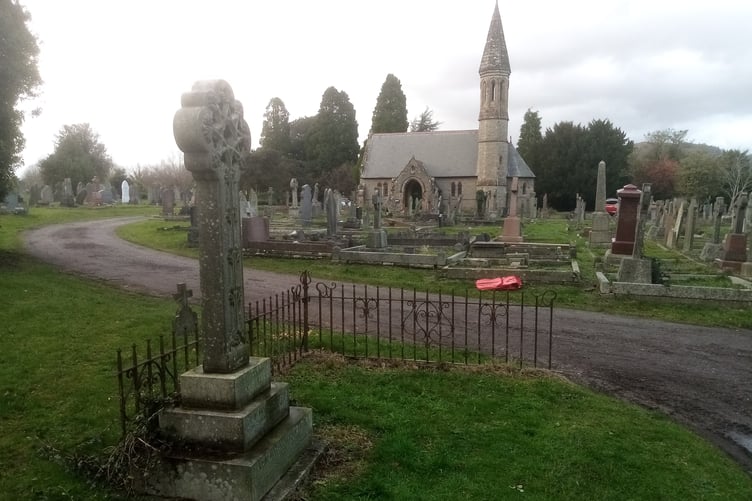
Mrs. Johnson died in August 1913, aged 68 years, and after a service in Trinity Church she was laid to rest in an elaborate grave in the New Cemetery at Llanfoist. Edwin Arthur Johnson died a year later, aged 58 years, and is buried alongside his wife. Many local dignitaries were amongst the mourners present at the graveside. There were no children of the marriage. At some point in Mr. Johnson’s career, he took on John Merton-Jones as an associate and he carried on the architect’s business from St. Mary’s Chambers in Monk Street and his son, Richard Merton-Jones took over from him.
Mr. Johnson’s will was valued at £40,181 gross and £23,235 net, around £2 million pounds in today’s money.
Comments
We've recently changed our login process. If you have an account for commenting, you will need to re-register on the login window.
This article has no comments yet. Be the first to leave a comment.