
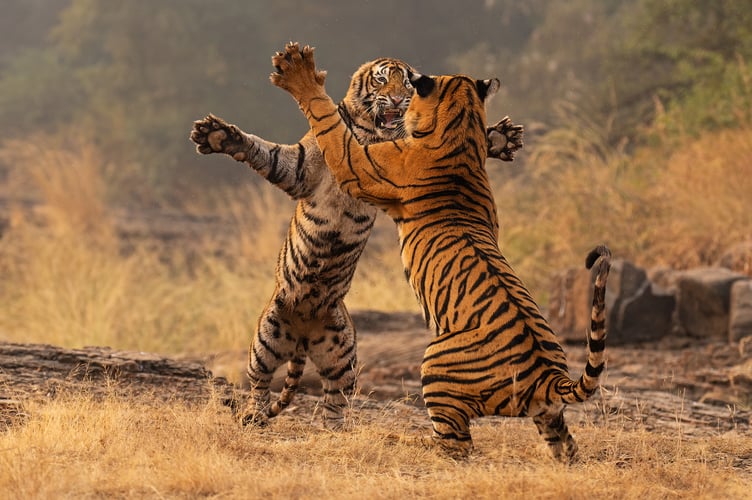
WILDLIFE photographer Andy Rouse has travelled the world and spent a lot of time sitting still and stoic in a host of locations to capture the perfect shot of a wild animal in their natural habitat.
Ask the man behind the lens, and he’ll tell you he doesn’t think of it as a job but more as a lifestyle.
In other words, it’s a passion and not a chore.



However, rewind 25 years and things were a lot different for the award-winning wildlife photographer.
“I was stuck in the straitjacket of a corporate job, and I was fed up. Something had to give,” Andy told the Chronicle.
That ‘something’ ended with the man originally from West Ham, jacking in a comfortable and well-paid job to try his hand at a completely different way of life.
Throwing caution to the wind and deciding to pursue your dreams works well on paper, but in a reality shaped by the forces of comfort, security, predictability and routine, it’s a big ask.
Yet sometimes if you don’t make the leap you never know if you’ll crash or land gracefully.
In Andy’s case, the gamble paid off.
“Although on paper my job looked glamorous with lots of travelling and monthly trips to LA, I found the reality of it suffocating,” he explained. “I was a long way from what I actually wanted to do.”
Although he had been interested in photography for a while, Andy didn’t buy his first camera until he was at university. It was a wise investment because not long after he combined his love of taking pictures and animals and won a BBC wildlife photography competition for his picture of a fox.
Yet back then, he considered photography more of a “stress-busting” hobby and not something he considered making a career of.
His entry into the corporate world saw him hang up his camera, and he only thought about picking it up again when life in the office began to make him miserable
“I woke up one morning and decided to quit and invest all the money I had in the bank to fund a trip to Botswana,” revealed Andy.
“I was hoping to take some pictures that I could potentially use for a portfolio,” revealed Andy.
During three weeks with a guide who ensured Andy could get up close and personal with all manner of wildlife, from lions to elephants, Andy fine tuned his craft.
Andy explained that this trip was the making of him because on the strength of one particular picture of an elephant spraying mud, he won an award that eventually led to a deal with a wildlife agency, and the ball was rolling.
“I’ve been lucky in that I’ve always had a knack for taking pictures that people seem to like,” explained Andy. “I wish I knew the secret, but my first and last principle is if I see something I like,I’ll take the picture; if not, I won’t.”
From elephant spraying mud in Botswana to tigers fighting in Ranthambore, it’s a philosophy that has served Andy well.
Yet it wasn’t all plain sailing.
Andy, who recently turned 60, recalled, “It was tough in the early days to make a living from it, but it was stock photography that helped me out because in those days it was a really good earner.
“Those first five years of being a pro were definitely exciting. It was almost a golden time because back then, there weren’t so many people doing it, but I had an edge because my business background taught me that you can’t just take pictures of what you like, but what sells in a way that you wanna do it.
“I always say that if I’m not successful, I can’t lead a life doing what I want, and that’s taking pictures of animals.”
Andy, who in his younger days worked in a zoo, where he developed his love for big cats, has always had a passion for wildlife in all shapes and sizes.
He used to rehabilitate hedgehogs and foxes, and once had a huge enclosure in his back garden where he raised cubs before reintroducing them into the wild.
“I’m pretty much a softie when it comes to animals and not at all like the tough wildlife photographer stereotype,” said Andy.
“I chose to spend my life with animals, and taking pictures of them is how I make my money. I couldn’t call it a job, and the best example of that is, if you were a wedding photographer, and no offence to wedding photographers, once you’re retired you’d probably never want to go to another bloody wedding again, but as a wildlife photographer, if I ever hung up my camera I’d still choose to go and hang around animals.”
Andy added, “I’m an animal hugger before I’m a photographer and my sole motivation is to take a good picture but never at the expense of the animal. I almost see myself as their PR guy, because a good picture can help raise a lot of awareness of what wildlife is really all about.”
In the last two decades, the advent of digital cameras has changed the industry dramatically, and professional photographers are not as sought after as they once were. Yet despite huge breakthroughs in technology, there is still a need for a person behind the lens with experience, passion, and who knows their subject inside out.
Andy, who has been on countless safaris and travelled to every corner of the globe, taking pictures of animals, is also a huge enthusiast of roaming the UK and taking pics of our domestic wildlife.
“I particularly love taking pictures of roe deer and hares. Given the choice, I’d probably do that for the rest of my life. Like everyone, I’m conscious of my carbon footprint and need to travel less, and that’s easy when we’ve got such a wealth of wildlife on our doorstep,” explained Andy.
“I love getting up at 3.30 am and the one-on-one nature of stalking a deer. You really do have to get into a different mindset and be aware of how you smell, sound and all the rest of it if you’re going to be lucky enough to catch a sight of the thing you’re looking for. It’s not everyone’s cup of tea, but I love it.
“Funnily enough, I once took a journalist with me, and as we were getting out of the car, they slammed the door, and I just turned to them and said, ‘What, the hell have you done? We may as well call it a day and go for breakfast because you’ve just alerted every deer in the area that we’re here!’’
Although he loves all animals, it’s big cats that Andy has a special self-confessed affinity for and which led him to the door of his late mentor, friend and fellow photographer Aditya Singh, whom Andy knew as Dicky.
“I used to think I was god’s gift in the early years,” explained Andy. “And then one day I got a message from Dicky out of the blue, who called some pictures I had taken of tigers rubbish. He said, ‘Come to India, and I’ll teach you about tigers.’
“Naturally, I was intrigued by such a challenge. So I went to India to see this guy and ended up staying for a few months. We got on like brothers. He taught me a lot about tigers and humility, and we became best friends.”
It was a shot of two tigers fighting that saw Andy dedicate his prestigious win in the 2025 British Photography Awards to Dicky.
Reflecting on the last 25 years behind the lens, Andy explained, “I’m not what you’d call a particularly technical photographer; it’s all pretty much instinctive. I just want to take pictures that’ll make people smile, and they can understand.”
Comments
This article has no comments yet. Be the first to leave a comment.