
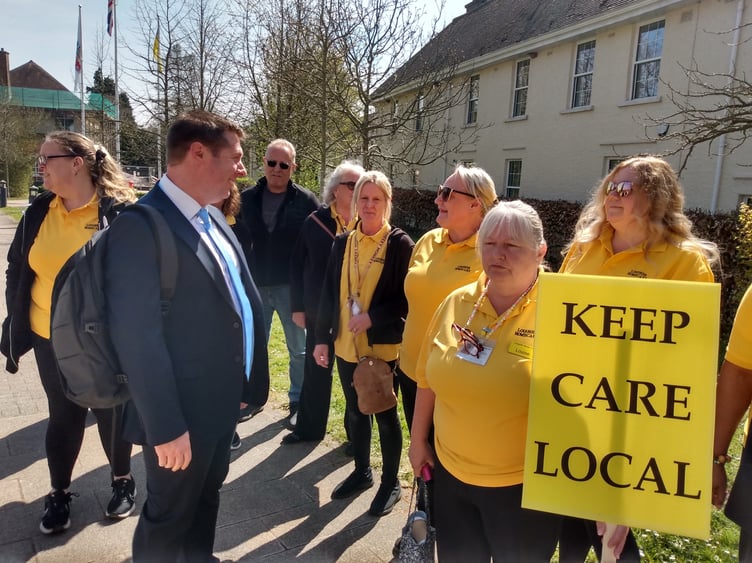
AN overhaul of how care at home is provided will aim to keep existing companies in place so people don’t lose their carers.
Changes to domiciliary care contracts in 2025 prompted a backlash, and a protest by care workers at Monmouthshire County Hall, when the number of firms holding contracts was reduced to three and people faced losing their regular carers.
Monmouthshire County Council introduced longer term, block contracts, after dividing the south of the county into three areas, as part of an effort to stabilise its costs and provide certainty for care firms and staff.
Social services chiefs said a number of lessons had been learned from that process which will now inform changes to domiciliary care contracts in the north and central areas of the county.
Head of adult services Jenny Jenkins acknowledged “lessons had been learnt” when the council’s people scrutiny committee was updated on how the next phase of the domiciliary care strategy would be implemented in spring next year.
She said: “The way we have determined to commission phases two and three is very different it will allow providers to retain their staff and to retain their clients, so it’s a very different process in that we’re not zoning the areas.
“We are hoping, and obviously providers will need to comply and be successful in the process, we won’t be pitching providers against each other in a way that is competitive.”
As a result the council expect there will be less need for carers to transfer between employers while the committee was also told a procurement process is being run on legal advice it couldn’t simply change existing contracts.
Councillors also heard how officers and firms, which won the new contracts in 2025, were surprised at what commissioning manager Ceri York said was “unprecedented” absence of staff transferring under Tupe arrangements.
No firms were named at the committee meeting but ahead of the contract changes care workers from Magor-based Lougher Care, who staged a protest at County Hall, said they didn’t intend transferring to a new employer.




Ms York told the committee: “It was a massive surprise to everyone and some of the providers, who are national companies, said it was something they’d never come across before.”
Caldicot West End councillor Jill Bond said concerns around quality of care remain including elderly residents having to adapt their needs to meet the capacity of care providers.
She said: “I’ve talked about a person who has been in bed for 14 hours and not had a shower for a year, those things need to be followed up.”
In response to questions around the quality of care Ms York said the council has increased the care and support provided in the south of Monmouthshire, where around 170 people need care at home, following the introduction of block contracts in August 2025.
She said: “When you look in terms of the number of hours of care and support we are able to provide it has continually grown since the block contracts came into place and we are providing more care and support than we were and it has been sustainable.”
She also said there had been a “considerable reduction” in the number of people in the south of Monmouthshire classed as having an “urgent need” who the council hasn’t been able to provide a carer for.
She also said the number of complaints after the new contracts were introduced were at “consistent levels” with those before the changes.
Comments
We've recently changed our login process. If you have an account for commenting, you will need to re-register on the login window.
This article has no comments yet. Be the first to leave a comment.