

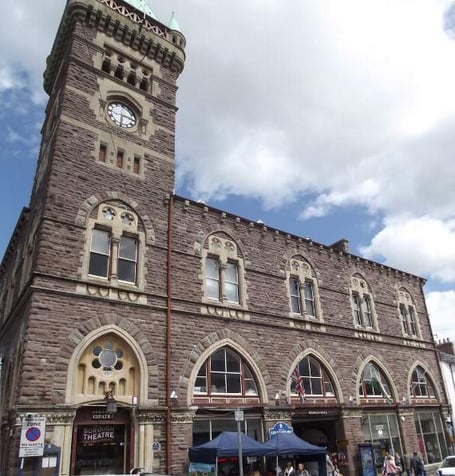
RESIDENTS in Abergavenny are invited to take part in a wide ranging consultation on how Monmouthshire could be developed in the next decade.
Monmouthshire County Council has issued its Revised Local Development Plan (RLDP) - and has identified a wide range of issues facing local communities.
And local member of the Welsh Parliament for Monmouth, Nick Ramsay, is urging constituents to take part in the public consultation.
Nick said: “I would encourage all those constituents who are interested in the shape of future development in Monmouthshire to take a look at the Growth and Spatial Options Paper.



‘‘An Easy Read version is available to view on the council’s website.
“The documents will not be available to view at the council’s principal office at County Hall, Usk as this building is currently closed to the public.
“I would urge people to take time to look at the proposals and comment on the questions set out in the Growth and Spatial Options Paper.
‘‘The document is available for non-statutory public consultation from now until Monday 1st February 2021. The deadline for responses is midnight on Monday 1st February 2021.”
The RLDP is looking to resolve isues in the county including the high average house prices (average price is £297,628 as of March 2020), a lack of local employment, an ageing population and a lack of affordable homes - there were 2435 people on the council housing waiting list as of summer last year.
And around 54 per cent of the working population are employed out of the county which has an affect on local communities, roads and transport.
The RLDP will also look at the challenges of rural isolation and sustaining rural communities; the protection of landscapes and heritage that make Monmouthshire a unique, special and attractive place to live and the need to tackle climate change and carbon reduction (MCC passed a motion to tackle climate change in May 2019).
These issues, challenges and opportunities have been re-assessed and were endorsed by the council at a meeting in October 2020 - they still remain relevant in light of the Covid-19 pandemic.
As a result of lockdown restrictions a consultation is due to take place on Wednesday, January 20 from 2pm to 3.30pm allowing times for Q&As.
Those wishing to attend the virtual consultation need to email the council and residents can also submit comments electronically, the email for both is [email protected]
Details of the RLDP can be found on the council’s website a detailed report examines several options up for discussion and looks at the pros and cons of each one.
The council is revisiting the Growth and Spatial Options and Preferred Strategy stages of the plan.
It is considering several options but its preferred one is to distribute growth proportionately with jobs and affordable housing distributed across the county’s most sustainable settlements with the level of growth proportionate to that settlement’s size and amenities.
This would utilise existing infrastructure and may provide new infrastructure; help support existing facilities and services through the county and may also attract new facilities although the report acknowledges some rural areas could be disadvantaged as they would not all benefit from additional housing which could affect existing facilities.
Some of the most sustainable settlements have infrastrucutre capacity issues which would need to be addressed to enable growth in these areas.
Another option is to focus growth on M4 corridors where growth would be predominantly local in the south of the county in the Severnside area close to the M4/M48 - but this option does ignore the rest of the county and does not assist in sustaining rural communities across the county as a whole.
An option to focus growth in the north of the county ie across most sustainable settlements is also up for discussion.
The pros for this is an opportunity to capitalise on its strategic rail and road links to the Head of the Valleys and wider Cardiff Capital Region via the A465 and towards Herefordshire via the A449 and A40 with the potential to provide economic opportunities and increase levels of self-containment within the sustainable settlements of North Monmouthshire.
However on the downside the option ignores the rest of the county and does not assist in sustaining rural communities across the county as a whole; would not address market and affordable housing need; would not support existing facilities or enable provision of additional facilities and infrastructure in areas outside of North Monmouthsire.
Information in the RLDP predicts that by 2033 there will be an extra 12,443 people living in the county, an extra 7,605 homes built and 7,215 more jobs.
The council’s preferred ‘growth option’ will help to deliver it’s core purposes of building sustainable and resilient communities for current and future generations, provide a wide choice of homes and secure a significant level of affordable homes.
It would also help in ensuring communities have a balanced population and are socially sustainable.
This would result in an increase in the working age population which would support job growth within the county.
The ‘spatial option’ is to distribute growth proportionately across the county’s most sustainable settlements which has the potential to enable the provision of homes in both urban and rural communities.
This could result in direct job growth to locations across the county which will assist in reducing the need for people to commute outside the county therefore promoting self-contained communities. It would also assist in ensuring a more balanced population throught the whole of the county.
To view all the options up for consideration in the RLDP visit the council website and follow the links https://www.monmouthshire.gov.uk/planning-policy/planning-policy-current-consultations/
Comments
This article has no comments yet. Be the first to leave a comment.