

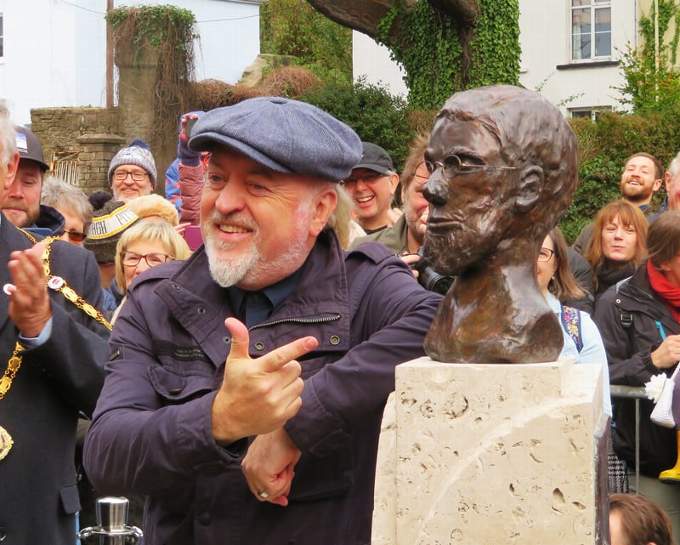
Comedian and naturalist Bill Bailey hailed his ‘geeky Victorian collector’ hero Alfred Russel Wallace as he unveiled a bust of the co-founder of the ‘Theory of Evolution’ in his Usk birthplace on Saturday November 6.
He told a large crowd gathered in Twyn Square: “I first heard about Wallace while I was trekking through the jungles of Indonesia 15 years ago and I’ve been fascinated by him ever since.
“This geeky Victorian collector changed our understanding of life on Earth.
“Along with Charles Darwin, he came up with one of the greatest scientific ideas of all time: the theory of evolution by natural selection.


“These two men independently came up with the same explosive theory, but now, 100 years on, Wallace has been forgotten.
“I guess you could say he’s the Missing Link in the story of evolution,” joked the star, who is chairman of the Wallace Correspondents Society and presented a BBC documentary “Bill Bailey’s Jungle Hero” about Wallace, which is currently on iPlayer.
Although famous in his own lifetime, Wallace’s role was largely forgotten until recently after his death at the age of 90 in 1913. While Darwin came from a wealthy background, Wallace, born over the river in Kensington Cottage, Llanbadoc, nearly 199 years ago (January 8, 1823), was “an unlikely hero, from humble origins.”
“He had a fractured childhood, a feckless father who was financially hopeless, and who squandered most of the family’s money, meaning that by the age of 14 he had to leave school and earn a living,” said the comedian, and 2020 Strictly winner.
But Wallace, a self-trained naturalist, left his career as a building surveyor to travel to Borneo to pursue his passion and collect exotic exhibits.
And while most Victorians just wanted a dead specimen, “unlike many of his contemporaries, Wallace also thought it was important to observe them alive.”
“The sheer abundance of species captivated him. Why were there so many, where had they come from?” asked Bailey.
“Unlike many of his contemporaries, he also thought it was important to observe them alive.”
Wallace soon spotted that orangutangs had adapted long, muscular arms to swing from tree to tree to avoid the perils of the jungle floor.
But Bill told townspeople there to celebrate their most famous son, the discovery of the “Wallace Flying Frog proved that evolution was ongoing”.
“Whilst it has muscular legs which can launch it into the air, and webbed feet which help it swim, it’s only in the infancy of gliding from tree to tree.
“Its flight is far from perfect - it flings itself from thing to thing.”
Wallace then wrote in 1856 about his findings to Darwin, much to the latter’s shock, as he thought he alone was on the brink of discovering evolution.
But the two combined for a joint paper presented at the Linnean Society in 1858 unveiling the theory of evolution, which sent shockwaves around the world, and spurred Darwin into writing “The Origin of Species”.
“Wallace was laying down a bold challenge to the scientific establishment,” said the comedian.
“It was like a keen amateur astronomer writing to Stephen Hawking, saying ‘Dear Stephen, I’ve worked out the Theory of Everything. I await your prompt response’.
“For Darwin the race was on, a race that Wallace didn’t even know he was in!”.
Chair of Usk Civic Society Tony Kear, which launched the fundraising for the bronze bust, set on a plinth of rare fossil-rich Portland Roach stone, said: “I like to think of Wallace’s bust looking down on all the fossils in his plinth, and imagining where they all came from and how they evolved into us unveiling his likeness today.
“I didn’t know anything about Alfred Russell Wallace until seven years ago, but now I hope the rest of the world will.”
Sculpted by Felicity Crawley, wife of fund president Tom Crawley, the bust was cast at the Arch Bronze foundry in London and the plinth includes plaques showing birds of paradise and the Malay Archipelago where he explored, set alongside an interpretation board. Wallace’s star is on the rise again, after a campaign launched in 2013 on the centenary of his death led to the reinstatement of a giant oil painting of him at the Natural History Museum, near Darwin’s statue, unveiled by Bill Bailey and Sir David Attenborough, and the creation of a bronze statue.
Comments
This article has no comments yet. Be the first to leave a comment.