
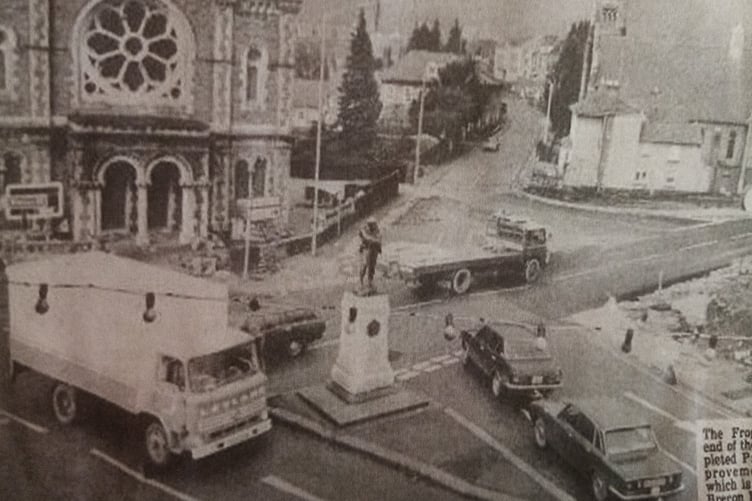
ONE part of the 1965 town development proposals did come to pass in 1975. This was the routing of the A40 from the Angel corner in Cross Street, along Monk Street, Hereford Rd. and Park Rd. meeting back up with Frogmore Street by the cenotaph.
The Chamber of Trade welcomed the opening of this new road as they said it would help Abergavenny breathe more easily but there were already misgivings among the people who were most affected.
Some feared congestion, particularly on market days.
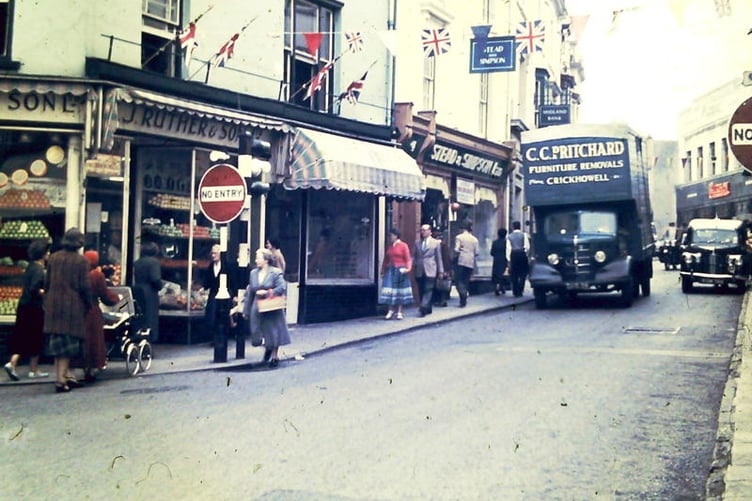
The changeover occurred at 9 o’clock one Sunday morning in May 1976 when all the new road signs for the by-pass were unveiled and Frogmore St. became one-way. The original route of the A40 had been straight through the town centre (Cross St., High St. and Frogmore St.) with two-way traffic.
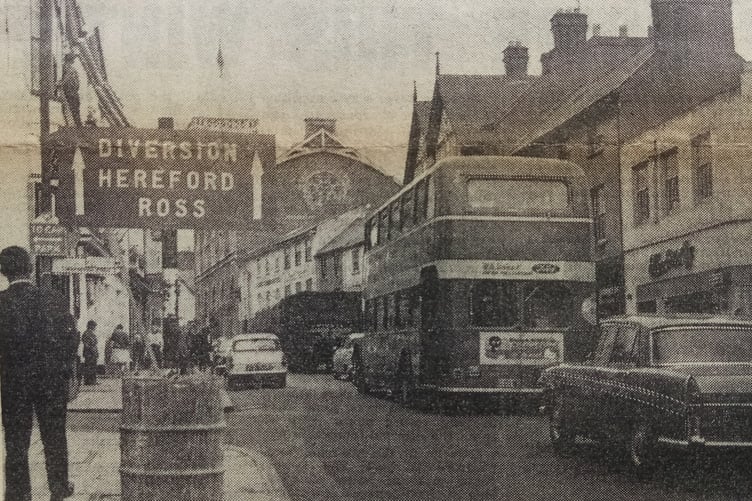
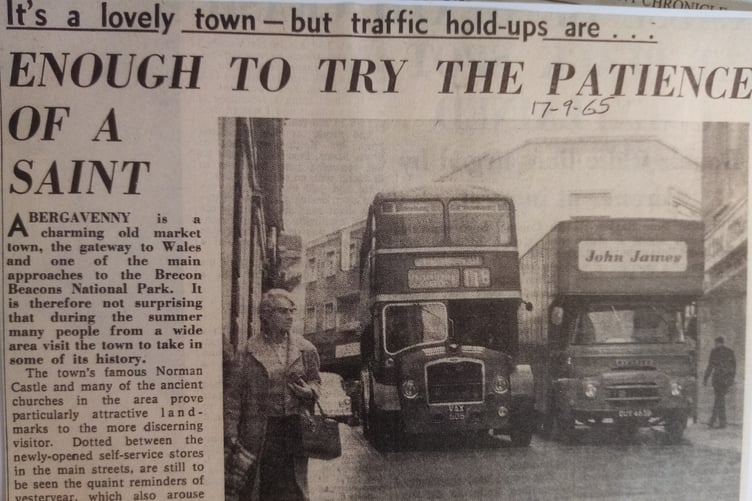
The Abergavenny Chronicle dated the 17th of September 1965 had the headline: “It’s a lovely town – but traffic holdups are enough to try the patience of a saint!” Double-decker buses were used on routes around the town and they had to try and get past delivery vehicles that were parked outside the shops to unload their goods. The congestion caused by the narrowest part of the main street, between the present Portico and the old Barclays Bank, was alleviated by putting traffic lights that diverted east bound traffic down Lion Street where it was able to join the Hereford Road and Monk Street. The new by-pass scheme had been provided at a cost of £135,000.
Two parts of the proposed route needed the most work. Firstly, there was a narrow lane running between Bailey Park and the cattle market that had to be widened to allow two-way traffic. The wall and railings that formed the boundary of the park were moved nearer to the avenue that runs through the park. Part of the lane can still be seen around the side of the Bailey public house. Then access to the Hereford Road had to be made on the southern side of the pub.
From an old aerial photo taken in 1929, it would appear that there was an entrance into the market already existing from the Hereford Road. This road was then extended past the existing slaughter-house and town mortuary but these were both demolished when the cattle market site was cleared for a new supermarket.

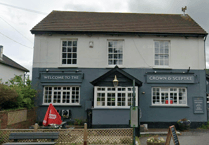
The Bailey pub, once known as the Victoria Inn, was closed in 1990 as there were severe cracks in the structure that had been caused by the volume of traffic that passed alongside 24 hours a day. There was a suggestion that the pub should be demolished and a roundabout put in its place to ease the traffic flow. This never happened as the building was restored in 1992 and traffic lights were put there instead.
Another feature of this part of Park Road, at its junction with King Street, was Davenco, formerly known as the Lion Engineering Works. This was a heavy engineering and casting business that was tied into the region’s coal, iron and steel industries. I can well remember walking past on my way to Hereford Road school and seeing the flames of the furnaces glowing red hot.
Colonel Harry Llewelyn eventually bought the business in 1954 and 25 men were employed there but demand for this sort of specialised casting was on the way out and so he had no choice but to close it down.
Sergeant’s the printers were on the corner of Park Road and Queen Street. These new premises were opened in 1887 as the company was expanding its range of goods and services. But trade declined over the years and the company closed its doors on Christmas Eve 1983.
The new Cibi shopping centre was built on the site and is now the Iceland store. On the opposite corner is Robert Price & Sons, builder’s merchants. This company had started in Lion Street in 1847 but moved to these larger premises around 1960.
Further along Park Road is the Conservative Club. This Club had started life in 1891 at premises in Baker Street but moved to its present site and opened in November 1929. This had previously been the site of a ‘pop factory’. On the opposite side of the road were two groups of houses called ‘Northgate’ and ‘Northleigh’. These houses appear to have been built around 1910 as the 1906 residential street directory does not have an entry for Park Road.
Abergavenny’s first roller-skating rink was built on the open stretch of land between Northleigh and the back of Tescos. Built by local businessmen, the Gwatkin Brothers, it opened on the 29th of September 1909 and boasted a 3000 square foot wooden rink and they advertised three sessions daily: 10:30 – 12:30, 2:30 – 5:00 and 7:00 until 10 o’clock in the evening. The Gwatkin Brothers had a furniture and hardware shop at 42 Cross Street as well as numerous investments in land and property around the town.
J.C. Gwatkin was a town Councillor and Mayor during 1905 but he died in June 1917. He and his brother had over-stretched themselves financially and the Skating rink was put up for sale in November 1918. The building would appear to have already been dismantled as the advert specified 500 corrugated sheets, rafters, joists, doors and windows.
The Chronicle dated the 20th of December 1918 reported that the freehold building land, recently the site of Park Hall, was sold to Mr. E.C. Straker for £130. Boxing matches were one of the events put on there during 1915. In 1916, an advert appeared in the Chronicle to the effect of: “Anyone giving information which will lead to the conviction of the person or persons who removed a wooden bridge over the Kibby brook near Park Hall, will be rewarded. E.C. Straker, Chronicle Office.”
The building, known as ‘Park Hall’, was at some time the workshop of the prolific inventor Walter Jones. He and his brother were best known for developing a variable pitch propellor and for building pioneering cycles, cars and hydroplanes.
On the other side of the road where Judd’s now is used to be a garage owned by Randolph Whittal-Williams and he had taken over the garage that was ‘AVM’, the initials of Anthony Van Moyland. The garage occupied land on both sides of the road and the Tesco side was a showroom for new cars.
Ted Williams and Son undertakers, now part of Northleigh, were established in 1886. It was usual for cities to have undertaking businesses as small towns were more commonly served by their local building firms such as J.G. Thomas & Son and Foster & Hill in Abergavenny.
The second phase of the project was to rearrange the existing junction of Park Road and Pen-y-Pound which led into Frogmore Street and the Brecon Road.
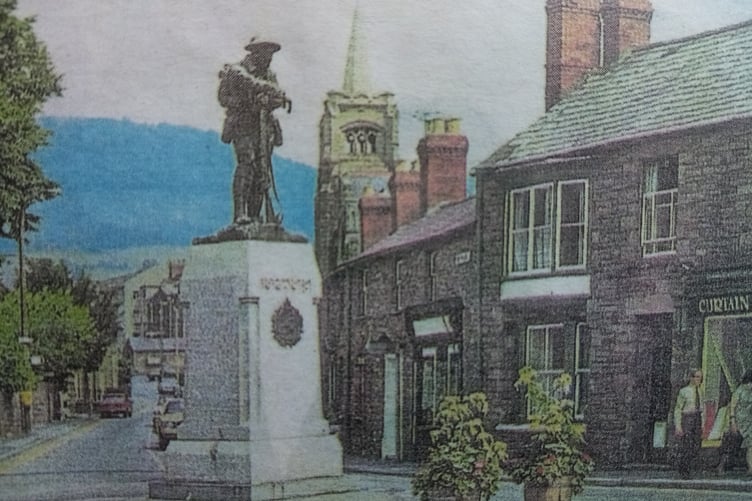
The plan now was to demolish the row of shops at the bottom end of Pen-y-Pound and use the exposed land to straighten out Park Road in front of the Baptist Chapel. Ironically, the original design called for the new road to go behind the Chapel as can be seen from the map. One problem, after the work had been completed, was that encountered by shoppers attempting to cross the busy two-way traffic between the Baptist Church and the Cenotaph.
The local traffic warden suggested putting up railings to protect pedestrians. A local newspaper also reported, “Pedestrian power reaches a new high on Park Road outside the Fairfield car park, where the push of a button at the new pelican crossing brings through traffic to a halt.”
Pelican crossings were first introduced in 1969 and the name is derived from PEdestrian LIght CONtrolled with the ‘O’ being changed to an ‘A’. I believe this was the first one installed in Abergavenny.
The new A40 bypass would now pass many buildings of note on its route around the town centre. On the corner of Monk Street and Cross Street is the Great George public house. The original pub sign was unusual as it had a different ‘Great George’ on either side. One was George Bernard Shaw and the other was George Washington. (The sign has since been removed after the building’s recent restoration.) But there is a suggestion that the pub was named after a famous diamond awarded to the Duke of Wellington in 1813.
The building was under threat of demolition in 1969 to make way for the much-needed widening of this busy junction. This never happened but a pavement widening scheme took place in 2001 following consultations on this dangerous corner for pedestrians. Bollards were erected alongside the kerb and a computer-generated model showed that HGVs could still manage to turn this corner. It was only a matter of days before the bollards were hit by a lorry and were hastily removed.
Monk Street has the original office of the renowned architect Edwin Arthur Johnson which is now Fonseca’s solicitors. Then there is the Tythe Barn and St. Mary’s church. The current Gateway Church used to be the Pavilion Cinema that was built in 1928 before closing in 1967. For a while it became a bingo hall before being abandoned until 1999 when it was purchased and converted into the present church that opened in 2001.
Prior to this, in 1994, a plan was submitted to the county council to turn the former bingo hall back into a cinema with a night club downstairs. A consortium of local businessmen had a budget of £200,000 to spend but it never materialised. On the other side of the road, we find Gabb & Co. solicitors that was founded by Thomas Gabb in 1760 and is the oldest firm of solicitors in Wales.
An early sketch of Monk Street in 1784 by Josuah Gosselin shows the building as it still looks today. (Joshua Gosselin was an amateur artist who often visited Monmouthshire to paint the landmarks.) Osborne House on the corner of Lower Monk Street, also sketched by Joshua Gosselin, has a history going back to at least the 1700’s when it was the residence of the Roberts family. John Roberts, High Sheriff of Monmouthshire in 1762, left the house to his second wife Martha and it subsequently became the property of Lewis Osborne, the steward to Lord Abergavenny after whom it became known as Osborne House.
In 1890 it was sold and turned into the ‘County Club’ for gentlemen. Before the new Hereford Road was built, this house, as far as the north side was concerned, was in the country and most of the land on which villas are now built belonged to the estate. (Priory Meadow, which is now the site of Bailey Park, was also part of the Roberts estate and it was from them that Crawshay Bailey junior took out his 25-year lease for Bailey Park.)
In more recent years the building was the home of the Gwent County Police Headquarters until they moved to a new building in Croesyceiliog in the late 1960’s. The Chief Constable’s office was next door whilst the Deputy Chief Constable’s residence was upstairs. In 1966 a major sewer pipe was laid along Lion Street which then crossed the Hereford Road to continue down Lower Monk Street.
The excavation work resulted in the building’s foundations being unsettled and scaffolding was erected to help stabilise the structure for the next three years before being practically rebuilt. In the 1980’s the building was used as a joint venture between the Brecon Beacons National Park Authority and the Abergavenny Tourist Information Centre as well as being the County Registry Office.
The name Osborne House has been resurrected and is now a residential block of flats. Thus, the by-pass has served Abergavenny well over the last 50 years and the only new work carried out has been the provision of a bus stop at the junction of Pen-y-Pound.
Comments
This article has no comments yet. Be the first to leave a comment.