
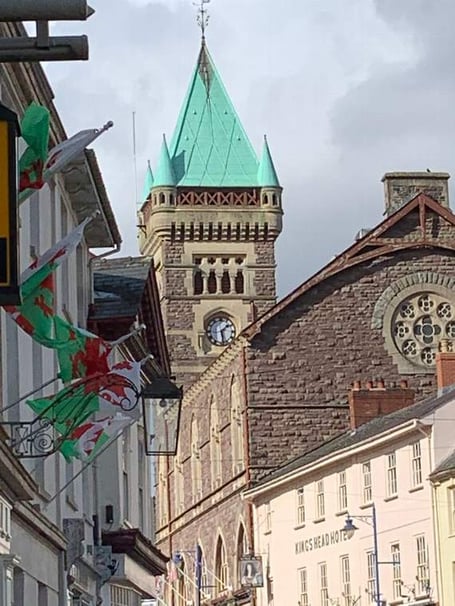
WAY back when Teddy boys stalked the avenues and alleyways of old mother Aber and people said things like, “Hey daddy o” and “bebop” without feeling an acute sense of shame, a gang of merry pranksters caused time to stand still during one of the town’s legendary ‘beat the clock races’.
And now, for lack of any sporting action from last weekend to report on, we bring you the strange and curious mystery of the stopped clock.
Back in the 1950s and 60s there used to be an intriguing challenge in Abergavenny. It involved running like a March hare from the Town Hall to the Swan Hotel as the town’s clock struck midnight.
The aim of the game was to make it to the Swan before the last of the 12 chimes sounded their big boom boom.




Although it is practically impossible to complete the journey in the given time, unless perhaps your surname is Bolt, it provided a great novelty and attraction for the townsfolk before Facebook and Netflix were a thing.
The first man to try this Herculean challenge was Abergavenny’s Fred Cooper in the early 1900s.
Cooper, who was born in Monk Street, was the first man in Britain to run the 100-yard sprint in ten seconds, and he was also the first have-a-go-Harry to attempt to run the distance from the town hall to the Swan Hotel in the time it took the clock to strike twelve.
A local resident who watched the one-man race said, “Fred Cooper failed by about one strike to reach the Swan Hotel.”
Several runners, including well-known local athlete Ken Flowers, have since tried but all have failed to beat the clock.”
Yet in June 1959, during Carnival Week, there was a whisper in the wind and a feeling in the air that an Abergavenny athlete was about to finally beat they tyranny of time and finally stay one step ahead of the 12 count.
It was 20 minutes to midnight on a balmy Saturday night. Over two thousand people lined the streets to watch nearly a dozen athletes who thought they had what it took to trump the town clock and cover the 270 yards before the chimes struck twelve.
Reputations were on the line, but so too was a cash prize of five guineas. And a man could buy a lot of Brylcreem and blue suede shoes with such lucrative loot.
The clock struck quarter to twelve and the gathered assembled quivered with excitement. One lady named Peggy Sue was heard to exclaim, “Lawdy Miss Clawdy. It’s all too much.”
The tension rose to fever pitch and then - nothing! A big fat anti-climax gripped the spectators in its sweaty hands as the clock stopped at precisely 11.47pm. The big hand never reached the stroke of midnight and the race against time had to be stopped.
All fired up and nowhere to go the athletes decided to hightail it to the Swan anyhow, but the audience had lost interest and fate had been cheated of its spectacle.
“For whom the bell tolls,” sighed one disgruntled bystander randomly as the mob shuffled away, despondent and dispirited.
All the next day speculation was rife. It was Sunday and folks had more time to speculate back then. Did “Old Faithful” stop of its own accord or was there a human hand and a sport of dirty work at play?
Some Carnival Week officials believed, without a doubt, that mechanical failure was the real culprit. They would not entertain the notion that foul play had been the order of the day.
Carnival joint-secretary Mr. Bill Jones told the Chronicle, “I just don’t believe that there’s been sabotage.”
But sabotage it was.
The Chronicle reported that when Mr. Wells, manager of Messrs Rowe & Son, the firm responsible for the maintenance of the clock, climbed the Town Hall stairs, evidence of vandalism most foul awaited his prying eyes and probing investigation.
The Town Clerk Mr. T.G. Hardwick announced solemnly, “The clock had been stopped deliberately. And the reason for its stopping lay in the fact that the pendulum’s swing had been halted.”
It transpired that a group of local sportsmen, thought to have been from Abergavenny Rugby Club, were responsible for what became known in Abergavenny lore as “Operation Tick Tock.”
The fiendish rascals waited until the clock struck a quarter to twelve before they tied the clock’s pendulum to the door of the cupboard with a black shoelace.
By the time the the first incredulous cries of “The clock has stopped!” rang through the night air causing confusion, indignation, disappointment and plenty of loud, uncontrollable laughter, the time thieves had already hot-footed it into the safety of the night and the pages of history.
And thus ends the tale of the day time stood still in the little town of Abergavenny.
Comments
This article has no comments yet. Be the first to leave a comment.