
Ifor ap Hywel, lord of the manor of Bassaleg, was the second son of Llywelyn ap Ifor and the beautiful Angharad Morgan, daughter and heiress of Sir Morgan Meredith of Tredgar. They held court at Gwern -y-Cleppa, and Ifor sponsored the poet Dafydd-ap- Gwilym, who named him Ifor Hael (Ifor the Generous) in his poetry.
The Morgans of Tredegar House greatly respected the name of Ifor Hael and frequently used it in political campaigns. In the late Victorian era, the war hero and generous public benefactor, Godfrey Morgan, Ist Viscount Tredegar, was even referred to as ‘Ifor Hael the Second’ and an avenue of trees used to run up to Gwern-y-Cleppa from Tredegar House.
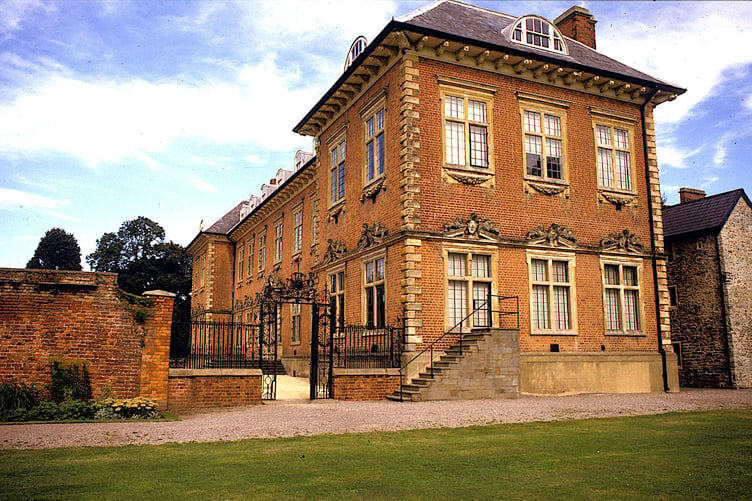
Gwern-y-Cleppa (the chattering alder grove) stood in a small grove half way along the footpath between Croesheolydd and the Cardiff Road and in 1570 it was marked by Saxton the map maker as a large building not far from Bassaleg. But by 1801, when Archdeacon William Coxe visited Monmouthshire, he said that the house was ‘nothing more than a pile of stones hidden in thickets’.
In 1946, the site was investigated by Anthony Pickford and in his book Between Mountain and Marsh, he comments that he found it to have been a very large house, with ‘the westward frontage of the building at least 240 feet long, and the eastward about 300 feet. A walled enclosure lay to the south and measured 70 feet by 75, from one outer thickness of the 5 feet walls to the other. The main structure appears to have been quite 100 feet wide at the greatest extent but in the confused mass of rock and earth it is hard to tell foundations from mere collapsed stonework and piles of rubble.’
Dafydd ap Gwilym once commented; ‘It is here that nobility resides and it is a fair lordship and dukedom’. He was the son of Gwilym Gam and Ardudfyl Fychan, sister of Llywelyn ap Gwilym Fychan of Emlyn, Lord of Ceredigion, and these people were kinsfolk of Ifor Hael. When his mother died and his father remarried, Dafydd, who hated his stepmother went to live with his uncle Ifor at Gwern y Cleppa, and he will always be associated with that place.
Little is certain of Dafydd Gwilym’s life, save what can be found in his poems, and the precise dates of his birth and death are not known: one record gives his life from 1325 to 1385, while another, vaguely says that he lived sometime between 1300 and 1400.
He is the most renowned Welsh poet and even considered by many to be the greatest who ever lived. About 170 of his poems have survived but there are many others that have been attributed to him. His main themes were love and nature in all its forms, such as birds, woods, mountains and rivers. The poems are never longer than sixty lines, and he wrote in strict, formal metrical patterns called Cwyddau that cannot effectively be translated into English.
Angharad, the daughter of Ifor Hael became Dafydd’s pupil and when an attachment grew between them she was sent by her father to a convent in Anglesey, and Dafydd, in order to be near her, went to live in an adjoining monastery, but found that she had become a nun and died soon afterwards. He then returned to Gwern-y-Cleppa, and the poems he wrote there were to influence Welsh poetry for the next five centuries. After the death of his patron Ifor Hael, he was appointed chief bard of Glamorgan.


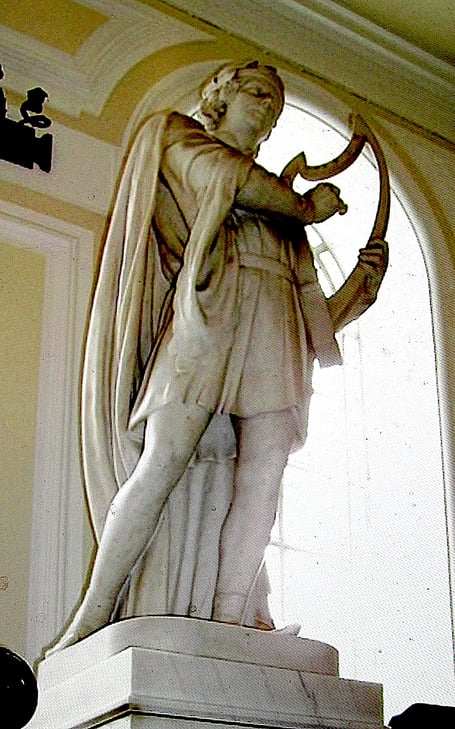
He was the contemporary of Chaucer and was writing poems when Owain Glyndwr was just a youth. His statue in the City Hall, Cardiff shows him as a young man with curling hair under a loose cap and in his hands he holds a harp.
In 1572, the Reverend D Jones recorded: ‘I have talked with a very old woman who had seen another who had talked with Dafydd ap Gwilym and she said he was very tall and slender with yellow hair flowing in ringlets, and it was full of silver clasps and rings.’
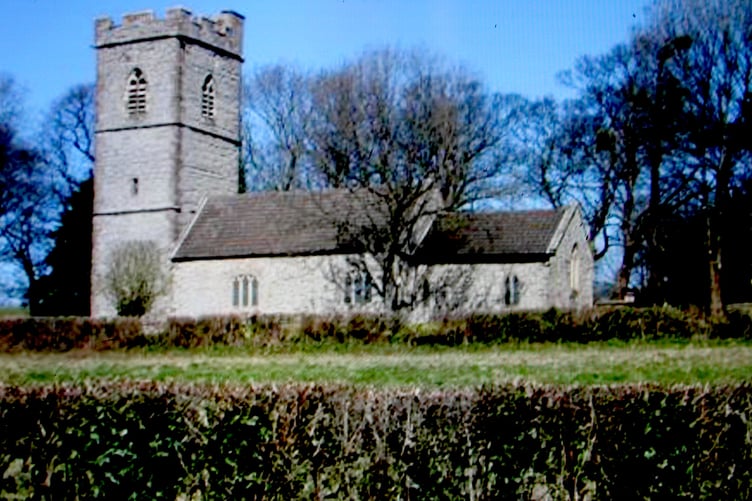
Ifor Hael and his wife Nest, daughter of Rhun ap Grono ap Llewarch, both died of the plague in 1361, when they travelled to the Bishop’s Palace at Bishton in Monmouthshire, to escape the plague which was raging at that time, in Newport and Cardiff. Earthworks near Castle Farm in Bishton mark the site of the palace, which was probably a timber building.
The name Bishton is said to derive from Tresgob (‘Bishop’s Town’) because it was once the site of one of the palaces of the Bishops of Llandaff. When both their palaces situated here and at Llandaff were destroyed by Owain Glyndwr, a new one was built at Mathern and today it is a private house.
Bishton Church is dedicated to St Cadwaladr who was the last of the Celtic kings to claim the title King of Britain, and it is one of the three churches to bear his name. The land on which it stands was given to the Bishop of Llandaff soon after 570 and in due course the original wooden church was rebuilt in stone after the Norman Conquest.
In 1949 a mysterious ornate medieval stone coffin was discovered in Bishton churchyard and it was the work of a skilled craftsman, so the occupant was obviously a person of some importance. Pascal the Bishop of Llandaff had died of the plague here but was interred in Llandaff Cathedral, so the ornate coffin (which was reburied) most likely contained the remains of Ifor Hael. He had died without heirs and his estate fell to his nephew Llewellyn, the son of Morgan ap Llewellyn who possessed Tredegar House.
There is a tradition that Dafydd ap Gwilym was buried within the precinct of Strata Florida Abbey in Ceredigion in a mound beneath a yew tree, and it is significant that in the Middle Ages, this Abbey was regarded as a suitable resting place for important people in the same way as Westminster Abbey. However, it is also claimed that his burial took place in the churchyard of Talley Abbey, 30 miles from Strata Florida. For many centuries, these rival claims have been debated and it is also claimed that he was buried at Christmas in the fortieth year of the reign of Edward III.
Comments
This article has no comments yet. Be the first to leave a comment.