
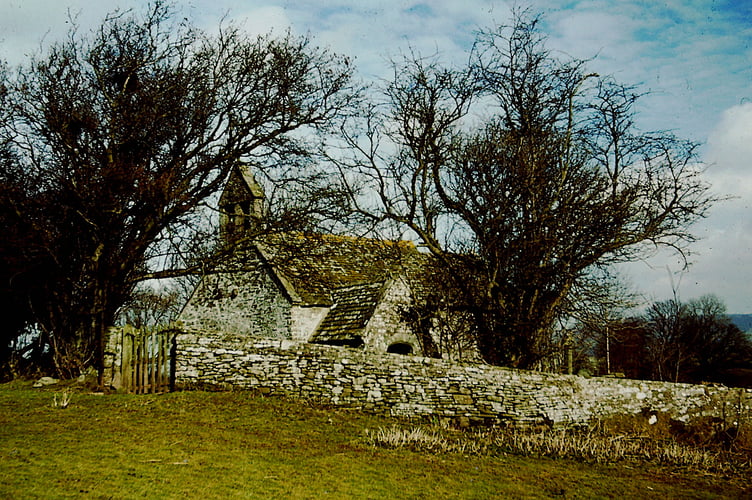
Kilgwrrwg Church is situated seven miles northwest of Chepstow and seven miles south east of Usk and was formerly known as Cilgwrrwg. The word cil means a retreat and such a name suggests that it was the monastic retreat of a hermit called Gwrrwg, who sought peace in this lonely location in the valley called Cwm Cerrig.
It has been described as ‘the most perfect example of an early Christian church site and was most likely founded c.722. There is a mention of it in the Book of Llandaff in around 1125 which states: ‘King Ithael son of Morgan and his sons Ffernwael and Meurig sacrificed to God and to St Dubricius, St Teilo and St Oudoceus and to Bishop Berthgwyn, and all his successors at Llandaff, three unicias of land altogether, in the middle of Cwm-cerruc.
There is officially no parking anywhere nearby and the church can only be reached on foot by crossing two fields and a small bridge spanning a stream. From there it can be seen standing within a walled churchyard on the crown of a grassy knoll.
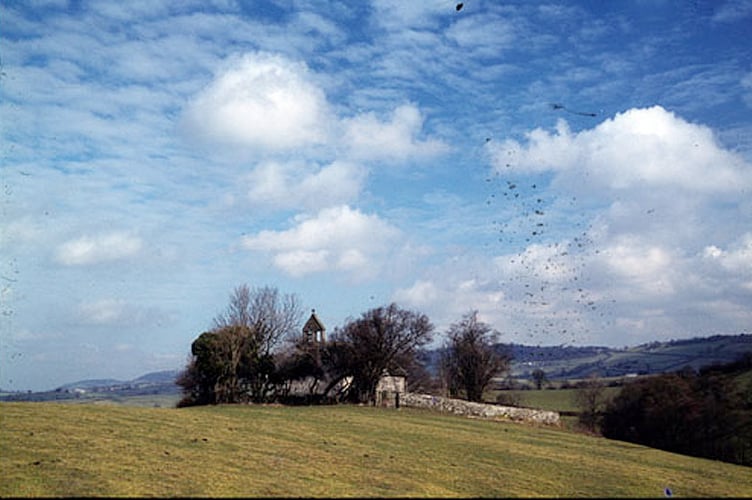
The little church is surrounded by a partly curved churchyard wall and there is a local legend that its location was chosen when a pair of heifers, yoked together, were left to wander. They settled on a low mound, which signified that this spot was divinely ordained for the site of a church.
The nearest building is Great Kilgwrrwg House which was dated by Fox and Raglan to the period c. 1500-1550. It is possible that the rebuilding work at the church is contemporary with the construction of this house and these buildings are the most substantial structures in the parish, and definitely the oldest.
Well into the eighteenth century Kilgwrrwg would have been in the heart of a Welsh speaking area and the field and place names recorded in seventeenth century deeds are almost all in Welsh, but no longer survive.
It has a blocked 13th Century west door, and above it on the exterior is a crudely carved corbel depicting a human face and probably supported the roof-beam of a small porch.

.jpeg?width=209&height=140&crop=209:145,smart&quality=75)
.jpeg?width=209&height=140&crop=209:145,smart&quality=75)

There is a 12th Century south door, two 15th century windows and a memorial east window containing stained glass by R.J. Newbery (c.1920) . It commemorates three men killed in the First World War: Joseph and Fred Bevan (presumably brothers) and Richard Morgan who is buried in the churchyard.
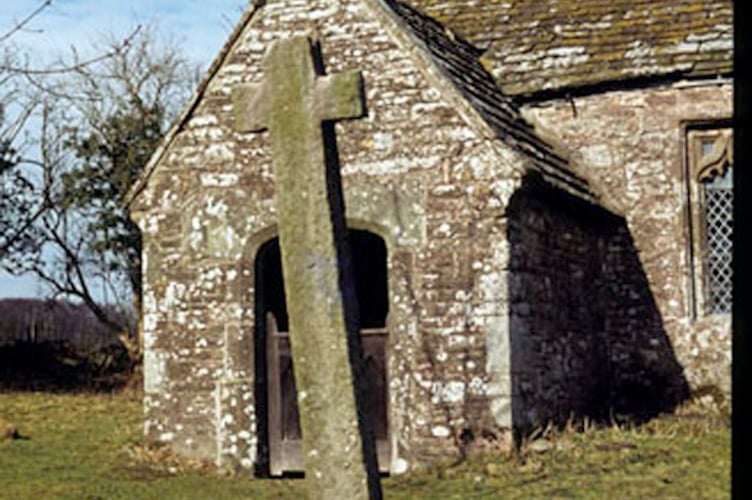
In the churchyard is a plain short-armed stone cross which dates back to pre-Norman times and may even have been erected before the church was built so it is not surprising that Cadw has stated that it is not possible to give it a date. The monolithic shaft of rectangular cross section is set on a small socket and has an integral head, simple in form and carved from local conglomerate stone. Made from a single block of stone it is the only completely intact medieval cross in Monmouthshire.
At the start of the 19th century the roof of the church was no longer weatherproof and the building was even described as little more than ‘a dilapidated sheepfold’, being used as compound for sheep, except for 12 Sundays in the year when there was a service. The accumulated filth of sheep had to be shovelled out the day before.
A restoration took place in 1820 that was instigated and financed by James Davies, the Devauden schoolmaster who generously helped to save this ancient church, and to equip it with furniture, Bible, prayer book and vestments.
In 1871 the church was in a very poor state, so it was restored by John Pritchard, the diocesan architect of Llandaff and he added a porch a bellcote and the north window.
The bell dated 1608 was donated by William Nicholas, whose substantial table-tomb is on the southeast side of the church. It was made by the William Evans foundry of Welsh Street, Chepstow.
The church was then rededicated as the Church of the Holy Cross, Kilgwrrwg by His Grace the Bishop of Monmouth. No earlier dedication has been recorded. Until 1980 this very small parish was held with Wolvesnewton and Devauden, but is now part of a grouping with St Arvans, Itton, Penterry and Devauden.
In 1977 an inspection revealed that one of the main supporting timbers of the nave roof, which was entirely of heavy stone tiles, had failed and was in danger of collapse. It was necessary to close the church to worshippers and visitors. Fund raising was started in order to find a way of saving the roof and the plight of the church was publicised in the press, and on television. His Royal Highness, the Prince of Wales, who had followed the progress of the work with interest sent his congratulations to the people of tis small parish, which had a population of less than forty, on the successful restoration.
In the meantime, the regular Sunday services continued to be held in the homes of the parishioners instead of the church. In good weather some services were held in the churchyard around the ancient cross, and the Harvest Thanksgiving took place in a barn on one of the local farms.
In due course the church was safely returned to use with the ‘rustic’ roof and stone tiling still intact but ten years later in 1989 the roof was fully restored at a cost of £37,000 and because of its situation it must have been quite a problem getting slates to the site.
The organ came from the redundant St Michael’s Llanfihangel Rogiet in 1979 and the wrought iron chandeliers were made at Shirenewton There is no electricity supply to the church so it is still lit by candles, just like the old days.
In the graveyard is a memorial to Richard Morgan, an Able Seaman serving aboard HMS Garland, a destroyer that had seen action at Jutland. He is said to be the last British serviceman to die in the first World War, having died a day before Armistice came into effect in 1918.
Comments
This article has no comments yet. Be the first to leave a comment.