

Khaki clad we lie in wait
Close by the embattled Normandy shore,
Each man conscious of his fate,
To weave a tapestry of war.


In Normandy
Soon the evil roar of a thousand guns
Defiles the summer sky,
As fate decided which of its sons
Will be the next to die.
In Normandy
Brave citizens of France with loyal hearts
Face the hell of conflict loosened from its chain,
As steadfast families play their lonely part,
And suffer death, misery and pain.
In Normandy
No redcoat tale of glory here we tell,
Where every yard of bocage takes its toll,
The thrill of action soon loses all its spell,
And war seals horror in our soul.
In Normandy.
Then fear takes second place to pride,
The tired and mighty armies pause,
Before we all move up for the next assault,
In the noble fight for peace and freedom’s cause.
In Normandy.”
The poem ‘In Normandy’
by David Edwards
1925 - 2020
During a lull in the vicious fighting around Caen, shortly after D-Day, a young Welsh soldier risked climbing out of his foxhole to stretch his legs. He found himself in a bombed orchard and there in the rubble and broken trees was a black and white photo of a house. He put the photo in his pocket and promised himself that one day he would return and find that house.
Dave Edwards from Abergavenny was a soldier in the 2nd Battalion Monmouthshire Regiment which landed on the Mulberry Harbour on Sword Beach shortly after D-Day. After a minor respite waiting for their bren gun carriers to be disembarked onto the harbour they were pitched straight into one of the most vicious actions of World War Two.
If the enemy had been caught unawares on D-Day, 12 days later, when the Welsh arrived, a crack panzer division was waiting for them determined to drive them back into the sea. The fighting was unrelenting and days later the 2nd Mons were in Mondrainville, near the city of Caen where Private Edwards found the photo. He could never have guessed that this simple act would forge a friendship with the town, residents and eventually leading to a school being named after him and his mate Tom Griffiths, also from Abergavenny.
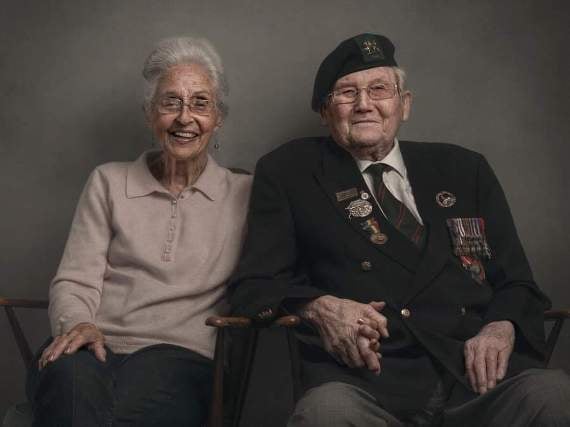
Mr Edwards, 95, has died after a short illness. He leaves his wife of 70 years, Diane, and sons Michael and Christopher and numerous grandchildren and great grandchildren. A service will be held at St Mary’s Church Abergavenny, followed by cremation at Croesyceiliog on December 2nd.
In 1986 Mr Edwards and fellow veterans Tom Griffiths and Ted Chapman VC, returned to the D-Day beaches on one of many reunions. In his pocket Mr Edwards had the photo and was determined to find the house they had seen 42 years before. The bombed ruins all around were unrecognisable all those years later, and they were about to give up when they were stopped by a family eating in their garden. The family saw their medals and recognised them as veterans and were pleased to offer welcome refreshment.
"I got my photograph out of my pocket and said we’re looking for this house," Mr Edwards said. "The man, Mr Le Goffe looked at it and I could see he was puzzled and then he showed it to his mother and his mother got excited.
"She said to my pal, who could speak French, “it’s my house and if he wants he can reach out and touch it’.
"And I could," he said.
They had found the house.
"It was a beautiful story and the beginning of the relations between Mondrainville and Abergavenny and also the beginning of the story between our schools," Mr Edwards said.
He and his late friends arranged exchange visits between primary schools in Wales and Normandy with help from the Le Goffe family. The project was such a success, a school was named L’ecole Edwards Griffiths in honour of the two men.
The school still maintains links with Llanyrafon Primary in Torfaen, where Mr Edwards used to give talks to the pupils.
“I think it’s wonderful that the children of Abergavenny and Mondraiville are mingling together and learning to respect and appreciate one another’s cultures. This was not always the case, and it is important that they are also learning about the war and the sacrifices people made to make this possible.”
“It is such an honour for me and Mr Griffiths to have a school named after us. We were just two privates doing our duty amongst thousands of other brave soldiers who should never be forgotten.”
On a subsequent trip back to France, on the 75th anniversary of D-Day, Mr Edwards, was presented with the Chevalier Legion d’Honneur (Knight of the Legion of Honour) medal - France’s highest order of merit - at the school which bears his name in the Normandy village of Mondrainville.
David Edwards was born in Abergavenny Cottage Hospital in 1925 and at 18 joined Monmouthshire Constabulary as a Police Cadet. He enlisted in the 2nd Battalion, Monmouthshire Regiment, a Territorial battalion, which even then was training for the eventual invasion of Europe. Shortly after D-Day they boarded a Liberty Ship in Portsmouth bound for Sword Beach where they clambered aboard pitching landing craft for the short journey to the Mulberry Harbour moored on the beach. After reuniting with their bren carriers, the 2nd Mons, part of 53rd (Welsh) Division moved up to relieve the 51st Highland Division which had been badly mauled trying to dislodge a crack German panzer division from the strategically crucial Hill 112 just outside Caen and the only high ground for miles around.
During the fierce fighting, Mr Edwards was shot in both legs by a sniper as he ran across open ground to deliver a message to his company commander. He was evacuated back to Britain and after five weeks convalescence considered himself lucky to be posted back to the 2nd Mons and his mates, now still fighting across France and into Holland.
The 53rd (Welsh) Division liberated s’Hertogenbosch in Holland and then fought through the freezing cold forests of the Ardennes before crossing the Rhine into Germany, fighting all the way until the war ended. Private Edwards soldiered on as around him, friends were lost in the fierce fighting.
As the war finally came to a close, the 2nd Mons found themselves protecting German civilians from the approaching Russian army, intent on revenge.
As the war in Europe finished, the Monmouthshire Territorials were warned off for embarkation to invade Japan, until news came the Japanese had surrendered after two atom bombs had dropped.
“We couldn’t understand it,” said Mr Edwards, “we had watched Caen being pounded by bombers day and night yet two bombs were enough for the Japanese. Little did we know.”
With tensions simmering in the former Yugoslavia the battalion was moved to Pola, then in Italy, to a midget submarine base on the Adriatic. Mr Edwards and his mates found themselves guarding a huge ammunition dump on an island, with the help of German Prisoners of War. “I had a sten gun and my German POW had a pick axe handle,” recalled Mr Edwards. “It was quite boring really, until one day we came off duty and I was taking my boots off when the whole island blew up. Years later we were back there on holiday and the Yugoslav guide tried to tell us that it was the Italians who had done it. I said no,no, it was Yugoslavs. I was here when it happened.”
It was towards the end of 1946 before David Edwards arrived back at Abergavenny Station and the walk home. He rejoined the police and was posted to Chepstow where he met and married Diane.
He had seen Diane in the High Street but was too nervous to strike up a conversation. Then one day, in uniform, he saw her pedalling her bike down the street and forced himself to stand out in front of her with his arm up. Unfortunately the bike’s brakes were worn away and Diane had to resort to skidding her feet on the ground to stop before crashing into this policeman.
Following this inauspicious start the couple were married for over 70 years.
Mr Edwards served in the newly formed police dog section, then traffic before retiring as a Sergeant Instructor at the Fairwater Headquarters. He worked for Sir Godfrey Llewelyn before taking on security with a builders merchant before retiring completely.
In his retirement he developed his skills as an artist painting local scenes, particularly Llanfoist and Crickhowell bridges.
Many years after the war, David Edwards remained convinced that in volunteering he was doing the right thing. “We were fighting an injustice that should never have happened. But it was also futile and obscene. I was lucky to get through it, but the coin could just as easily landed a different way.
“But it did teach me that the word free is a misnomer, Freedom isn’t free, it costs, and sadly we still seem incapable of understanding that.”
This article was written by Douglas Mcarthur
Comments
This article has no comments yet. Be the first to leave a comment.