
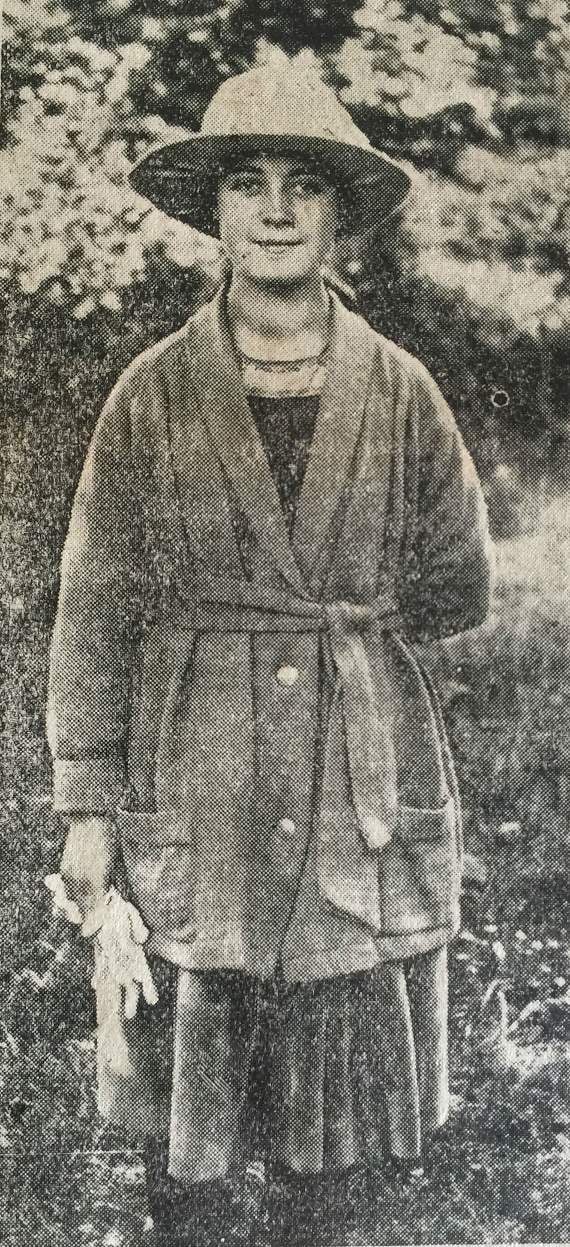
In the summer of 1920 murder, most foul visited the sleepy Monmouthshire village of Llanvetherine when a well-to-do widow met a terrible and unforgiving end at the hands of what everyone initially thought, given the extent of the poor lady’s injuries, was some callous and ferocious madman.
As the case unfolded it transpired that the bloodthirsty culprit was something of a devil in disguise and the very last person anyone would have initially suspected capable of such a hideous crime.
The true identity of the villain in this piece was a blow to the sensibilities and moral certainties of, not just those in Monmouthshire, but to people farther afield, as the case in all its lurid detail made national headlines.
Let’s now rewind the clock and watch events unfold as they happened nearly 100 years ago.




It was a fine Friday morning in June. The birds were singing, the sky was blue and the warm southern breeze air carried a promise of a better future for the world and everyone in it. A world which was slowly recovering from the carnage and suffering of the First World War which had ended but two years previously.
Yet in a picturesque cottage in Llanvetherine there lay a sight which would not have been dissimilar to those which haunted the ravaged souls who returned from the killing fields of France. For in that nondescript abode lay the battered and brutalized body of 53-year-old Sarah Anne White. The poor woman’s blood was splattered all over the floors and walls of the bedroom where she lay, and her skull had been shattered from repeated blows to the head.
Police Sergeant Hatherall was the first official on the scene. The officer would later describe the sight which greeted him as “sickening” as he grimly noted the bits of skull and brain on the floor.
It was thought that Mrs White had been attacked in the early hours of the morning. Judging from the disarray of the room there appeared to have been a violent struggle before she was stunned into submission.
By the side of Mrs. White’s bed there lay what was thought to have been the murder weapon - a mallet.
The mallet, which was of the type used for driving in stakes, was covered in blood and hair.
When Sergeant Hatherall’s superior officers visited the crime scene they thought it was advisable to call in the assistance of Scotland Yard. A telephone call was made to London and Chief Inspector Helden and Sergeant Soden arrived at Llavetherine early on Saturday morning.
Mrs. White’s body was initially discovered by her 15-year-old niece, Primrose Katherine Alice Whistance. Primrose was known to everyone as Katie and had lived with her aunt at Rose Cottage for four-and-a-half years.
Apart from the companionship of her niece, Mrs. White had lived alone since the death of her husband 16 years previously. She was well respected and liked by everyone in the village as a reserved but kindly soul. She was said to have always dressed smartly and was always very particular about her attire.
During her interview with the Police, Katie, who the Chronicle described as “an attractive and intelligent looking girl,” explained she had been living with her aunt for four years though she helped during the day at Trerhiw Farm, the residence of her uncle a few 100 yards away.
Katie explained that during the day of the murder, “Auntie seemed very strange and gave me a ring as a keepsake. I went for a cycle ride in the afternoon and when I came back she said - pointing to a box which she had put my best clothes ‘You had better take that up to your mother tomorrow morning as I cannot keep you any longer.’ I did not say anything and went to bed about 9.30pm. I always slept with auntie but on Thursday she did not seem if she could sleep. She kept twisting and turning and I could not go to sleep.
“At last when it was after midnight I asked her if she had been to sleep and she replied, ‘Never you mind. Go to sleep yourself!’ She still kept twisting and turning and I could not get to sleep. At 3.30am when it was still dark she said to me ‘You had better get up now and be off before many people are about.’
“I dressed and went downstairs but before I left the bedroom auntie said to me, ‘leave the front door unlocked and don’t be more than an hour and a half. I am expecting someone. If there is anything wrong when you get back go for the sergeant at once. I am going to get up now.’”
Kate informed the police she had no idea of the identity of the guest her aunty was expecting but left the house about 5am leaving the front door unlocked.
When she returned later that morning Katie said at first glance everything appeared normal except she ‘could not find auntie anywhere.’
Katie explained, “I called out ‘Auntie! Auntie!’ and then as there was no reply and everything seemed so quiet I went for the sergeant. He came back with me and told me to stay outside while he went upstairs. He came down almost immediately and told me that auntie had been murdered.”
The following Monday, officers from Scotland Yard arrested Katie at her mother’s home at approximately 8.30pm and charged her with the murder of her aunt.
The very next day the young girl was brought before the Magistrates.
The Chronicle reported, “The mother of the accused arrived carrying in her arm an infant baby while her little son aged six trotted by her side. Their dress and appearance bore the stamp of penury and they were a pathetic trio.”
Considering the crime with which she was charged Katie was remarkably self-composed. A newspaper report states, “As one gazed at this attractive and intelligent-looking girl of refined and gentle appearance attired in a smart fawn dress one felt amazed that she was regarded as the central figure in such a brutal crime. She cast her eyes on the ground and continually fidgeted nervously with her hands and occasionally bit her lip, as though to repress her feelings but otherwise she did not show any outward sign or emotion until Inspector Helden of New Scotland Yard gave his statement and she broke down in tears.
Chief Inspector Helden told the court he arrested the prisoner at her mother’s home on Saturday, June 12 for the murder of her aunt.
Upon her arrest Kate said, “I did not do it. What makes you think I did?” She was later taken to the police station and made a statement which Inspector Helden said he would present as evidence to the court at a later date.
The prisoner was remanded until June 28.
The next day was the funeral of Mrs. White. Katie’s mother explained that before her arrest her daughter was talking about going to the funeral.
“I said ‘One of us must go’ and she replied, ‘I should like to go.’ I said to Katie the other day, ‘Who is going to look after the graves now that your auntie has gone?’ And she said, ‘I will do that if no one else will, as I always helped auntie to do it.’”
The Chief Constable told the Chronicle that no further arrests were likely and the full story would be disclosed at the adjourned inquest in June.
During this period Katie maintained her innocence and repeatedly claimed, “I did not do it.”
During her next court appearance the Chronicle noted that Katie was, “Smartly dressed and wore a fawn macintosh and a blue straw hat trimmed with light brown ribbon. There were no tears in her eyes and she had not been the appearance of one who had been crying or who was on the point of bursting into tears. Indeed she was remarkably composed and self-possessed.”
Katie’s guilt appeared beyond doubt when the court finally heard the confession the accused had made to officers on the night of her arrest.
Chief Inspector Helden told the court that after Katie signed the confession she was given a glass of hot milk which she drank and after a few moments said, “I feel better now. I have not had much sleep lately. I was going to tell my mother about it when it was all over.” She then said she felt tired and fell into a deep sleep.
Katie’s statement read, “Now I am here I may as well tell you the truth about it. I did murder my auntie. On Thursday the 10th of June my aunt grumbled at me for being out late about a month ago and told me I should have to go. She then packed my box and told me I could take it in the morning. We had supper together and went to bed about half-past nine. Auntie went to sleep and I also went to sleep. I woke up sometime in the night. I went downstairs to the back kitchen and got the mallet. Auntie had told me to bring it in on Thursday evening from the stable. I went upstairs and hit auntie with it and she fell out of bed. I hit her again on the floor. I then got my box and my bicycle and went to my mother’s. I worried about my auntie turning me out and knew I would lose a good home.”
Chief Inspector Helden added that shortly after he arrested Katie she fainted and when she came to she was crying for about 25 minutes before asking him, “What can they do to me for this?” To which he replied, “That is not for me to say.”
It was for the jury of 12 men and women who would sit in judgment on Katie at the Monmouthshire Azzises on November.
Interestingly enough, On July 9, the police at Scotland Yard received an anonymous letter alongside a photograph of a young man which stated, he, not Katie murdered Sarah Ann White.
The letter was simply signed ‘Cox’ and it was posted on July 8 from somewhere in South London.
The back of the photograph was stamped ‘Up to Date Studios 189 Southwark Park’. Police contacted the studio and discovered the man in the photo had visited the studio three weeks previously and given the name Mr. Smith and an address in Bermondsey.
The address was a Salvation Army house, and they confirmed that the man in the photo was a laborer called James Fox who had lived at the home from April 21 to June 21, 1920.
A check of the records confirmed that Fox had been registered as sleeping on the premises during the dates of the murder. Fox denied writing the ‘confession’ letter and a sample of his handwriting did not match with the hand that had penned the letter.
Fox admitted the photograph was of himself but said it was one of many he purchased from ‘Up To Date’ studios, and which he generously distributed amongst chosen lady friends at the Salvation Army Hotel. Police decided not to pursue this line of inquiry any further.
On the day of her trial, Katie traveled from Cardiff jail to Monmouth’s Shire Hall. A large crowd gathered to catch a glimpse of her and her appearance was noted as being, “Even more robust than before she was committed. Her appearance bears ample testimony to the fact that she has been well looked after and the prison environment has not prejudicially affected her health.”
She appeared at the Monmouth Assizes before Mr. Justice Lush and sat through the long nine-hour proceedings quite stoically without showing any emotion or seeming to realize the gravity of her situation.
The Chronicle reports, “Several times she dropped her eyelids and seemed in a half-doze. Twice she was highly amused at incidents in the proceedings. The first incident when her mother was in the witness box and giving evidence with a baby in her arms. Katie’s smiling face was in mark contrast to her mother’s phlegmatic countenance. And the second time she smiled was when the prosecuting counsel remarked that girls at the critical ages of 15 and 16 were sometimes unable to resist sudden impulses.”
In their opening speech, Katie’s defence made the remarkable plea that it would be better for the girl to be found guilty than guilty and insane because if the jury returned the latter verdict she would be detained in a criminal lunatic asylum.
Katie pleaded not guilty but the jury disagreed and after a retirement of 25 minutes the jury returned a verdict of ‘guilty.’ The foreman said he hoped the girl would be dealt with as leniently as possible on account of her tender age and the environment in which she had been brought up.
Addressing the prisoner, the Judge said, “If the evidence was not clear as to lead to no other conclusion one would have wondered if it was possible for a girl of your years to have committed such a terrible crime against one who treated you with every kindness. I hope you have asked and will receive forgiveness.
“I have now this duty to perform. I record no sentence. I pass no sentence. I only order you to be detained during His Majesty’s pleasure.”
The accused was taken down to begin a new life governed by cold iron bars, unforgiving discipline, and the monotony of despair.
And so ends what local folklore has come to regard as the tragic tale of the ‘lonely cottage murder.’
Comments
This article has no comments yet. Be the first to leave a comment.