
I AM often asked why “Red Square” is so named when it should be known as High Cross as the original main street was at two different levels and connected by steps, High Cross and Lower Cross.
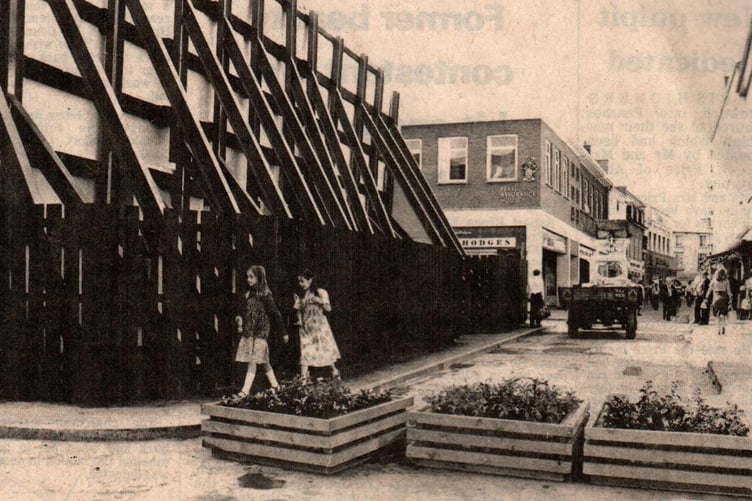
One Monday morning in July 1977 Council officials called on the occupants of 25, 25A and 28 High Street and asked them to leave immediately as the buildings were in danger of collapse.
The premises were then shored up with a maze of scaffolding that completely blocked the main street while Monmouth District Council made up its mind on what to do next.
It was later learned that the Council already had a plan that involved putting up a four-storey building which would overhang the pavement to provide flats or offices on the upper floors and arcaded kiosks on the ground floor.
However, this plan was subsequently withdrawn as it had been rejected by the ‘county development control joint advisory committee.’
Local businesses were unhappy with the delays and the continued closure of the main street. An action committee was set up under the leadership of the town Mayor, Councillor Leslie Biggs, and some 2000 people signed a petition supporting the Chamber of Trade who were leading the fight.
The Town Council and the Civic Society were in agreement and called for immediate demolition with the site being left as an open space.


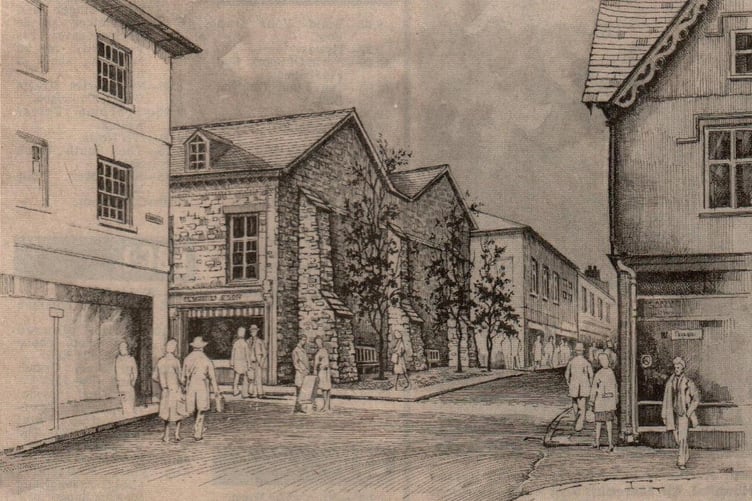
By the end of the year new proposals were put forward to demolish the buildings known as 25, 25a and 26 High Street, (and that part of the dividing wall between these properties and No. 1 Flannel Street and No. 1 St. John’s Street, said to be dangerous,) and to construct a new party wall and a block of residential flats above retail units on the ground floor.
Mr. Hugh Williamson, the project architect, said, “We want the fullest public participation in the development of this important site.”
The town Chamber of Trade had slammed the proposals. Their chairman, Mr. Owen Richards, said that he had been told the Civic Society were also against the plan. Mr. John Sullivan suggested that a forum of all the town’s interested organisations should get together in a bid to thrash out a new design acceptable to the majority of the townspeople.
The plan put forward by the Chamber of Trade rejected the Council’s proposals for retail outlets and offered an open plan area with seats and trees on the street side of a new buttress wall.
The Civic Society were also in favour of this and together they were going to press the Council to agree.
Chamber president, Mr. John Sullivan, “Felt the scheme would be more in-keeping with the surrounding buildings, enlarge the town square feature, provide a focal point for the town and a welcome resting place for shoppers and pensioners.”
The Chronicle of the 21st of September 1978 reported that the Chamber of Trade had produced a 5,787-signature petition calling for the Secretary of State for Wales to hold a public enquiry into Monmouth District Council’s plans for the site and to consider alternatives.
It went on to say that: “It deplores the state of the town centre and in particular that scaffolding is still obstructing the High Street 14 months after it was first erected.”
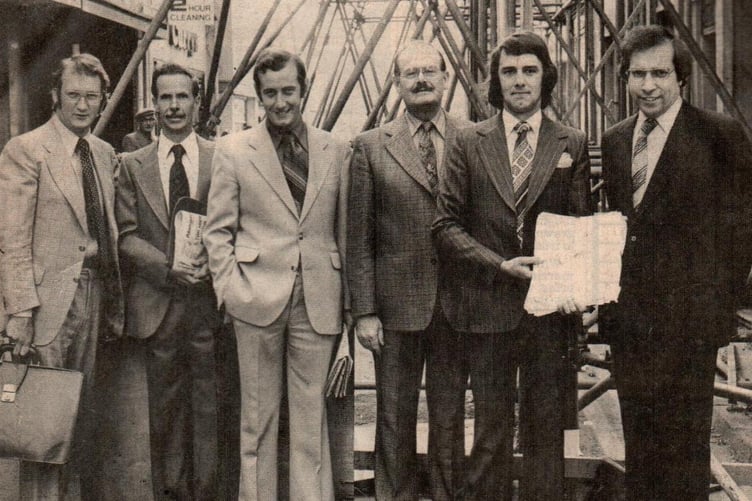
The following week the delegation, led by John Sullivan, met with the Under Secretary of State at the Welsh Office in Cardiff and handed over the petition and other supporting documents.
The Under Secretary, Mr. Alec James, said he would give the matter serious consideration and would report back if he thought it desirable to ask the Secretary of State to intervene.
At the same time the Council were arranging for an open meeting to be held in Chepstow to discuss the High Street dilemma. John Sullivan had gone around the town putting up posters that advertised the meeting with a view of getting as many townspeople as possible to attend.
The Council thought that the wording on the posters was more evocative than necessary and decided to take Mr. Sullivan to court for fly-posting.
They had already asked Mr. Sullivan to remove them but he had refused to do so. Three weeks later the Chronicle published a letter from John Sullivan that read: “I am rather concerned by a report I read in the Chronicle about a fortnight ago that I was being summonsed by Monmouth District Council for alleged fly-posting in connection with advertising the now famous ‘Public Meeting’ which was organised by Abergavenny Town Council. A meeting, by the way, that was so overwhelmingly opposed to the MDC plans for High Street buildings, it is impossible to believe that any truly representative council could ignore the wishes of their electorate. I am, however, somewhat at a loss to understand how I can be summonsed for this crime without receiving any such notice from MDC. Since your report I have not heard a word from the Council, and I find it very distressing not knowing if I am to be branded as a criminal or not.”
At the meeting in Chepstow the Council decided to accept the fifth revised scheme for the High Street.
John Sullivan commented, “That the decision was taken in spite of two petitions and the unfavourable opinion of a public meeting and he was totally dismayed at the outcome. This can result in nothing but bitterness in the future so there is obviously no point in any future discussions. We shall be putting our heads together and deciding on a more militant course of action!”
John Sullivan then wrote a letter to the Chronicle on the 19th of October and said: “I have never been more dismayed by what is supposedly called a democratic society than I was at the special meeting of Monmouth District Council last Thursday. What does it take to encourage those who are in power to be democratic and not dictatorial? After nearly 18 months and four plans in the waste paper bin, with a fifth about to join them, one would think that this Council would have got the message and come to terms with the people it serves. It is regrettable that what will follow the MDC decision is likely to be more militant, ugly and bitter. But it is imperative that the wishes of the people of Abergavenny are upheld.”
The situation in the main street was made worse in January when the Burgess building, where Boots the Chemist now stands, caught fire and the whole structure became unsafe and so was screened off by a hoarding that extended into part of Flannel Street. This resulted in a narrow gap between the hoarding and the scaffolding.
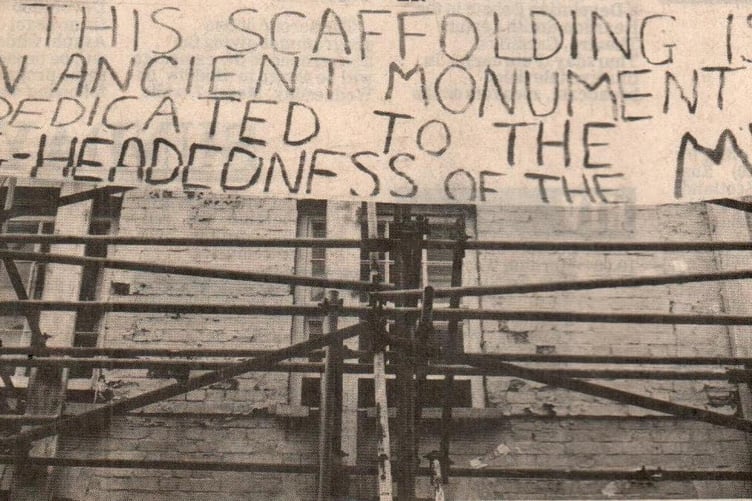
The following month, February 1979, saw a banner spread across the scaffolding about 30 feet above the street that read: “This scaffolding is an ancient monument dedicated to the pig-headedness of the MDC.” Needless to say, the Council made a complaint to the police and an unknown person was questioned. (John Sullivan was later summoned to the Magistrates court in May but received an absolute discharge on all counts but was required to pay some costs.)
This publicity had come at the right time for those taking part in the mass protest at the next full MDC meeting to be held in Abergavenny on the 6th of February.
Although the High Street was not on the Council’s agenda, the demonstration was going to take place outside the Town Hall to greet the Councillors as they arrived. Support for the action was forthcoming from a wide variety of organisations from the WI to the NFU and it was hoped that many individuals would also turn up. Whilst it would be a peaceful and orderly protest it was meant to leave the Council in no doubt that the town was opposed to its plans.
The Council were also taking the opportunity of considering making the High Street traffic-free as the road had already been closed for over 18 months.
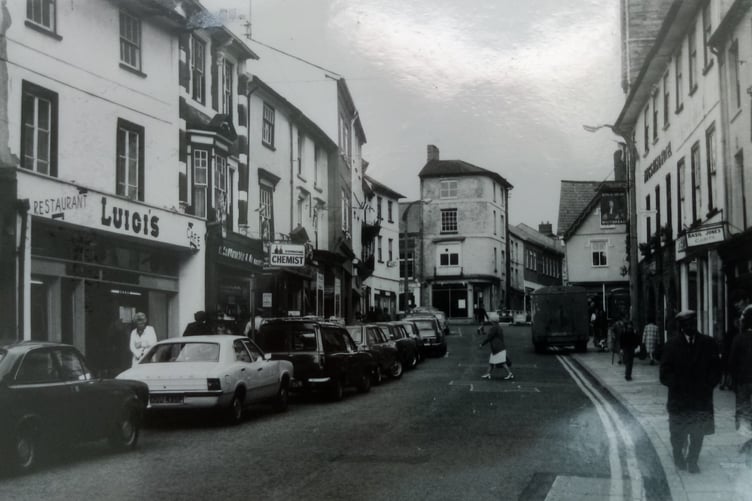
John Sullivan felt that the prolonged closure of the High Street had already had a detrimental effect on trade, and John Wilson of the Civic Society said he would like to see the town open for access.
Councillor Stanley Clark said he had conducted a “poll” walking through town and he had received a 100% response to have traffic free streets.
Work began to demolish the buildings in May 1979 and this created a barrage of criticism from townspeople as to the length of time being taken by Collingbourne Contractors.
Mr. Collingbourne made a statement to the local press that said: “In the 10 years of demolition work this job has proved to be the most difficult we have ever undertaken. The safety of pedestrians, my workforce and people working in adjoining properties had to be considered and we required specialist equipment, which all caused inevitable delays. The conditions have been cramped and made worse by the contractors working on the damaged Burgess building next door."
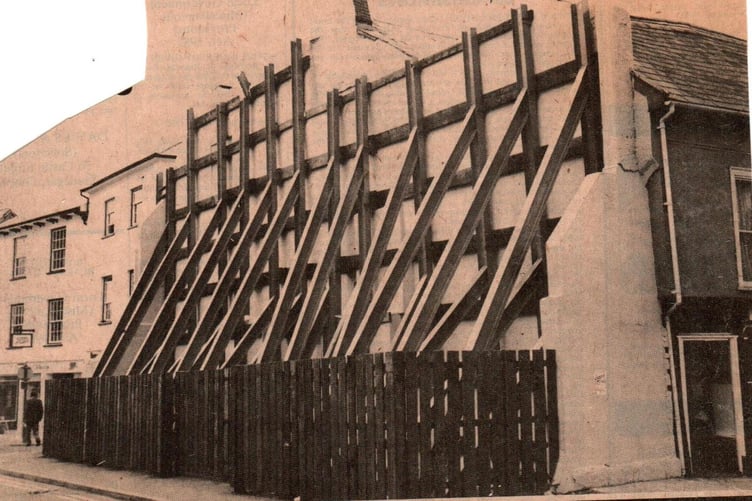
Alongside the demolition the contractor had to shore up the rest of the remaining buildings with a large quantity of steel girders. Red paint was used on these girders and this is how “Red Square” got its name.
The Civic Society complained to the Council about the colour of the girders and Councillor Doug Edwards wrote a letter to the Chronicle in response. He explained: “That the site is bounded on three sides by busy thoroughfares with different ironwork at different heights. The predominant colours in the area are a light buff/sandstone and the character of the ‘area’ is one of movement and vitality, and it is considered that any scheme on this site should express this vibrance. The shoring is a very clear, bold expression of structure and any scheme regarding the shoring should reflect or express its character. It is not therefore desirable to apply ‘make-up’ to the shoring in a vain attempt to disguise it.”
The High Street was still closed to traffic and three attractively filled flower boxes were installed across the road. Opinions were still divided about the permanent closure of the street but it seemed that most people would be happy if vehicle access was limited to deliveries only.
The Abergavenny Chronicle dated the 4th of October 1979 stated that traffic was now flowing through the High Street for the first time in over two years. The work on the old Burgess building was almost complete. There was still divided opinion on the road opening and so it was to be for a six-month trial.
A further change came about in the local elections in May when Abergavenny’s representation on Monmouth District Council was completely changed with none of the five retiring candidates being returned but all five Independents, who fought the campaign on the High Street issue, won seats on the Council.
The Abergavenny Ratepayers Association now got involved by planning to hold a competition to encourage young architects to submit designs for “Red Square.”
The Chamber of Trade commissioned an architect to come up with three different schemes that reflected what could be done with the approximate £60,000 budget that the Council was prepared to spend although two of the schemes were more likely to cost around £75,000.
But the Council at last agreed to an open space but by the time the new supporting structure for Flannel St. and St. John’s St. had been built, half the planned open space had been used up.
The new windows created have been leased to the local Tourist Association who have provided an attractive display of interest to residents and visitors alike and was being accepted as an appropriate development.
A similar tribute was paid by newly elected Councillor John Sullivan, who was one of those who led the fight for an open space, and he said: “Despite the anger, confusion, division and intense feeling it originally generated, it has been a saga that has perhaps done more than any other episode in living memory to create a deep sense of community interest and pride in the town. Public participation, as far as Abergavenny was concerned, was going to mean something….and there would be a better spirit of understanding and cooperation between authority and people.”
July the 4th 1982 took on a new ‘Independents Day’ as this was deemed to be the end of the five-year saga and it was celebrated by the original protagonists with a champagne toast in front of the new Tourist Board windows.
Leading the celebration was Councillor John Sullivan and the other four newly elected Independent Councillors. Councillor John Wilson congratulated Monmouth District Council and the project architect, Mr. Hugh Williamson, on an attractive town centre feature. Councillor Bill King did say that there was one problem as people had taken to sitting on the low wall between the pillars and damaging the flower beds which were a feature of the scheme. But he said that local organisations had already offered to provide seats alongside the wall.
A blue plaque has been put up by the Abergavenny Local History Society to remind people that the real name is “High Cross.”
The final word has to go to the Reader’s Digest who edited the AA Book of British Towns. In the entry on Abergavenny, there is a photo of the original buildings, taken from the tower of the Town Hall, and this remained unchanged in the 1982 revised edition of the book despite the publishers making local enquiries to ascertain any changes that had occurred since the last edition.
Comments
We've recently changed our login process. If you have an account for commenting, you will need to re-register on the login window.
This article has no comments yet. Be the first to leave a comment.