
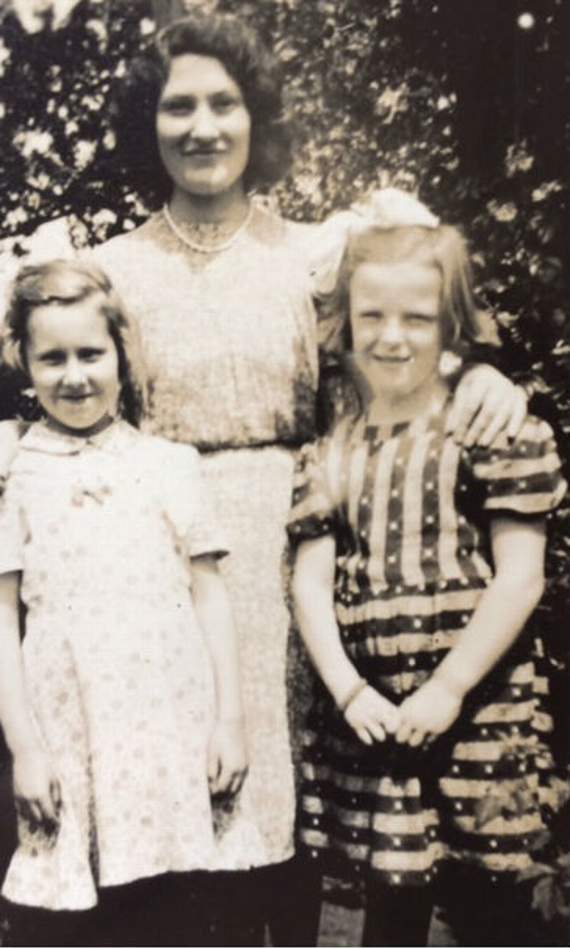
Annie van Krimpen-de Rijke was born and bred in Rotterdam but in the Spring of 1946 the eight-year-old girl was packed off without family or friends to a little corner of the UK that was both unfamiliar and strange to her - Abergavenny. Chronicle reporter TIM BUTTERS finds out how a stranger in a strange land who couldn’t initially speak a word of English fell in love with a little town in Wales she had never heard of and one which gave her sanctuary from the horrors of the Second World War.
IN the aftermath of the Second World War the world was still a chaotic cauldron of trouble and turmoil. Hitler and the Nazis had finally been laid to waste but their legacy of destruction and despair lingered on like a slow rot.
In the Netherlands, for example, thousands were still feeling the ill-effects of the Dutch famine caused by the German blockade of 1944-45.
In September 1944, Dutch railway workers went on strike. They hoped their action would prevent the movement of Nazi troops and aid the Allied advance. However, the Allied campaign failed and in retribution, the Nazis blocked food supplies to the Netherlands which caused widespread famine.
Crazed with hunger, many people resorted to eating tulip bulbs and sugar beets. Over 20,000 people had died of starvation prior to the Allied liberation of May 1945.
When the Royal Air Force dropped over 6,6000 tons of food the Dutch wrote ‘Many Thanks” in fields full of Tulips.
Although the famine ended with liberation it was decided that the tens of thousands of malnourished Dutch children should be evacuated to countries overseas such as Sweden, Denmark, and the United Kingdom to continue their recovery.
Suffering from malnutrition, eight-year-old Annie van Krimpen-de Rijke was sent from Rotterdam to Wales seeking sanctuary and sustenance to feed the all-consuming hunger which had been part of her life for far too long.
Accompanied by other children and their teacher escorts in a ferry, Annie’s first port of call was Harwich. From there she was taken to a children’s camp at Woodlands near Doncaster. The children spent six weeks here before traveling to Newport to meet her new foster parents.
At the train station, she met Stan and Nancy Williams from Abergavenny’s Trinity Street. Alongside another Dutch girl named Madzi, Annie would spend her Summer with the Williams in a town where everyone spoke a language that was completely foreign to there ears.
Recalling her first impressions of Abergavenny, Annie explained, “Because of the famine the Netherlands was full of empty shops. In Abergavenny, there were shop windows full of all kinds of things.
“Also in Abergavenny, I saw and ate food I had never seen before. For an eight-year-old child, this was overwhelming.”
During this time Annie and Madzi also attended Victoria Street school. Their teacher was a Miss Roberts who had a lot of understanding and patience with the two little Dutch girls who could not speak a word of English.
Annie told the Chronicle, “When I arrived in Abergavenny I did not speak English, but the teacher, Miss Roberts, drew pictures and wrote down the English words. That is how I learned English. I still have the bible they gave me when I returned to the Netherlands.
“The people in Abergavenny were very kind. For me, it was a great experience which made a deep impression.”
During her time here Annie grew very fond of her foster parents and in 1955 when she was old enough to travel alone a 17-year-old Annie caught a ferry to Dover a coach to London a train to Newport and onwards to Abergavenny.
Annie explained, “It felt like coming home. I stayed with Mr. and Mrs. Williams again and spent a lot of time with Mr. and Mrs. Batten in Victoria Street who became very dear friends to me.”
Between then and now, Annie has returned to Abergavenny on numerous occasions to meet the many good friends she has made in the town. Bringing her husband Wim and their two children alone to experience the town which made such an impression upon her.
Annie said, “I frequently returned to Abergavenny to meet up with my good friends. Not only Mr. and Mrs. Williams and Mr. and Mrs. Batten but also Mr. and Mrs. Walkley from Stanhope Street. A Dutch girl who I met in 1955 stayed with them in 1946.
“Although Mr. and Mrs. Williams and Mr. and Mrs. Batten have passed away, I still have a few good friends in Abergavenny.”
Out of terrible situations, something good can often be salvaged. In Annie’s case, the Dutch famine led to her arrival in Abergavenny. A town which would change her life in more ways than one.
Annie explained, “My stay at Abergavenny had a great influence on my life because I eventually became a teacher of English in the Netherlands. That would never have happened if not for my initial stay in Abergavenny and the kindness and patience of the people who live there.”
Comments
This article has no comments yet. Be the first to leave a comment.