
IN the face of adversity, the necessary strength and spirit to overcome the odds can be found in the most unlikeliest of places.
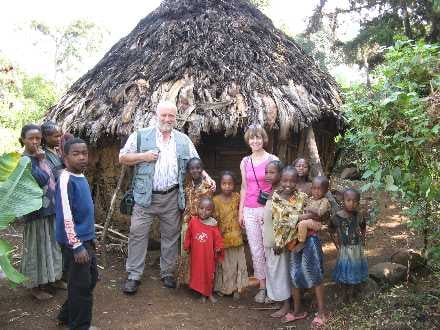
When Nevill Hall hematologist Peter Smith was diagnosed with cancer two years ago, he found his amongst the humility, humour and humanity of the Ethiopian people who he has worked with as a charity worker for the Southern Ethiopia Gwent Health Link since the turn of the century.
Although very reluctant during our time together to discuss his illness, preferring instead to concentrate on the bigger picture that the charity he works for is involved with, the story of one man putting aside his own life-threatening illness to strive in the cause of helping others, lies at the very essence of the Gwent Health Link.
It is also one of the many reasons why the charity recently received an award from the Welsh Assembly at the Royal National Eisteddfod for its excellent work and inspired contribution towards community partnerships between Wales and Ethiopia.

Ethiopia has a population of 77 million with an average life expectancy of around 50 years of age. One in 27 women will die from pregnancy related complications, and one in seven children die before the age of five years.
In the whole of Ethiopia there are only 2,000 doctors and 143 hospitals, far too few to deal with the immensity of the problem.
Non-doctor health professionals, including health officers and nurses/midwives, are the front-line medical staff at resource-poor health centres. They are responsible for the care of large populations with very limited training and equipment.
The link supports this group of health workers through partnerships with health centres and rural hospitals. The link provides skill training as well as the provision of essential equipment and training materials.
Peter's involvement with the charity began some time ago.
"I was working at Nevill Hall and heard a rumour flying around that there was a group of people from the hospital planning to visit Ethiopia to see how they could help improve things."
Having already had plenty of experience of traveling and living for a time in the Middle East, Peter felt the need to "try and make some sort of difference" with the skills he had acquired during his career, and got in touch with Nevill Hall hospital consultant surgeon Biku Ghosh to offer his services.
Peter told me, "Biku had already been over on his own to Dilla, and was well aware of the work out there that needed to be done.
"Biku's contact over there was a surgeon called Dr Aberra, a man who very much like Biku could easily have gone private and made a fortune, but instead dedicated his time and resources to helping others."
Alongside Biku, Peter joined microbiologist Dave Williams, and two others in what would become his first experience of Ethiopia.
"Despite the obvious poverty and hardships of the country, you cannot help but be overwhelmed by the sights and sounds that ambush you when you first arrive in the place.
"It was a real eye-opener for me. The roads we travelled on were not what we know as roads, and they were mainly being used by people on foot with no shoes, or by those lucky enough to have a horse and cart.
"Yet surrounding all this was the most breathtaking natural environment imaginable. It was like traveling back in time to a land completely untouched by technology and the modern world.
"And the welcome we given by the locals, whose manners and conduct, I must say, were second to none, was just unbelievable."
The link's continuing medical education programme incorporates emergency skills workshops and hospital attachments, and is the first of its kind for non-doctor health workers in Africa.
It provides them with practical training in essential and emergency skills in surgery, obstetrics, trauma, anesthetics, paediatrics, and emergency medicine, as well as providing hands-on training for laboratory technicians.
"Initially, when we first went out there we were expecting to teach a dozen or so laboratory scientists, but what we found was a classroom with numbers in excess of 50-55.
"At first they treated us with a type of reverence. I remember when I first stood in front of a class they were all looking at me in silence, and I asked, 'does anyone here speak English?' "There was not a whisper by way of reply. So I took my lab-coat off and said, 'I think I better go home then.' And just as I was walking out the door, I heard a unison of voices shouting 'Mr Peter, Mr Peter, please stay and teach.'
"After that it was a case of simply breaking down the 'respectful reluctance'. Their thirst for knowledge is incredible. They already knew the theory behind so many of the things we were teaching them, but had never been in possession of the necessary equipment or tools to put it into practice.
"Luckily for us Biku is a hard taskmaster. I can fondly recall him examining our suitcases before we left for Ethiopia, as he started chucking out certain items and saying, 'you don't need this, you don't need that.' What he was actually doing was maximising all the available space, so we could take more essential medical equipment and materials.
"As a result we went there with jackets and suitcases literally bulging with microscopes, slides, and so forth.
"When we first went out to Dilla, they had no way of carrying out blood tests or transfusions. So we set up blood banks and taught them the necessary knowledge, and because blood is my speciality, it was rewarding a 100 times over to go there on my second visit and see a man lying in bed with blood going into him.
"On subsequent visits we have taken over more microscopes and slides, as well as books telephones, computers etc. It is important for the workers out there to realise the link is a perpetual on-going endeavour which has not forgotten them."
Since the link's first visit, more than 300 health officer students and 200 health officers have been trained in their workshops, and it has also trained over 120 laboratory scientists, and 120 midwives.
Some months ago the Chronicle reported on the link's efforts to raise money for the provision of motorbikes ambulances, after the serious problem of transporting critically ill patients to the nearest health centre or hospital was highlighted on a recurring basis.
Motorbike ambulances already used in other African countries seems to be the ideal solution compared to four wheel ambulances thanks to their low cost, ease of training, low maintenance cost and more importantly the fact that they are user friendly on the difficult terrain and improper road surface.
Peter informed me that since then the link, thanks to donations, has acquired two of the aforesaid ambulances which will be presented to the Ethiopian health centres on November 2.
Peter added, "Even today, people who are seriously and acutely ill, or heavily pregnant with complications, are forced to travel by foot, or are carried in chairs on poles to the nearest hospital which is often 50-60km away over rough terrain.
"The fact that we have now secured these ambulances is another surefire indicator that things are dramatically improving for the better over there, and it's all down to the hard work put in by everyone involved.
"I'm not a religious man, but I fiercely believe in humanity. I think if there was less prayer and more hard work and determination to fix the problems we all face in today's age, than the world would be a better place.
"I think of myself as a blind socialist. I'll always fight for the underdog, because in my experience it's those who have literally nothing that appreciate everything no matter how small or how slight.
"The irony is in this country there's too many people who have everything handed to them on a plate, and instead of showing the least bit of gratitude, they just sit on their backsides, whining and moaning their lives away.
"That's why I admire men like Biku and Dr Aberra so much. They really are the figureheads of the whole link as far as I am concerned. They are such motivated, inspirational, and dedicated individuals who command great respect and loyalty from a lot of people all over the world, because of the amount of time and effort they dedicate to others."
When Peter was diagnosed with cancer two years ago, it was his friend Biku Ghosh who operated to remove the tumor in his leg, unfortunately another tumor has now appeared in his chest, but surprisingly Peter seems very relaxed and unfazed by it, and when I asked the source of his positive attitude towards what ultimately is a life-threatening disease he replied, "I take great inspiration from the manner in which the people I have met in Ethiopia conduct themselves in the face of such hardship and struggles. They are always quick to smile, carry themselves in a graceful way, and are always quick to help in any effort that will serve for the greater good. They quite simply at times restore my faith in humanity.
"So when I was diagnosed with cancer two years ago, of course at first I was knocked for six, but then I thought of all the obstacles I had seen various individuals in Ethiopia overcome. I thought of the burdens so many of them continue to bear with great dignity, unwavering strength, and an inspiring and complete lack of self-pity.
"And it was thinking these thoughts that put the fire in my belly and the steel in my resolution, to not let this disease of mine reduce me in any way, shape, or form. I vowed there and then to fight it every step of the way, and return to the land and to the people who have enriched my life in a thousand and one ways."
Since being diagnosed with cancer, Peter returned to Ethiopia late last year. Other colleagues will return to Ethiopia later this month, but unfortunately, due to the nature of his condition, Peter is unable to return on this occasion, but is adamant he will be joining them in the not too distant future.
•The South Ethiopia Gwent Health Link still desperately needs help to raise funds for their vital work in Ethiopia. So if you can assist them in any way please contact coordinator Biku Ghosh on 01873 732439 or visit their website at http://www.ethiopiagwentlink.org">www.ethiopiagwentlink.org for further information.
Comments
This article has no comments yet. Be the first to leave a comment.