
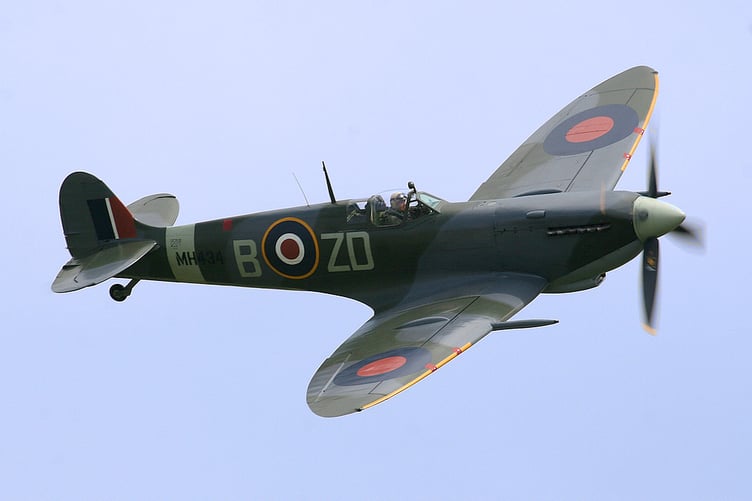
ON March 6, 1936, in an aerodrome near Southampton, a man terminally ill with cancer watched with nervous eyes as a small light blue aircraft took to the skies for the first time.
The man’s name was Reginald Mitchell, and the aircraft would eventually have a name. That name would be Spitfire.
No other plane is more associated with resistance, courage, and victory in the face of overwhelming odds than the Spitfire. It is a British icon, and 2026 marks its 90th anniversary.
.jpeg?width=209&height=140&crop=209:145,smart&quality=75)

Nine flights have been organised in April to mark the occasion, and although it won’t be flying directly over Abergavenny, it will come close when it heads from RAF Valley to MOD St Athan, this Tuesday (April 14), escorted by RAF Texan and a Jupiter HT1 helicopter.
During the war, the skies above Abergavenny were alive with the sound of Rolls-Royce Merlin engines, as rookie pilots from their base in Llandow got to grips with training in the planes that would become more synonymous with Britain than any other.
When the ‘few’ defeated the ‘many’ in the Battle of Britain, the Spitfire played a crucial role in repelling the mighty Luftwaffe.
One of the Spitfires which survived the legendary ‘Battle’, piloted by Sgt Fokes of 92 Squadron, was to meet its end two years later in Abergavenny on the lower slopes of the Skirrid.
On March 8, 1942, almost six years to the day of the first Spitfire’s maiden flight, trainee Sergeant Pilot Reg Crowe experienced difficulties in cloud near the ‘holy mountain.’
Spinning out of control, the 26-year-old ploughed through the trees on the lower slopes and met his death.
"The sound of the impact was very loud, and I heard it from my home in Gilwern," said former chairman and chief observer in the Royal Observer Corps, Mr Howell Davies.
"I think the pilot had become disoriented, which led to the crash.
He added, “Spitfires flying low up and down the Vale of Usk between Abergavenny and Crickhowell was a common sight in 1942."
In 2008, Spitfire Society member Mr Davies contacted the relatives of the deceased pilot to set up a meeting and hand over Mr Crowe’s leather helmet, which was found at the crash site 66 years earlier.
Mr Crow’s great nephew, Michael Corney, met Mr Davies in the shadow of the Skirrid at the Crown Inn, Pantygelli, and presented him with the helmet his great uncle Reg Crowe had put on for the last time that fateful March morning.
Abergavenny’s most famous connection with the Spitfire, of course, would be The Lang Pen Company.
The Lang Pen Company touched down in this neck of the woods for the sole reason of manufacturing radiators for Spitfires.
To that end, Llanfoist became the location, and a new factory was built.
Employment surged as employees did their bit to keep the flag flying for the war effort. In the aftermath of the historical conflict, there was no need for Spitfires, and the Llang Pen Company vacated the premises and left the factory to stand idle for a period.
The factory was saved from becoming derelict when Coopers Mechanical Joints of Slough picked up the reins.
Comments
This article has no comments yet. Be the first to leave a comment.