
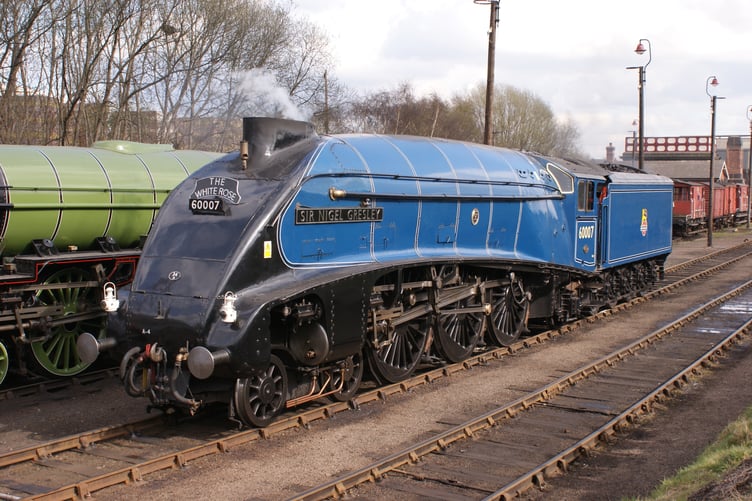
SIR Nigel Gresley will be thundering his way through Abergavenny tomorrow.
In case you didn’t know, Sir Nigel is a train named after an Edinburgh man who was responsible for perhaps the most famous train of all - The Flying Scotsman!
The Sir Nigel Gresley, also known by those in the know as the 60007, is the proud owner of the postwar steam speed record.
On May 23, 1959, with a passenger train in tow, the locomotive reached 112 mph. Not quite as impressive as the Mallard’s all-time world steam record of 126 mph, which it recorded in 1938, but nevertheless, still a proud boast.
The preserved British LNER Class A4 4-6-2 Pacific steam locomotive was built in 1937 at Doncaster. It was retired for service on February 1, 1966, and restored a year later.
It doesn’t get out as much as it once did, but it is still a frequent flyer at heritage railways and tomorrow will be hurtling down the tracks on its way to the West Somerst Railway Spring Steam Gala (May 1-4).
As is fitting for Abergavenny’s past as a railway town, there’ll no doubt be a healthy turnout for the loco.
In the beginning, or at least the 19th Century, Abergavenny had three railway stations.
As one of the main points of call in the Merthyr, Tredegar & Abergavenny Railway, the town was once alive with the symphony of steam, the clickety-clack of tracks, and the sight of an iron horse roaring on by to destinations unknown, or at least Brynmawr.
Before it became a hotbed for food tourism, Abergavenny was renowned for the smell of steam and the quality of its tracks.
The town’s first mayor, Joseph Bishop, was the first superintendent of the Abergavenny Merthyr & District of the London & North Western Railway Company. It was usually railway officials who sat on the council and told the town how it was going to be governed.
To help cope with the influx of railwaymen, houses were purpose-built in areas such as Stanhope Street, North Street, and St Helen’s Road.
The building that now houses Fire and Fork was the first to be constructed near the old Brecon Road Station.
And the Somerset Inn on Merthyr Road was once the headquarters of the Abergavenny branch of the Amalgamated Society of Railway Servants.
It’s safe to say the railways helped define the geography and character of the town.
Yet, for the most part, only scant evidence remains to remind people what once was.
The Railway Inn on Brecon Road, remains of the old bridge in the River Usk, a crumbling wall here, a cycle track there.
Times change, it’s all it ever does. And when one of the UK’s greatest and scenic railways was dismantled in 1958, it took two of Aber’s three stations with it.
Abergavenny Junction and the Brecon Road Station may no longer be standing, but the Great Western Railway at Monmouth Road still is.
For decades, it had an old-world character and charm, but it has recently fallen foul of an intensive upgrade to make it fit for purpose in the modern era.
We’ll see what Sir Nigel Gresley makes of it when he passes through tomorrow.
Comments
We've recently changed our login process. If you have an account for commenting, you will need to re-register on the login window.
This article has no comments yet. Be the first to leave a comment.