
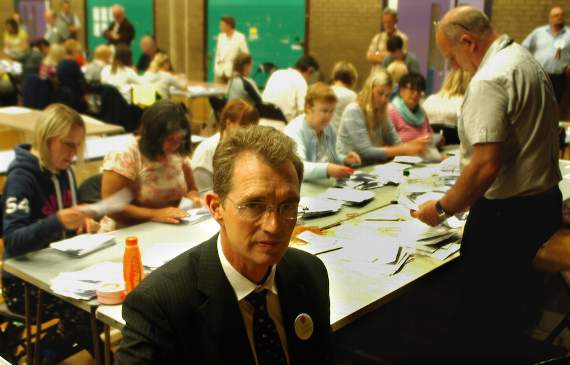
Monmouthshire bucked the trend in Wales in the EU referendum as one of only five local authority areas to back the Remain camp - albeit by the smallest of margins.
In the end, there was less than one per cent between the ‘Remain’ and ‘Leave’ vote, amounting to just 492 votes between them.
The county celebrated the highest turnout in Wales at 77.7 per cent, with 55,630 people having their say. In total 28,061 voted for Remain and 27,569 backed Leave. Another forty voters spoiled their ballot papers.
Nationally, pollsters came under fire after getting it wrong, as 52% voted Leave to 48% for Remain, despite most final polls suggesting a last-week rally would tip the balance in Remain’s favour.



MCC chief executive Paul Matthews, said that more than seven thousand new people had registered to vote since the Welsh Assembly elections five weeks ago.
Speaking after the declaration, Monmouth MP David Davies - a prominent Brexiteer - praised the turnout and the good natured campaigning in his constituency, despite the national campaign garnering public derision for the increasingly ‘toxic’ atmosphere.
“I am pleased with the UK’s decision to leave the European Union, although I recognise that the Monmouthshire local authority area voted narrowly to remain.
“To those calling for my resignation, may I respectfully point out that the area I represent has different boundaries. The parliamentary constituency of Monmouth includes thousands of people living in Torfaen where there was a big vote in favour of leaving.
“Nonetheless, it would have been close, and of course I want to be mindful of all those who voted in either direction.
“Over the past few weeks there has been a lot of passion and heated rhetoric on both sides of the argument.
“While the Leave campaign won, now is the time to show humility and remember that a large proportion of the country are worried at the result,” he said.
The Conservative MP moved quickly to dispel worries that the Brexit victory would stoke anti-migrant sentiment, a shredding of workers’ rights, and revoked promises to support Welsh agriculture.
“Hard-working migrants from EU, and non-EU countries, were led to believe there was some sort of xenophobic agenda. This is utterly untrue. I have friends in Monmouth who come from in and out of the EU.
“Hard-working, law-abiding migrants are as welcome today as they always have been. We do need to get a better control of migration numbers and benefits, but this will not have any impact on hard-working people already in the UK,” he said.
One claim of the Remain campaign focused on rights of workers, despite the UK having stronger protections than the minimum requirement for EU member states.
Mr Davies dismissed the rhetoric, saying that there was no intentions for a bonfire of workers’ rights, and that British industry support of such rights was central to staying attractive to investors.
“Workers’ rights are vital to maintaining that positive relationship. They are good for employees and for business. It would be nothing short of madness to try to take them away.
“It was also suggested that MPs would not continue to fund agricultural support or infrastructure support in Wales.
“Commitments were made during the campaign that these would continue to be supported and I certainly want to echo my own absolute commitment to continued support for both,” he said.
Following a deeply polarised referendum, which saw counter demonstrations and calls from some MPs to reject the will of a voting majority, Mr Davies sought to bridge the gaping divide.
“It looks as though the next few weeks will be eventful for the major political parties. My own view is that the Remain campaign should acknowledge the result for Brexit and the Leave campaign should acknowledge it was fairly close.
“We all need to be talking to each other with a little less passion and a bit more courtesy,” he said.
Neighbouring local authority areas of Powys, Blaenau Gwent and Torfaen all voted Leave, as just a handful of traditionally Labour areas in England and Wales followed party pleas to back the Remain camp.
Following the historic referendum, NFU Cymru pressed for cross-party co-operation to foster a smooth and consensual transition into post-Brexit Britain.
Atop of this agenda was ensuring Welsh farmers had ample time to carve out the best possible future for themselves, and their vital sector.
Reacting to the UK public’s decision to leave, NFU Cymru president, Stephen James said, “This referendum stimulated significant discussion amongst farmers on the pros and cons of being part of the European Union.
“Our priority now is to work with government in Cardiff and London, as well as the EU, to ensure that our departure takes place with the minimum of disruption, and to develop policies that will deliver a productive, profitable and progressive Welsh agricultural industry,” he said.
Mr James added that all parties, along with industry bodies, would now have to carve out a new direction ahead of invoking Article 50, which officially serves a two-year notice of the country’s intention to leave the European Union.
Crucially, he said, support for all farmers would take paramount importance during this unprecedented period.
“For the time being, we know that from now until our departure from the EU becomes effective, Welsh farmers will continue to receive CAP support and have access to EU markets.
“Beyond this we are, however, entering a period of considerable uncertainty as politicians hammer out the terms of our withdrawal,” he said.
The NFU chief said work must now focus on ironing out an amicable future relationship with European markets, within a realistic and sector-assuring timeframe.
“At the forefront of most farmers’ minds will be the twin questions of what level of access we will enjoy to the European markets, and what level of support farmers in Wales might receive once the withdrawal process is complete.
“We must ensure we have the best possible access to Europe’s markets and an agricultural policy that guarantees parity of treatment with the rest of Europe.
“If farm businesses are to plan for the future, they need to know the answers to these questions sooner rather than later,” he said.
Mr James warned that the best deal for farmers would have to ensure the UK market wasn’t opened up to ‘goods which do not meet our own high standards of production’, following any agreements between decision-makers.
Agriculture is a major tenet of the Welsh economy, with 60,000 people employed either full or part time on holdings in Wales.
The sector has a gross output of nearly £1.5bn and underpins a food supply chain worth £6bn each year.
In Monmouthshire, and across Wales, the sector employs almost 230,000 people.
“Negotiating and concluding trade agreements with the European Union, and the rest of the world, now becomes vital. Wales is particularly reliant on export markets and we will be looking to the UK government to prioritise favourable trade agreements,” added Mr James.
The NFU’s governing body will now meet on July 5 to discuss the implications of Brexit for Welsh agriculture, and to press for a meeting with Welsh Government officials.
Comments
This article has no comments yet. Be the first to leave a comment.