
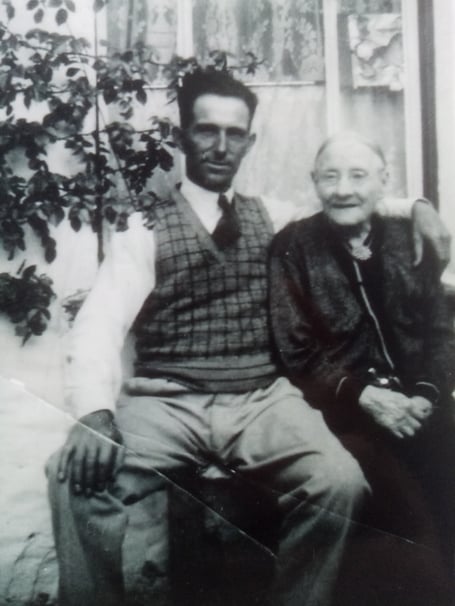
MY father died when I was very young and all my mother told me about him was that he was from somewhere in Gloucestershire, he had fought in the First World War and had a previous wife (who was from Ireland) and two daughters.
Encouraged by a cousin, who was researching my maternal side, I decided to try and find out more about my father. I sent off for his birth certificate and this told me that he was born on the 2nd of October 1895 and his mother, Emily Beale, was unmarried and her occupation was ‘house and parlour maid.’
There was no father’s name on the certificate. Despite this Emily managed to have my father baptised in her local church in Beverstone, which is a small village just outside Tetbury. A lot of clergy would not baptise the children of unmarried women in those days.
Shortly afterwards Emily married a local man in Cirencester and she went on to have nine more children but she left my father to be brought up by her parents, George and Eliza Beale.

Eliza had been married once before in 1867 but shortly after giving birth to a son her husband died of TB. Eliza then married my great-grandfather, George Beale, in 1871.
The 1911 census shows George, Eliza and my father living in Painswick and my father is working in a mill making pins. Painswick is regarded as the pin making capital of the world and this former cottage industry was being industrialised by water power using the local river. (Making pins at home was the origin of the term “pin money”.)
I paid a visit to Painswick and found a local guide that said: “On a clear day you can see the Sugar Loaf Mountain in Abergavenny from the local golf course.” Whether this had any influence on my father moving to the Abergavenny area is something I will never know but it is believed that around 350,000 people came to south Wales at this time from the surrounding counties to look for work.
The next thing to find out was where and when my father married his first wife and so I paid a visit to Gwent Archives where they hold indexes of all the Birth’s, Marriages and Deaths since 1837. Then I sent off for the marriage certificate and this told me that my father married Ellena Duggett in the Catholic Church in Brynmawr on the 26th of February 1916. His occupation was a boiler maker’s helper, which I later found out was at the former British Steel Works in Ebbw Vale. He was lodging at Glaslyn Farm and Ellena was living close by at the Corn Exchange in Gilwern.
The certificate also said that the marriage was by licence and not the usual Banns. Licence is required when time is of the essence and it could have been that he was trying to avoid being conscripted into the forces as only single men were initially eligible.
It also occurred to me that his occupation in a steel works could have been classed as ‘reserved.’ But the rules were changing fast by the passing of the Military Service Act of 1916 and my father duly received his call up papers three months later when he went off to Brecon Barracks for his basic training.
Luckily his service record is available on line but two thirds of the records were destroyed in the London Blitz during the Second World War. He had been enlisted into the Cheshire Regiment but had subsequently been transferred to a Labour Company.
The Labour Corps were formed in March 1917 and consisted of recruits who were not quite A1 fit for front-line service or men who had manual jobs in peacetime. They were expected to dig and repair trenches, build new roads and railways (as well as keep them in good repair) and to move supplies from the Channel ports up to the front line. His records show that he sailed for France on the 15th of December 1916.
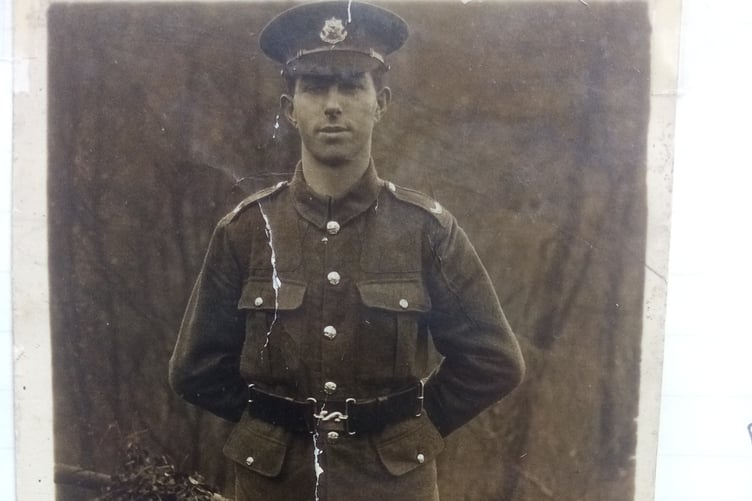
I thought that the Chronicle of that year may have had an article about local men leaving for the front and so I looked through the micro-film copies of the newspaper that are held in Abergavenny library.
I found something quite extraordinary in the very last edition dated 29th of December 1916 under the headline: “Soldier’s wife’s lapse.” It went on to say: “Ellena Beale, a woman of Irish nationality, the wife of a soldier serving in France, was charged at the Crickhowell Police Court with stealing from Lady Tulloch of Glaslyn Court, Gilwern articles to the value of £3:10 shillings. According to the evidence, defendant, who had been in the service of Lady Tulloch, took the articles which were found on her when she was arrested. The defendant was trying to get back to Ireland when apprehended by the police. Lady Tulloch said she would not have taken these proceedings but for the defendant’s conduct in the district recently.
The defence lawyer said that his client had yielded to temptation and she wished to apologise to Lady Tulloch for her inexplicable behaviour in taking these articles. She had suffered mentally and physically, and he could assure the court that she had been punished a good deal already. Her husband knew nothing of these proceedings.
The Bench said the defendant must pay £3 to cover expenses, and be bound over for one year to be of good behaviour.” Friends of my father told me that Ellena had a very nervous disposition and I have to assume that as my father had now left for France, she found herself alone with no family to support her.
The records show that my father never had leave until he was demobbed in September 1919, ten months after the Armistice. I can only assume that the Labour companies were kept behind to clear up the mess that had been left behind by four long years of trench warfare. I do not know what happened to Ellena in the intervening years as the next record I found was from the Chronicles of 1918/19.
The wartime Mayor of Abergavenny, Zachariah Wheatley, had commissioned the Chronicle to do a house-to-house survey of Abergavenny asking the question: “What contribution to the war effort was made by your house?” The results were published over five consecutive weeks. Although my father was still in France, he is recorded at 22 Park Street, Lance Corporal E. J. Beale, Labour Company, Overseas.
Ellena must have been living there waiting for him to come home. My father received the standard two medals for his war service: the 1914-1918 War Medal and the Victory Medal.
The 1921 census records my father as working in the steel works then known as ‘The Ebbw Vale Steel, Iron and Coal Company but the entry is annotated (out of work). The heavy industries went into a steep decline after the war as demand for their products dropped dramatically. The miners came out on strike and my father could have stopped work in sympathy with them or they may have been locked out by the management.
The King declared a State of Emergency and troops were put on standby. However, the Chronicle of the 26th of August 1921 reported that there was going to be a revival in the iron and steel trade in Ebbw Vale as the Company was going to restart their plant and would soon be employing 5000 men.
The stoppage had been a long and trying one, many of the men having been out of work since last October. The Company collieries would also be getting back to normal.
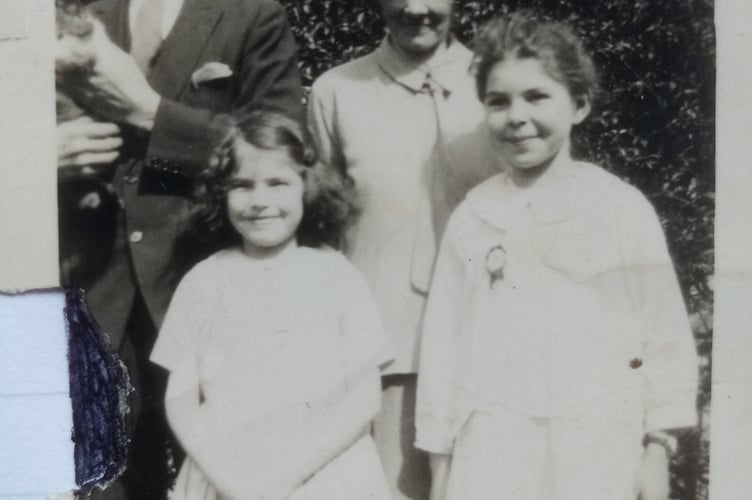
All I do know is that my father left the steel works sometime after 1923 and went to work for the local council in Abergavenny where he stayed for the rest of his working life. By now he had settled back into married life and had two daughters, Eileen born in 1920 and Mary in 1923.
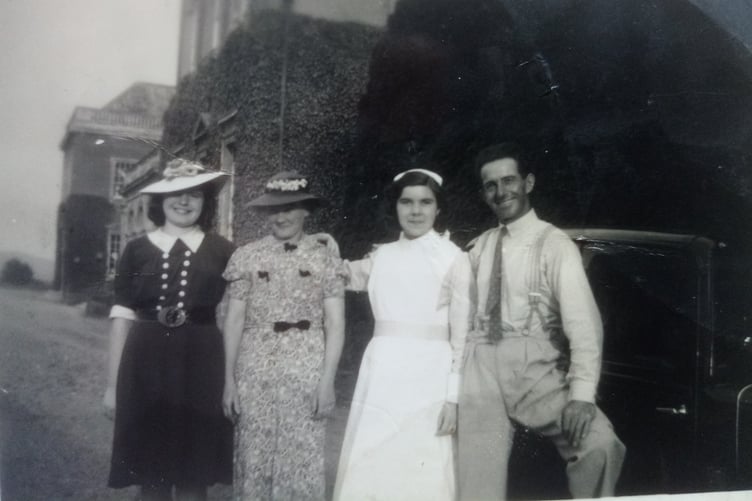
Eileen became a nurse and there was a photograph in the family album that shows my father visiting her and I knew that Mary also became a nurse when she was old enough. I could never work out where the photo was taken as the building in the background did not look like any hospital around Abergavenny and district.
Then the 1939 Register became available on line and this was a snapshot of the population taken at the outbreak of the Second World War.
The information requested was designed to show who was in reserved occupations and who was available for war work. The details were also used for the issuing of ration books and identity cards.
The Register showed that both Eileen and Mary were working as nurses in a mental hospital at Holme Lacy in Herefordshire.
This is now a Warner Leisure Hotel and I went to see for myself if the building was the same one as shown in the photo that I had. I recognised it as soon as I drove through the main gate and the staff made me feel very welcome as I explained what I was doing. They said I could have a good look around by myself and I found a corner in one of the rooms which had information about the history of the house.
Then something happened which must have been very painful for my father. His youngest daughter Mary was by now working in a TB sanitorium and she caught the disease after being bitten by one of the patients.
This was in 1943 and it was a death sentence then as diagnosis usually came too late and there was no effective cure. Mary was sent home to be cared for by her mother until her inevitable death. She was just 19 years of age. TB is highly contagious and Ellena caught it off her daughter and died four months later. Both Ellena and Mary are buried in separate graves in the New Cemetery at Llanfoist but without headstones.
My father must have got over his grief quite quickly as within twelve months he had met my mother and they were married in 1944. By this time my father was 48 and my mother was only 24, the same age as his eldest daughter Eileen.
During my father’s time as a lorry driver with Abergavenny Council, they were replacing their horse drawn carts with motor vehicles. One such experience recorded in the Abergavenny Chronicle of 30th of March 1935 stated that the Council were not impressed with the mpg (miles per gallon) performance of the newly acquired lorry that they were using for the street collection of household rubbish. The manufacturer had quoted a figure of 19 mpg but the Council were getting more like 5 mpg.
They sent off a complaint to the manufacturer whose tests on the vehicle showed that their figure of 19 mpg was accurate. The Council were advised that the activity of door-to-door collecting would involve the vehicle to be stationary but still ticking over and this obviously would have an effect on the overall fuel consumption. The Council’s solution was to switch off the lorry’s engine when they were on a sloping road allowing the lorry to freewheel!
I found two mentions of my father in the Abergavenny Chronicle archives. The first was on the 17th of March 1944. The minutes of the Town Council meetings were reported in full on the front page and under the heading of “Sickness of Workmen” it was reported that 72 days had been lost and E.J. Beale, reported last month as absent through an accident outside of Corporation time, was still off duty.”
I have no idea what had happened to my father at this time.
My father was also a patron of the Labour Club in Park Crescent. The Chronicle of 21st of January 1949 had an article about how the Council wanted to have a roundabout outside the Labour Club at the junction of the three roads that are Park Crescent, Pen-y-fal Road and Skirrid Road.
The Article read, “The roundabout at the junction of Park Crescent and Pen-fal-Road looks like being permanent. For a time, red lamps were put around it, presumably, with the idea of warning pedestrians of the danger of breaking their legs, but the lamps are no longer placed there at night. Although the pavement has not been made up and is still in a rough state it seems to be assumed that pedestrians have accustomed themselves to negotiate this difficult portion of thoroughfare, even in the dark. Nobody is reported to have broken their neck or strained their ankle so far, so everything must be perfectly all right. Well, I hope you don’t come a cropper while looking for the ‘silver lining’ here.”
The following week, the front page of the Chronicle printed a letter under the headline: “What Our Readers Think – Accident at Roundabout. Dear Sir, Being an interested reader of your Sugar Loaf Musings each week, I was rather struck by your remarks about the ‘roundabout’ at the junction of Park Crescent and Pen-y-fal Road. It is correct to say that red lamps were put there for a long time, but in my opinion not long enough. Two nights before Christmas those red lamps disappeared, for what reason I don’t know. I should have thought they would have been left there till after Christmas considering there were strangers about. I came along that way on Christmas Eve, both gas lamps were out and no red warning lamps, and unfortunately for me I had my hands in my pockets when I fell over the obstruction. I was taken to the Cottage Hospital and had four stitches inserted in my forehead and nose and attended hospital six times for treatment; so, you see there was one nasty accident that was not reported. Yours Faithfully, J. Beale.”
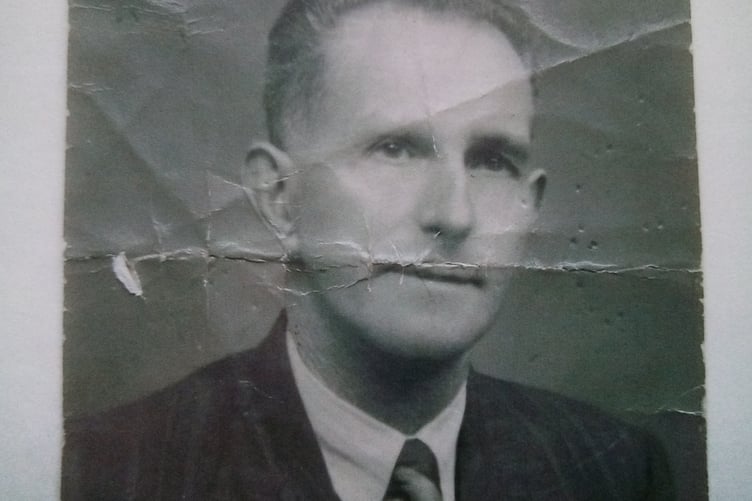
Three years later my father died from a perforated stomach ulcer. It was reported in the Chronicle as, “The sudden death on Wednesday, 18th of June of Mr. E. J. (Jack) Beale, at his home in Park Street, came as a great shock to his fellow employees and all who knew him. He was at his work as lorry driver for the Abergavenny Corporation on the Monday previous. He had been employed by the Corporation for over 25 years. Born at Gloucester he came to the Abergavenny district at the age of 14 years. He leaves a widow and four children. It was abundantly clear at the funeral that the late Mr. Beale was very popular, by the number who paid their last respects.”
My mother had a letter from the Town Clerk who passed on the condolences of his worship the Mayor. There was no death in service benefit or pension for my mother as my father had died before the normal retirement age but the Council did have a scheme that refunded all the pension contributions that he had made during his working life.
And so, my knowledge of my father has increased dramatically by researching my family tree, something that is now so much easier with online records and access to old newspapers. Not all this narrative is a matter of public record but my half-sister, Eileen and her new family, kept in touch with us and was able to fill in some of the details.
Comments
We've recently changed our login process. If you have an account for commenting, you will need to re-register on the login window.
This article has no comments yet. Be the first to leave a comment.