

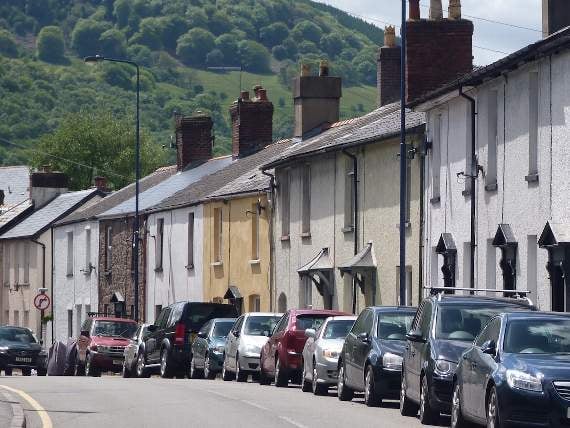
A detailed survey of the varied character of Abergavenny’s suburbs will be on show at a Civic Society exhibition at the Gunter Mansion in Lower Cross Street on Friday, November 17. Volunteers have spent nearly four years surveying the town and Mardy, finding information about the history of the town’s growth and recording their impressions of the streets and the buildings. Now they want local people to add to the information and to say what they think of where they live.
The survey started as a pilot ‘characterisation’ study in partnership with the Civic Trust for Wales, aiming to test whether volunteers with limited experience could carry out the work to a near professional standard. Dick Cole, a retired town planner who led the project with Tony Konieczny, tells how the team had to learn how to look closely at buildings and learn the language of architecture and construction.
‘Old maps have been a great help too, though the absence of maps between the 1840s and 1880 makes it difficult to date early building in, say, North Street or Mardy,’ he added. Clearly there is plenty of scope for more research.
An aim of the study was to identify the distinctive characteristics of the town that might be echoed or respected by new development. While locally quarried Old Red Sandstone and Welsh slate roofs feature extensively in pre-1914 building, these materials are now rarely used, and since 1945 there has been a succession of fashions in styles and materials. Tony Konieczny regrets that there is little truly modern architecture adding respectfully to the variety of the town. ‘Nationwide companies now build most houses and use similar ‘traditional’ styles that actually have little resemblance to what was actually being built here in the period they are imitating,’ he says.



They agree that the most important thing is to cherish the most distinctive of the thirty-six character areas that have been identified. Dick Cole says, ‘While we have some gems like Fosterville or parts of Grofield, it is equally important to protect the stone walls and trees of the top end of Pen-y-Pound, the village-like character of the Chapel Road and North Street area, and even an interesting recent development such as Maes y Llarwydd.
“Some of the council estates are interesting too, such as Poplars Close and Dan-y-Deri, the former on the site of a prisoner-of-war camp.’
Stan Pochron, the society’s new chairman, recommends the exhibition, ‘As a relatively new resident, I have found this work by our members invaluable for learning about the town.
“The story of the ancient centre is well researched, but little has been written about how the town has grown over the 180 years since the building of Grofield started.’
The exhibition is open on Tuesdays, Fridays and Saturdays from 10.30am to 4pm until December 14 and the content can also be viewed at https://abercivsoc.com.
Comments
This article has no comments yet. Be the first to leave a comment.