

SPACEX is being valued on what it may become — a company that could build the infrastructure of humanity’s future through satellites, launch systems, communications networks, defence platforms and perhaps the industrialisation of space itself.
It is a breathtaking vision. Yet more than a century ago, another generation of Americans helped create the infrastructure of the modern world itself.
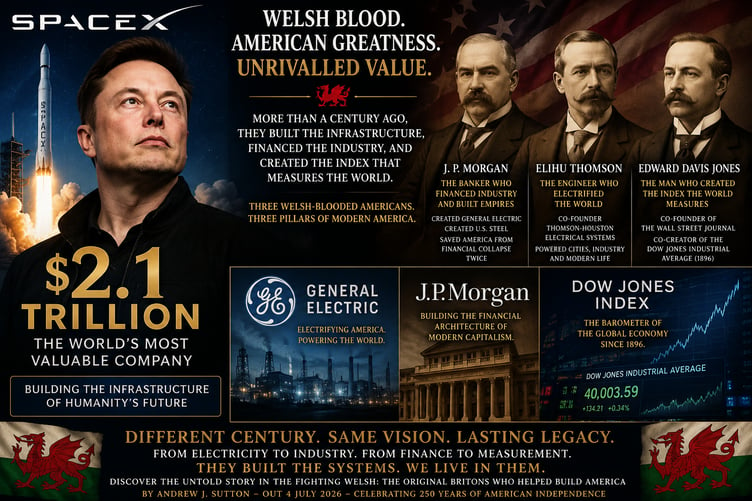
Among them were three men of Welsh ancestry: Elihu Thomson, J. P. Morgan and Edward Davis Jones.
Together, they helped build, finance and measure modern America.

-and-Rebecca-Williams-(right).jpeg?width=209&height=140&crop=209:145,smart&quality=75)


At the centre of that story stood General Electric. Founded in 1892 through the merger of Edison General Electric and Thomson-Houston Electric Company, GE became one of the defining enterprises of the industrial age.
It helped bring electricity into homes, factories, hospitals, transport systems and communications networks. Electricity was not optional. It became the foundation of modern life.
In its early decades of dominance, GE was not simply valuable as a company; it represented a commanding share of America’s industrial future.
By some measures, its market and infrastructure importance approached the equivalent of one percent of American GDP — not built on speculation, but on power stations, contracts, patents, machinery, lighting systems and the physical electrification of a nation.
Behind much of that achievement stood Elihu Thomson, the son of Welsh parents and one of the great engineers of the electrical age.
His innovations in lighting systems, transformers, dynamos, electrical distribution and industrial research helped turn electricity from scientific curiosity into practical infrastructure.
If SpaceX is being valued as the infrastructure company of the twenty-first century, General Electric helped build the infrastructure company of the twentieth.
But infrastructure requires finance, and the man who brought capital, discipline and structure to America’s industrial rise was J. P. Morgan.
Morgan’s family roots traced back to Llandaff in Glamorgan, Wales. He engineered the merger that created General Electric, helped assemble U.S. Steel into the world’s first billion-dollar corporation, reorganised major railroad systems, financed Thomas Edison’s work and played a decisive role in stabilising American markets during financial crises.
Morgan did not merely back companies. He helped build the financial architecture of modern capitalism.
The Welsh connection also extends to the way America measures wealth itself.
In 1896, Edward Davis Jones and Charles Dow created the Dow Jones Industrial Average after asking a simple but revolutionary question: how could anyone truly measure the direction of the American economy?
Their answer was a single index of leading industrial companies, calculated by hand in New York and published for readers who needed clarity in a rapidly changing economy.
That index became the world’s most recognised financial barometer. Through crashes, wars, depressions, recoveries, technology booms and today’s artificial intelligence surge, the Dow has remained one of the principal measures of economic confidence.
When it rises, markets celebrate. When it falls, governments pay attention. Yet few people stop to remember that the “Jones” in Dow Jones belonged to Edward Davis Jones, a man of Welsh ancestry whose name remains embedded at the heart of global finance.
Jones was also co-founder of The Wall Street Journal, the newspaper that became America’s financial paper of record.
Since its first publication in 1889, The Wall Street Journal has helped define how investors, bankers, industrialists, policymakers and business leaders understand markets, industry, finance and economic change.
The newspaper helped shape the language of American capitalism, while the Dow Jones Industrial Average helped measure it. Both carry the name and influence of Edward Davis Jones.
Today JP Morgan Chase is the world’s largest bank, but investors in Elon Musk’s ambitious and speculative project have even dwarfed the Welshman’s legacy.
The comparison with SpaceX is not meant to diminish Elon Musk’s achievement. It is meant to challenge how we define value.
SpaceX is valued at more than $2 trillion because investors believe it may shape the future. General Electric shaped the modern world. J. P. Morgan helped finance it. Dow Jones helped measure it. The Wall Street Journal helped explain it.
Perhaps the greatest enterprises are not merely those worth trillions on paper. Perhaps they are those that helped create the world in which trillions became possible.
The Welsh ancestry of these men matters because Welsh Americans have too often been overlooked in American history, frequently absorbed into broader labels such as “British” or mistaken simply as “English”.
As America prepares to celebrate its 250th anniversary in 2026, author Andrew J. Sutton argues that this hidden Welsh contribution deserves to be recognised more clearly.
Drawing on modern research into the peoples of Britain, including Oxford University’s genetic study suggesting that the Welsh retain some of the closest links to Britain’s earliest post-Ice Age populations, Sutton frames the Welsh as heirs of the original Britons.
In The Fighting Welsh: The Original Britons Who Helped Build America, he argues that Americans of Welsh ancestry played a far greater role in the foundation, expansion and early growth of the United States than history has generally acknowledged.
Had John Pierpont Morgan used his first-class ticket on the Titanic’s maiden voyage in April 1912, the very ship owned by the White Star Line, which he financed, history might have turned out very differently. At the last moment, he decided not to sail, and when the “unsinkable” ship struck the iceberg that claimed more than 1,500 lives, the future of modern finance quite literally remained ashore with him.
Ironically, the first SOS distress signals sent from the Titanic were not received in America, but in Wales. On the night of 15 April 1912, Arthur “Artie” Moore, an amateur radio enthusiast from Caerphilly, picked up the ship’s desperate Morse calls on his homemade wireless set, nearly 3,000 miles away.
Dismissed at first as a hoax, his report was later confirmed as genuine. Moore’s astonishing feat foreshadowed his later distinguished career in radio and sonar technology and provided yet another reminder that Welsh ingenuity often sits quietly behind some of history’s greatest moments.
The very technologies and financial structures that power today’s global digital economy owe much to inventors with Welsh bloodlines whose ideas spanned the ages:
David Edward Hughes (1831–1900) of Bala invented the carbon microphone and developed early wireless telegraphy, laying the foundation for the telephone, radio and all future voice communication.
Donald Watts Davies (1924–2000) of Treorchy, Rhondda, invented packet switching, the core principle that made the Internet possible.
Sir Terry Matthews (1943) of Newbridge, the brilliant telecommunications pioneer who founded Mitel and Newbridge Networks, built the data systems and networks that brought broadband and digital connectivity to the modern world.
Together, these Welshmen form an unbroken chain of innovation that has often led the world and should be remembered more fully today too.
The Fighting Welsh: The Original Britons Who Helped Build America, book by Andrew J. Sutton, published to mark the 250th anniversary of American Independence, is available to Purchase Now on www.Amazon.co.uk and from the Celtic Manor Hotel.
Comments
This article has no comments yet. Be the first to leave a comment.