
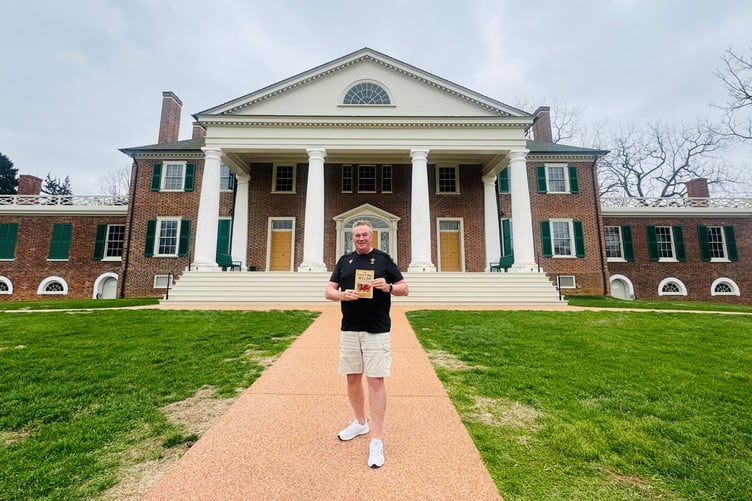
WHEN the Declaration of Independence was declared on July 4, , Welsh blood flowed through the veins of many who designed, defended, and financed America’s break from the English Crown, helping transform the colonies into a free land and democratic republic.
It is my contention that per capita, no ancestral immigrant group contributed more to the founding of American democracy.
The main principal architects of Independence—Thomas Jefferson, John Adams, James Madison, and James Monroe—all had noted Welsh connections, as did the financier whose personal credit kept the Revolution alive.




The Fighting Welsh reaches back into Welsh history itself—the story of the original Britons—to reveal centuries of resistance to authoritarian kings, imposed rule, and land-owning elites. It shows how traditions of literacy, law, faith, and defiance were forged in Wales and carried across the Atlantic in blood and character, helping shape a new democracy in the New World.
Thomas Jefferson — Author of the Declaration of Independence
Welsh immigrants to the New World gained opportunities their ancestors in Wales had long been denied. For the first time, they could own land, apply their skills freely, and build futures for their children. That transformation is reflected in the life of Thomas Jefferson, who wrote that his ancestors came from the area around Snowdon in Wales—a land where life had often been harsh under English rule.
By the time Jefferson was born, his father, Peter Jefferson, had established a substantial Virginia estate fittingly named “Snowden.” Young Jefferson inherited both wealth and status, giving him access to America’s political elite. Yet unlike many affluent Virginians of his era, Jefferson did not side with the English Crown or the privileges it offered his class.
Instead, he showed early political courage—sometimes bordering on outright rebellion—alongside a sharp intellect that would earn him a place among the most transformative leaders in world history. Jefferson even called his favourite horse Caratacus named after the ancient Briton [Welsh] Sillurian Tribe leader who so fiercely resisted the Roman legions his courage was recorded by Roman Historians
As author of the Declaration of Independence and later President of the United States, Jefferson proclaimed that governments derive their power from the consent of the governed, and that people have the right to alter or abolish any government that oppresses them—an extraordinarily radical and dangerous position at a time when America remained a colony ruled by King George III.
President Ronald Reagan later captured Jefferson’s legacy with clarity:
“Jefferson articulated the American idea that liberty is the gift of God, not the gift of government.”
John & Abigail Adams — The Intellectual Defenders of Independence
Jefferson was not alone in his stand for independence. Among his closest allies was John Adams, who later became America’s second president. Many believe that part of John Adams family lineage traces back to Wales, often associated with the ancient ap Adam naming tradition of West Wales.
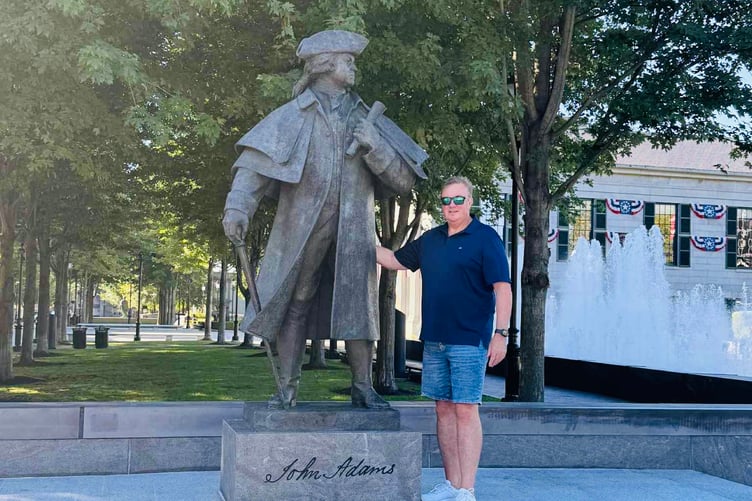
His wife, Abigail Adams, also carried Welsh ancestry and played a vital role in the political and personal life of the Adams family. Abigail was far more than a supportive spouse—she was an adviser, moral compass, and mentor to their son, John Quincy Adams, who would later become America’s sixth president. The family’s home town of Quincy reflects Abigail’s heritage, and she went on to serve as the nation’s second First Lady, reminder her husband when president, to remember the women when making policy.
What is often overlooked is that years before Independence, Adams had already laid much of its intellectual foundation.
In 1774–1775, as tensions with Britain escalated, Adams wrote a series of essays under the pseudonym Novanglus, published in the Boston Gazette. In these writings, he argued that liberty did not originate with English kings or Parliament, but long pre-dated them. Adams reached beyond England itself, pointing to the ancient Britons—the Welsh—as evidence of an older tradition of freedom and resistance to imposed rule.
Though Jefferson and Adams later belonged to different political parties, they continued to work for the common good of the republic. Even as presidents, they openly debated one another’s ideas—praising achievements while challenging failures—a model of principled disagreement rarely seen in modern politics.
In one of history’s most remarkable coincidences, both men died on July 4, 1826, exactly fifty years after the signing of the Declaration of Independence they had helped bring into being.
Richard Price — The Welshman Given the Freedom of America
Known as the Welsh Voice of Liberty in the American Revolution, Richard Price (1723–1791), of Llangeinor, Glamorgan, was one of the most influential moral philosophers of the eighteenth century—and the only person ever granted “The Freedom of America” without setting foot on American soil.
Price did not champion American independence from the safety of the New World. He did so from London itself, deep inside the territory of the British Crown. A Welsh intellectual who had been denied entry to England’s leading universities because of his background, Price understood firsthand what it meant to live under imposed authority. He warned that America risked becoming “another Wales”—a nation ruled and taxed without fair representation.
In 1776, the same year America declared independence, Price published Observations on the Nature of Civil Liberty, a pamphlet that electrified both Britain and the colonies, selling tens of thousands of copies. It reached Benjamin Franklin, John Adams, and Thomas Jefferson, all of whom praised its clarity and moral force.
Price wrote: “Liberty is the right of every human being to direct his own actions, provided they do not injure others.”
In recognition of his influence, Congress instructed that their thanks be conveyed to him, along with the extraordinary honour of the Freedom of America—making Richard Price the only man ever granted honorary American citizenship without ever crossing the Atlantic.
In essence, Price gave the Revolution its moral vocabulary. He transformed the slogan “No taxation without representation” into a coherent philosophy of liberty rooted in justice, consent, and human dignity—helping provide the ethical foundation upon which the American Republic was built.
James Madison -Father of the American Constitution
As Jefferson declared America’s right to self-determination, it fell to James Madison to give those ideals lasting form in law.
Madison’s influence on the founding of the United States is unmatched. He was the principal architect of the U.S. Constitution, the chief author of the Bill of Rights, a co-author of the The Federalist Papers, and one of the clearest political thinkers of the Revolutionary era.
He famously observed: “If men were angels, no government would be necessary.”
No More Kings — Madison and Hamilton’s Great Divergence
Many who know the musical Hamilton are unaware of the deeper philosophical struggle behind it.
Madison and Alexander Hamilton began as allies, co-authors of The Federalist Papers and early designers of the Constitution. But once the republic took shape, their visions sharply diverged.
Hamilton favoured a powerful central government led by educated elites, a system Madison feared could recreate the very hierarchy Americans had fought to escape. Madison championed dispersed power, constitutional restraint, and citizen sovereignty.
It was Madison’s vision that prevailed and he would become the 4th president of the United States.
In 1837, Congress summarized his legacy simply:
“James Madison was the guardian of the Constitution and the friend of liberty.”
Madison later became the fourth President of the United States, devoting his entire life to designing, defending, and preserving the framework of American democracy—a legacy unmatched in American political history. Hamilton’s political movement faded after his death; Madison’s constitutional philosophy endured and became the foundation of modern American governance.
Madison was of mixed ancestry, with maternal Welsh lineage traced through the Gaines family—born in Scotland to Welsh parents—and a paternal connection to the Conway family. The surname Conway carries strong Celtic resonance, deriving from Conwy, the ancient castle town and river of North Wales in historic Gwynedd close to where Jefferson believed his ancestors also lived. Madisons father’s family were influential landowners in Port Conway, Virginia, named after them.
The Declaration of Independence was signed on July 4, 1776.
The Constitution was drafted in 1787 and formally ratified in 1788.
Together, Jefferson’s Declaration and Madison’s Constitution created the philosophical and legal foundations of American democracy.
George Washington — His Wife, His Generals, and the Birth of the Presidency
Fittingly, one of the first people of Welsh blood to help shape the new American nation was not a statesman, but a remarkable woman: Martha Washington, the original First Lady of the United States. Through her mother’s Jones lineage, Martha inherited the legacy of early Welsh settlers who crossed from the rugged borderlands of Wales to Virginia in search of land, security, and opportunity.
As First Lady, Martha Washington led not by proclamation but by presence. In her steadiness, compassion, and moral clarity, she embodied enduring Welsh virtues. She stood beside her husband, George Washington, while he served as Commander-in-Chief of the Continental Army, often in harsh field conditions—including at Valley Forge—where she comforted soldiers, organised essential supplies, and on more than one occasion helped turn despair into resolve.
Crucially for American democracy, Martha was also at Washington’s side as he helped invent the modern presidency. Together they reinforced a defining principle of the new republic: America would never crown a king.
But it was as President that Washington performed his most revolutionary act.
With no precedent to follow, he built the executive branch from scratch—establishing the Cabinet, stabilising the new government, supporting the Constitution, and setting the standard for lawful, limited executive power.
His final decision changed history.
After two terms, Washington voluntarily stepped down.
At a moment when nations routinely slid into dictatorship or lifelong rule, he proved that the American Revolution had not merely changed governments—it had transformed the very idea of leadership. Power would be entrusted temporarily, never seized permanently.
A notable cluster of Washington’s senior generals—including Henry Knox, Anthony Wayne (known as “Mad Anthony Wayne”), and Daniel Morgan—also came from families of Welsh descent, reinforcing the quiet but powerful role Welsh bloodlines played in securing America’s independence.
Robert Morris — The Financier Who Made Independence Possible
Perhaps no individual was more essential in turning Congress’s ideals into reality than Robert Morris—the immigrant who became a patriot, and whose financial genius kept the American Revolution alive. While others crafted the words of independence, Morris found the money to make it possible.
When Congress was bankrupt, when soldiers went unpaid, when George Washington’s army starved through brutal winter camps, and when the Revolution seemed close to collapse, it was Morris who stepped forward.
He personally guaranteed loans, risked his own fortune, organised supply chains, stabilised collapsing credit, and effectively created America’s first financial system from nothing.
Without Morris’s courage, credit, and relentless drive, the ideals of the Declaration may never have survived the war.
According to records acknowledged by the Pennsylvania House of Representatives, Morris was of Welsh ancestry. He emigrated to America in 1747 from Liverpool and rose to become Superintendent of Finance, serving as the young nation’s financial backbone at its most vulnerable moment.
It is no exaggeration to say that Robert Morris was the financial architect of American freedom.
James Monroe and America’s Place in the World
Under 5th President of the United States , James Monroe who had Welsh blood through his mother, the United States began to assert its independence on the global stage—not only through land acquisition, but also through the formulation of a defining foreign policy principle.
In his December 2, 1823 address to Congress, Monroe articulated what would later be called the Monroe Doctrine: a declaration that the Western Hemisphere was no longer open to European colonisation or interference, and that the United States would regard any such efforts as hostile to its interests and security.
Monroe’s doctrine emerged at a time when many Latin American nations were winning their independence from Spain and other colonial powers, and the young republic feared a return of Old World colonising ambitions. It asserted that the New World and the Old World should remain separate spheres of influence—a bold stance for a nation only forty years into its independence.
Independence Day on July 4th is something to take pride in. And for Americans, it is a moment to remember—or to rediscover—the sacrifices that made freedom possible, including the often-overlooked contributions of a small ancient nation: Cymru, Wales, whose people carried generations of struggle, resilience, and belief in liberty across the Atlantic and into the foundations of the United States.
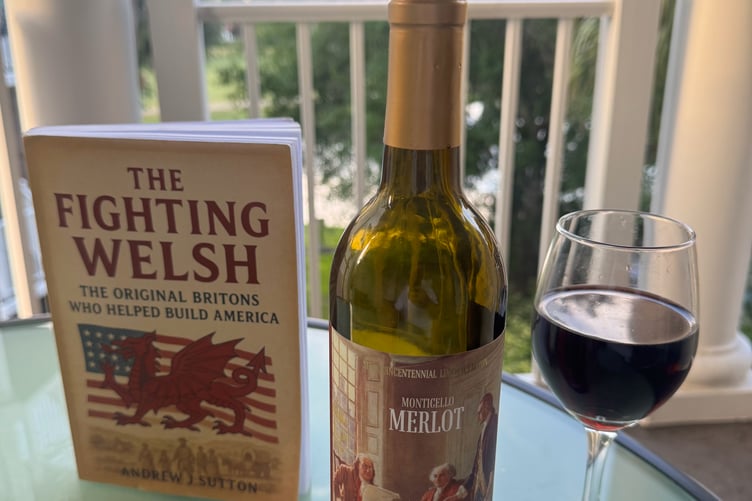
Pre-orders for The Fighting Welsh open worldwide on 4 June 2026 on Amazon.com, with the book launching officially on 4 July 2026 in recognition of America’s 250th year of Independence.
Comments
This article has no comments yet. Be the first to leave a comment.