
THERE is scarcely a sector of America’s rise, whether political, industrial, financial, artistic, educational, or media, that is untouched by Welsh blood.
Between 1740 and 1900, Wales became the -World’s First Industrial Nation- producing more iron and coal than almost anywhere else on earth.
In the heart of the ancient Silurian lands of South Wales, the town of Tredegar rose in the nineteenth century as one of the world’s great industrial strongholds.




What had once been a landscape of hills, forests, and streams became a furnace-lit powerhouse of iron, engineering, and innovation.
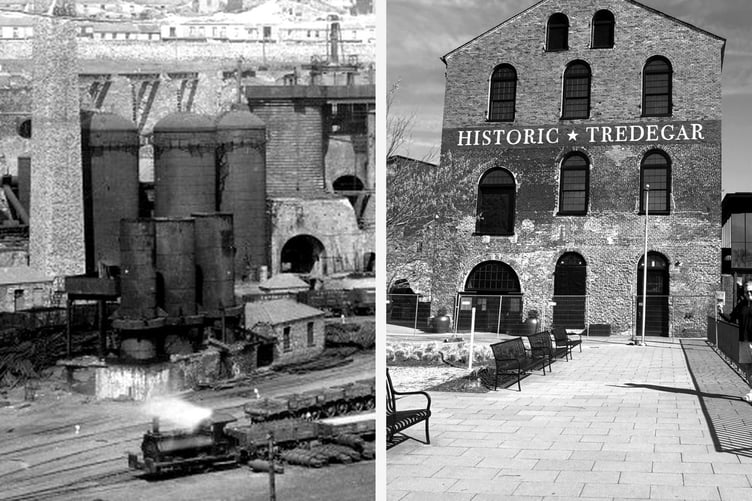
At the centre of this transformation stood the Tredegar Ironworks, founded in the early 1800s and later owned by the influential Crawshay and Morgan families.
Its vast furnaces roared day and night, producing rails, plates, and heavy ironwork that travelled across the British Empire and beyond.
Tredegar was not merely a place of production; it was a training ground of industrial mastery.
Its ironmasters pioneered large-scale smelting techniques, advanced blast furnace design, and the disciplined organisation of labour that would later define modern industry.
The town’s skilled engineers and metalworkers became renowned for their craftsmanship, exporting both their products and their expertise overseas.
From these valleys came generations of miners, furnace-men, puddlers, and master craftsmen whose knowledge did not remain confined to Wales.
As America’s railways expanded westward, Welsh ironworkers and colliers carried their experience across the Atlantic.
The discipline, technical skill, and industrial culture forged in Tredegar helped shape not only Britain’s fortunes but also the industrial backbone of a rising United States.
Among them was Rhys Davies, a Welsh engineer whose influence on American industry was extraordinary.
In 1837, when an ambitious new ironworks rose on the banks of the James River in Richmond, Virginia, its founders deliberately named it Tredegar Iron Works, both a tribute to the famous Welsh town and to Davies himself.
Recruited for his rare expertise in furnaces and rolling mills, Davies brought over fellow ironworkers from Tredegar and Merthyr Tydfil.
His experience, refined in Welsh ironworks and France, was crucial in establishing one of the leading iron producers in the United States.
Though Davies died tragically in 1838, the result of an altercation with a worker rather than an industrial accident, the ironworks he helped design continued to transform America.
When the Civil War erupted, Tredegar Iron Works became the industrial heart of the Confederacy, producing cannons that fired the first shots at Fort Sumter. More than half of all Confederate artillery. Mortars and heavy guns that later stood on display outside the White House, stark reminders of a divided nation.
Yet the influence of Tredegar Virginia extended far beyond wartime armaments. Its innovations in furnace design, casting methods, and rolling-mill technology made it one of the most efficient iron producers in the country.
It supplied vast quantities of railroad track, bridges, and structural iron that helped drive the expansion of America’s industrial infrastructure, commerce, and transportation networks long after the war had ended. The South relied almost entirely on Tredegar Iron Works for weapons, rail tracks, and armaments, an industrial lifeline shaped directly by Welsh skill and ingenuity. Notably, the works were inspired by and named after the original Tredegar in the South Wales Valleys, designed and influenced by immigrant Welsh engineers.
The Morgan family of South Wales were not merely landlords; they were architects of the region’s industrial growth.
Through their estates at Tredegar House near Newport and extensive mineral rights across South Wales, they controlled vast tracts of coal and iron-rich land that fuelled Britain’s industrial revolution.
Their wealth was forged from the very earth beneath the valleys, and their influence shaped both local governance and industrial expansion.
The town of Tredegar in Wales itself became a symbol of this transformation.
Morgan Street, at the heart of the town, was lined with shops and businesses serving a population sustained by iron and coal.
A photograph which has been in my family since 1851 shows the Morgan Street of that era and captures a community steeped in industry — smoke rising from furnaces, terraced houses climbing the hillsides, and at its centre the famous town clock.
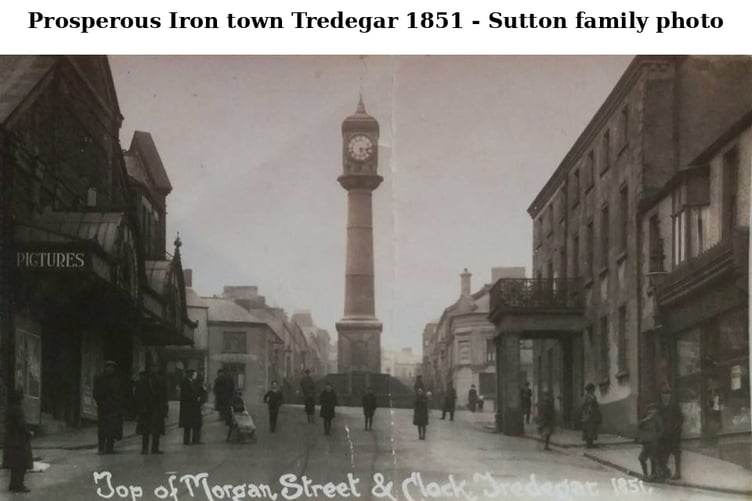
That clock, donated by the Morgan family, stood as a civic landmark and quiet declaration of patronage and permanence.
In a town built on molten iron and black coal, it marked not only the hours of labour but the passing of an era in which Welsh industry stood at the forefront of the modern world.
Tredegar Iron Works stands as both a monument to and a product of Welsh industrial genius, proof that the knowledge and craftsmanship born in the valleys of Wales crossed the ocean to forge the backbone of another nation.
Its legacy endures not only in the surviving brick furnaces along the James River but in the broader truth that Welsh expertise helped power the economic, industrial, and military rise of the United States.
In America, the name Tredegar became immortal, a piece of Wales embedded in the story of American industry, and a lasting emblem of the Welsh hands and minds that shaped two nations.
The success of Tredegar Ironworks in Virginia played a part in the decline and eventual demise of the original works in Wales, due in some part to the lack of demand for the Welsh product, but also a brain drain of its age meant that what Wales lost, America gained in skilled workers, such as iron puddlers emigrating as they were the equivalent of Silicon Valley geniuses today.
One such puddler was Tredegar-born James Davis, who left Wales to become a US senator and presidential candidate.
Even in the new world and despite his entrepreneurial drive and endeavours, Davis would show the social justice that run through his Welsh blood by becoming the initiator of the world’s first legislative minimum wage.
During the later years of Wales’s industrial revolution — at a time when Welsh skills, industry, and labour traditions had already crossed the Atlantic and taken root in America — the town of Tredegar gave the world one of the most remarkable humanitarian ideas ever conceived: healthcare free at the point of need.
Long before the creation of Britain’s National Health Service, the people of Tredegar had already built their own system of community healthcare through the Tredegar Medical Aid Society.
Funded collectively by workers and employers, it ensured that families in the town could receive medical treatment regardless of their ability to pay.
This pioneering model later became the inspiration for the National Health Service, championed by Tredegar-born Aneurin “Nye” Bevan, who as Minister of Health in 1948 brought the principle to the whole of Britain.
But the idea itself was not created by government — it was created by the people. It grew from the powerful Welsh tradition of community, solidarity, and mutual care: the belief that a society is strongest when its people look after one another.
From the coalfields of Tredegar came a principle that would change the world: healthcare organised by the people, for the people — a humanitarian legacy born in Wales that continues to shape modern societies today.
The Fighting Welsh, published to coincide with the 250th Year of Independence is now available on Amazon.
Comments
We've recently changed our login process. If you have an account for commenting, you will need to re-register on the login window.
This article has no comments yet. Be the first to leave a comment.