
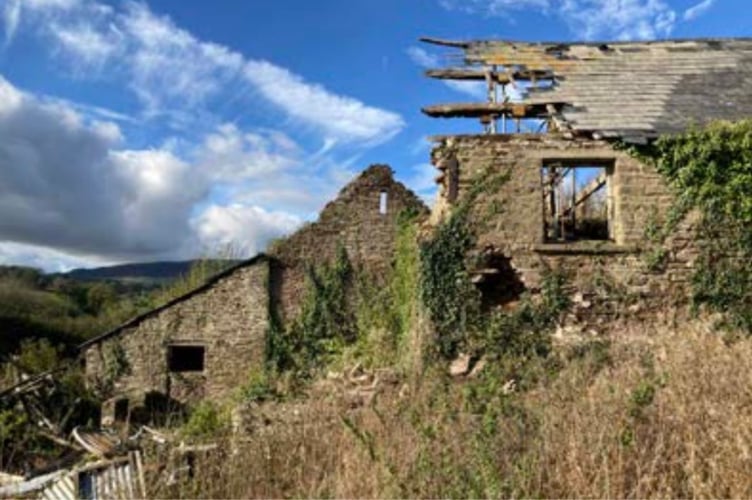
A RESTORATION project that will convert three listed barns to residential accommodation will also benefit birds, bats and owls, a meeting heard.
Councillors approved the renovation and domestic conversion of the historic barns, that were once part of the grade II star-listed 15th century New House Farmhouse between Abergavenny and Monmouth, but have been empty for 25 years.
All three barns near Llanddewi Rhydderch and Llanvetherine are grade II-listed and photographs showing the “dilapidated” condition of two of them were highlighted to councillors who were told they are highly ranked on Monmouthshire County Council’s “buildings at risk” register.
The approved plans, submitted by Ingrid Mansfield Thomas, will see Y Beudy, an old byre and later a milking parlour, converted to a living space and it will be linked to the Cruck Barn to become a three bedroom house.

An existing link between the Cruck Barn and the Old Stables will be rebuilt and that will form a car port at the front with a living space above it, with a kitchen, as an annex.
Planning officer Philip Thomas told councillors: “Both the Cruck Barn and the Old Stables are rather dilapidated and in need of some significant TLC really to restore them. Y Beudy is the best preserved.”
He described the Old Stables, which has a large part of its roof missing, as in “probably the worst condition” and in need of some rebuilding.
Mr Thomas said: “The Cruck barn is a fantastic building and has got some amazing timbers in it but is need of restoration and is on our register of heritage assets needing urgent work.”
He said changes had been made during the design process in response to comments from the council’s heritage officer and said: “We commend this well developed and much needed proposal to restore these fragile heritage assets for future generations”
In response to Devauden Conservative councillor Rachel Buckler, who asked about the impact on swallows and a tawny owl that may be living in the barns, Mr Thomas said the council’s ecology officer is satisfied with mitigations proposed but it will ultimately be a matter for environmental agency Natural Resources Wales.
He said: “It will need a licence, primarily because of bats, from NRW.”
Mitigation measures include hedgerow and fruit tree planting, hedgehog boxes and invertebrate habitat features including insect bricks, four artificial bird boxes, three swallow cups, an owl box and three bat boxes as well as a specific loft void for bats in the new roof space.
Independent councillor for Wyesham, Emma Bryn, said restoration will also preserve a home for the bats.
She said: “The bats will have a permanent home. At the moment it’s all falling down so the bats and the owls will all lose their homes as well as us losing a building. So it will preserve it for us all, I hope.”
Mr Thomas replied: ““That’s a good point because the buildings will fall down and there won’t be a roost left so that’s partly why NRW look at these things in the round, and don’t just say ‘ooh it’s a bat roost, you can’t do it’. They look at the bigger picture and enhancements and new features to provide for the wildlife.”
The highways department had objected to the application as it said the access drive, shared with New House Farmhouse that is in separate ownership, is only 3.65 metres wide, from verge to verge, at its narrowest point which is less than its 4.5m standard.
Labour’s member for Croesonen, Su McConnel, said that was described as the “modern standard” and said: “Well modern standards are usually there to keep people safe.”
Mr Thomas said a wider, engineered access wouldn’t be “sympathetic” to the listed buildings and one additional home would only result in a “very limited” increase in vehciles using the drive.
He said: “This access has been in use for a very, very long time and we don’t expect this one dwelling to attract much traffic. It’s a small sort of compromise to make to make sure these buildings are put back into use.”
A modern 20th century brick lean-to will also be demolished, which will allow for three parking spaces, and the plans also include solar panels on the new roof of the Old Stables as well as a ground source heat pump and treatment plant.
Drainage and water run off will also have to be approved as part of the SUDS, or sustainable urban drainage systems, approval process.
Comments
We've recently changed our login process. If you have an account for commenting, you will need to re-register on the login window.
This article has no comments yet. Be the first to leave a comment.