
RUGBY is woven into the fabric of Welsh life. More than a game, it has long symbolised community, discipline, resilience, and collective identity. When Welsh immigrants crossed the Atlantic in the eighteenth and nineteenth centuries, they carried these values with them—into mining towns, churches, schools, and universities. Their influence extended across American education, industry, civic leadership, and ultimately, sport.
One of America’s most influential universities, Yale University, owes its name and early prosperity to a Welshman, Elihu Yale. Beyond its name, Yale was shaped by early trustees, ministers, and benefactors from Welsh or Welsh-border families, steeped in Puritan-Welsh traditions of literacy, moral discipline, and civic duty. These ideals helped establish Yale as a leading centre of education in colonial America—and later, as the birthplace of American football.
During the 1870s, football on American campuses was a chaotic hybrid of soccer and rugby, played under inconsistent rules. That changed in 1875, when Yale faced Harvard in a landmark match played under rugby-style rules adopted by Harvard from McGill University. Fifteen players per side ran with the ball, passed backward, and kicked forward—precisely as in Welsh and British rugby. More than 2,000 spectators attended, signalling the emergence of a powerful new sport.
Two spectators at that game—Princeton students Jotham Potter and Earl Dodge—later became key figures in codifying early American football rules. Genealogical records indicate that Potter’s ancestor, Samuel Potter, came from Wales. Potter and Dodge organised the meeting that formed the Intercollegiate Football Association and established the first standardised rules of the game.




By 1876, Yale, Harvard, Princeton, and Columbia were playing what was essentially rugby football under a new American name.
Central to this transformation was Yale coach Walter Camp, later known as “The Father of American Football.” Camp introduced the line of scrimmage, the system of downs, and redefined scoring by evolving rugby’s “try” into the American touchdown—adapting British rugby principles into a uniquely American game.
The term “touchdown” itself originates in rugby, where grounding the ball beyond the goal line earned the right to attempt a kick. Camp retained the language while reshaping the method, demonstrating how deeply the British—and especially Welsh—rugby tradition was embedded in the sport’s DNA.

These developments did not occur in isolation. Many early players, administrators, and rule-makers came from British and Celtic immigrant backgrounds, particularly Welsh communities in Pennsylvania, Ohio, and New England, where rugby knowledge, chapel culture, and teamwork were deeply ingrained.
Jotham Potter, of Welsh ancestry, played a central role in organising early rulemaking. Another key figure was Parke H. Davis of Princeton. The surname Davis—derived from the Welsh ap Dafydd (“son of David”)—is widely recognised as Welsh in origin. Davis played for Princeton between 1890 and 1892 before becoming one of the sport’s earliest historians and record-keepers. During his later coaching tenure at Lafayette College, the first leather football helmet, described as a “head harness,” was introduced in 1896—another milestone in the game’s evolution.
Numerous early Princeton trustees and clergy bore Welsh surnames, including Howell, Lloyd, Price, Evans, Harris, Morgan, and Griffith, indicating that Celtic influence extended beyond the field into governance and administration.
Harvard University, America’s oldest and most influential university, reflected similar values during its first century: reverence for scripture, disciplined scholarship, and civic responsibility—hallmarks of the English Welsh borderlands. The Harvard Rugby Football Club, founded in 1872, remains one of the oldest in North America, established just eight years after Neath RFC (1871), the oldest rugby club in Wales.
By the 1890s, American football had become dangerously violent. Mass formations such as the Flying Wedge led to mounting injuries and fatalities. As deaths increased, Walter Camp reportedly argued that elements of British rugby needed to be reintroduced to prevent the sport from destroying itself.
In 1905 alone, nineteen players died and more than 130 were seriously injured. Newspapers condemned the sport as “war without rifles.”
That same year, modern rugby was flourishing in Wales, producing legendary players, vast crowds, and global admiration. On their way home from touring Britain, the New Zealand All Blacks played exhibition matches in the United States, showcasing a fast, skilful, and far safer version of rugby.
American audiences—many descended from Welsh, English, Irish, and Scottish immigrants—recognised the parent game from which American football had emerged. The tour resonated deeply, particularly following Wales victory over the All Blacks in Cardiff in what became known as “The Match of the Century,” confirming Wales as the world’s leading rugby nation in 1905.
Public concern reached President Theodore Roosevelt, who summoned representatives from Yale, Harvard, and Princeton to the White House and demanded reform. The result was the formation of the National Collegiate Athletic Association in 1906 and sweeping rule changes, including the abolition of the Flying Wedge, the creation of the neutral zone, and the legalisation of the forward pass.
These reforms transformed American football into a safer, more strategic, open-field game—fulfilling Camp’s belief that rugby principles had to be preserved to ensure survival. The flowing, open play admired in Welsh rugby echoed once more in America’s evolving sport.
Without Elihu Yale, there would be no Yale University. Without Yale, there would be no Walter Camp. Without Welsh rugby traditions at a critical moment, American football might not have survived its most dangerous years.
At the very moment reform was needed, Wales stood as the unofficial world champions of rugby, producing heroic figures such as Arthur Gould of Newport—hailed as “The Greatest of Rugby Football Player” and later inducted into the World Rugby Hall of Fame. While the All Blacks showcased rugby in America, there were virtually no New Zealand immigrants in the United States in 1905. It was Wales that represented rugby’s highest standard and moral authority at the time.
From that pivotal period, American football evolved into the modern NFL, watched weekly by millions, while rugby union remained largely amateur for much of the twentieth century.
Despite their shared physical demands, elite-level crossover between rugby and American football has been exceptionally rare.
The Fighting Welsh highlights one of the clearest examples: Paul Thorburn.
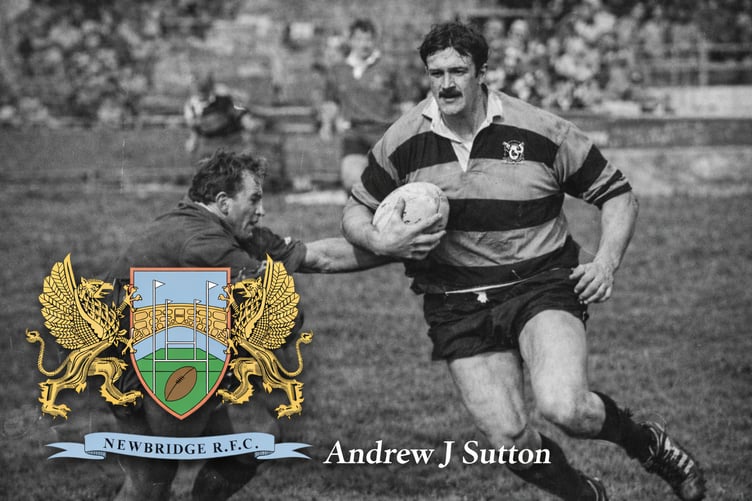
I played alongside Thorburn, one of the greatest kickers in rugby history.
Thorburn represented Wales at the highest level and also appeared in an official NFL game as a kicker for the Los Angeles Rams, while still an active international rugby player.
Already a national hero, Thorburn had kicked the match-winning conversion against Australia to secure Wales third place at the inaugural 1987 Rugby World Cup. In 1986, he set a record that still stands: a successful penalty goal from 70 yards and 8.5 inches—the longest kick in rugby history.
Offered a professional NFL contract, he declined to preserve his amateur rugby status. He later captained a Wales to a Triple Crown and led a touring party on an unbeaten tour of Canada in 1989.
Pre-orders for The Fighting Welsh open worldwide on 4 June 2026 on Amazon.com, with the book launching officially on 4 July 2026 in recognition of America’s 250th year of Independence.
Comments
We've recently changed our login process. If you have an account for commenting, you will need to re-register on the login window.
This article has no comments yet. Be the first to leave a comment.