
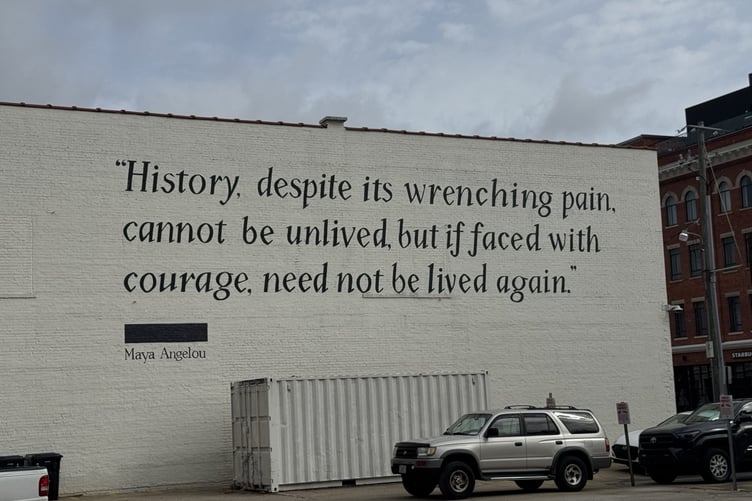
SEPARATED by more than 4,000 miles and an Atlantic Ocean, Montgomery, Alabama and Montgomery, Wales share a hauntingly similar story — one of conquest, subjugation, and ultimately, resistance.
In The Fighting Welsh, local author Andrew J. Sutton draws a powerful parallel between these two places, revealing how both were shaped by systems of domination — and how both became crucibles for human courage.
In Montgomery AL USA, history stands openly in the streets. The city was the first capital of the Confederacy and home to Jefferson Davis, whose government fought to preserve slavery. There is almost poetic justice in the fact that today the statue of Davis stands outside the State Capitol, gazing down Dexter Avenue toward Dexter Avenue Baptist Church, where Martin Luther King Jr. preached, and on toward Court Square, where Rosa Parks sparked the Montgomery Bus Boycott — an act of quiet courage that ignited the modern Civil Rights Movement in America.
Sutton writes that he has walked these very streets, and that seeing history laid out so visibly is essential — allowing visitors to confront the past exactly as it unfolded through time.
From these same streets that were once filled with confederate soldiers and protects Klan members emerged the Selma–Montgomery Marches and landmark civil rights legislation that reshaped America.
Montgomery, Alabama was built on land taken from Indigenous peoples and wealth created by enslaved Africans. Yet it also became a moral battleground where ordinary people forced a nation to confront its conscience.
Across the ocean lies Montgomery in Wales a frontier town founded by Norman conquerors in the 13th century from which the name originates taken from the Norman lord Roger de Montgomery, one of William the Conqueror’s most powerful lieutenants after the Norman invasion of 1066.
Montgomery Castle rose as a fortress of English power, built by subjugated Welsh hands. Native Welsh people were stripped of land, rights, and legal protection under a brutal two-tier system of rule, becoming second-class citizens in their own homeland.
At this time, Welsh communities were forced into unpaid labour by de Montgomerie lords and Norman knights. They were legally tied to the land, denied rights, and subjected to brutal punishment if they resisted. Captives were treated as property, traded between Marcher lords like livestock. Under Norman law, a Welshman could be killed by his lord without trial, while an Englishman who killed a Welshman paid only a fine. It was conquest written into law.




But Wales resisted.
In 1402, Owain Glyndŵr, the last native Prince of Wales, led a daring uprising. With skilled Welsh archers and guerrilla fighters from the surrounding hills, his forces captured Montgomery Castle — a symbolic victory that signalled a national rebellion against English oppression.
Sutton shows how both Montgomery’s were born from conquest — and how both later became symbols of resistance.
The American city was named after a Revolutionary War general whose family descended from the same Norman line that founded Montgomery in Wales centuries earlier. Two towns, linked by name and lineage, reveal a shared historical truth:
History connects us across oceans, centuries, and bloodlines, reminding us that while power rises and falls, the human spirit endures. Separated by continents, these two Montgomerys reveal the same sobering reality:
“Where power is built on domination, suffering always follows — and resistance always rises.”
Comments
We've recently changed our login process. If you have an account for commenting, you will need to re-register on the login window.
This article has no comments yet. Be the first to leave a comment.