
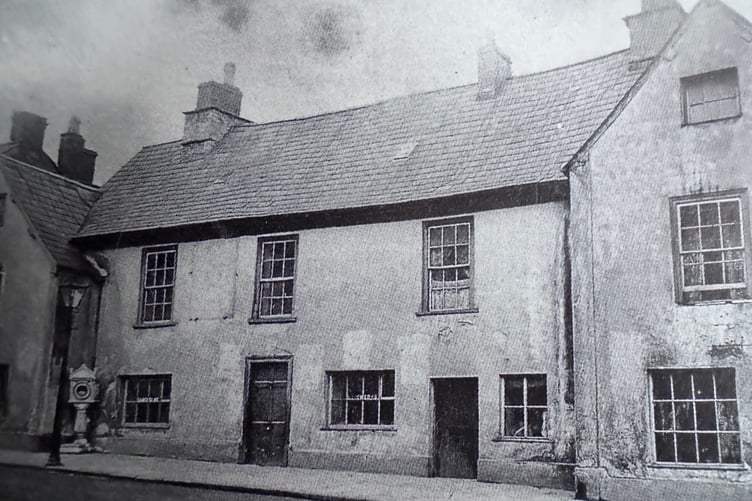
THE original Gunter family can be traced back to the Normans and the family settled in Breconshire.
One part of the family moved into the Abergavenny area and a certain James Gunter bought the lands of the dissolved priory and his grandson, Thomas Gunter II, built the property now known as the Gunter Mansion (37-40 Cross Street) around 1630.
It is believed Thomas lived there as well as being his place of work as a lawyer. This seems to be borne out as a large number of documents were found under the floorboards in 1907.
They were dated between 1674 and 1697 and had “Thomas Gunter, Attorney at Law” written on them. While most of these documents were in a very fragile state, some of them have been preserved and are kept in Abergavenny Museum.

The Local History Society did a comprehensive street survey in 1979 and it would appear that the ground floors were retail outlets and the upper floors were used as living accommodation from the start of Queen Victoria’s reign in 1837.
Number 39 became a public house in 1856 and was known as the Parrot Inn. In 1897 the name was changed to The Cardiff Arms. The last landlord of the pub went bankrupt in 1907 and this led to an advert in the Chronicle dated September offering: “An important block of main street freehold property to capitalists, builders and others. The Hereford and Tredegar Brewery, who are selling in consequence of the surrender of the licence of The Cardiff Arms, to offer for sale by auction all that freehold property, containing 2050 square yards and a frontage of 78 feet, known as 37, 38, 39 and 40 Cross Street”.
A local builder, Thomas Smith Foster, bought the whole building and started work to renovate and develop his newly acquired property.
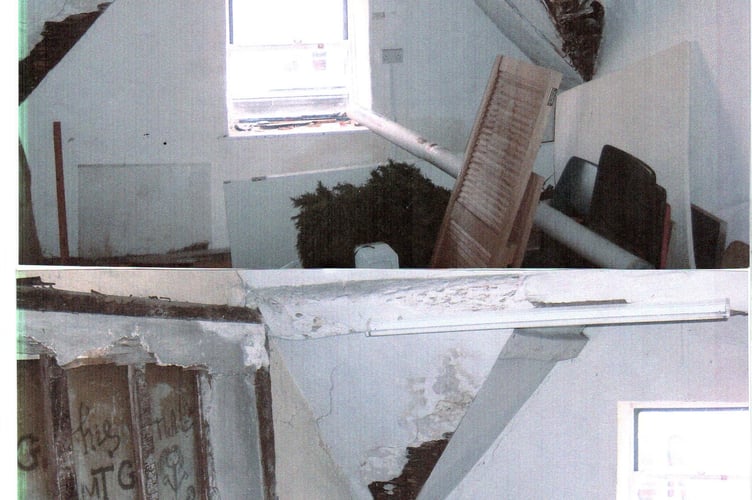
Soon after his workmen had begun, they found a highly decorated little room in the attic of the lower gable end (No. 37).
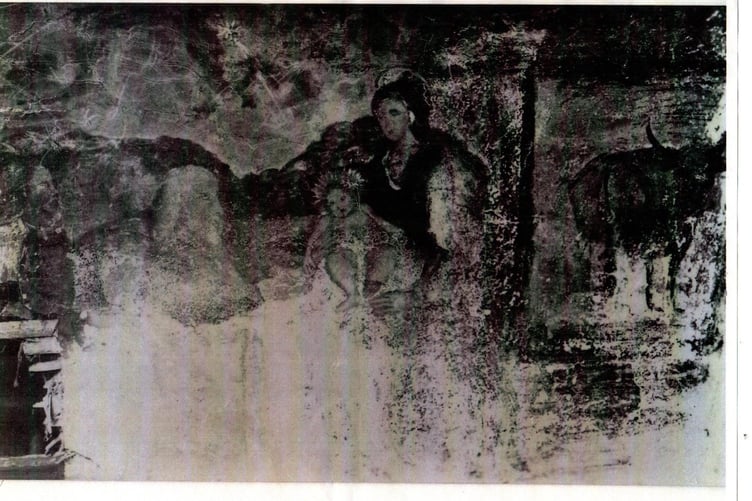
Mr. Foster’s wife, Ada Foster, took a keen interest in this discovery. The really exciting find was a mural on the ceiling depicting the Adoration of the Magi.
Mrs. Foster thought that this was worth preserving and had it photographed before it was removed. As it had been painted on a lath and plaster background, parts of the image crumbled away but most of it was mounted in an oak frame behind glass.
On further inspection of the room, Mrs. Foster found a symbolic “IHS within rays, surmounted by a cross” which is the mark of the Jesuits.
Mrs. Foster made enquiries with local historians and John Davies from Pandy gave his opinion that this attic room was a secret catholic chapel and was undoubtably the one that John Arnold of Llanfihangel Court referred to in his evidence to the House of Commons in 1678 that led to the arrest and execution of Father David Lewis.
The painting of the Magi was probably the altar-piece of the secret chapel with the altar positioned below it. Up until now, the precise house in which the chapel was established had never been ascertained as the description had only been “the house of Thomas Gunter”.
John Davies wrote an article in the Abergavenny Chronicle dated the 17th of January 1908 about the discovery of the chapel and its mural of the Adoration of the Magi. This prompted other people to respond with their own memories.
One said that the Foster’s discovery of the chapel was not strictly true as the previous tenant, Mr. D. E. Jones, had found it and the auctioneer had disclosed it during the auction of the property on the 17th of September 1907.
Another letter came from Caleb John Hill of Llanvetherine and he said he was interested and somewhat amused by John Davies’s article. During the many years that he had worked with his father in renovations to properties in the town, he had opportunities of seeing many ancient things and amongst them those of the Parrot Inn.
In June 1865, the whole front roof of the property was stripped and slated, and then he saw what had been so eloquently described.
At that time there was no access to the attic but one could see where an entrance had been and closed up from the outside, the only entrance then being through the roof. The work was done for the then owner, Mr. John Goodwin of the Swan Hotel, and subsequently, in September 1876, the back was slated for the trustees of Mr. John Watkins, painter, of Cross Street.
In his book, Out and About in Monmouthshire, Fred Hando described a visit to the Gunter Mansion sometime before 1956.
He met with an 81-year-old Mrs. Francis who had lived in the house for 50 years. She assured him that Mr. Foster had built a primitive stairway to the attic in 1907 and there had been no alternative entrance.
Fred Hando walked around the outside of the house and could find no obvious external entrance to the attic but he did see a lintel, that could have been a doorway, on the pine end of No. 37 just above the peak of the intervening cottage roof of the adjacent property.
Mrs. Francis went on to say that Mr. foster had decided to give her the extra room and knocked down an existing lath and plaster wall which was dividing the attic into two unequal spaces. It was then that the treasures were exposed.
Two other personal recollections came to light. The first was from Helen Jenkins who said she moved into the premises in 1951 and the framed mural of the Magi was standing against a wall.
Her husband put it in an alcove over an old oak sideboard in the part of the property that was a café. Visitors from all over the world came to their house and free access was given to see the mural and the original cherubic ceiling on the first floor.
The second recollection came from the late Adoree Flower whose grandmother had bought the whole building around 1952 and she recalls spending her teenage years there. Whilst helping her family to clean the property she discovered the mural hidden behind a dresser.
Local historian, Alfred Jackson, was consulted and he contacted Christie’s who verified it as a “priceless 17th Century work by an unknown artist.” The mural then found its way to Abergavenny Museum where it is still on display today.
Comments
We've recently changed our login process. If you have an account for commenting, you will need to re-register on the login window.
This article has no comments yet. Be the first to leave a comment.