

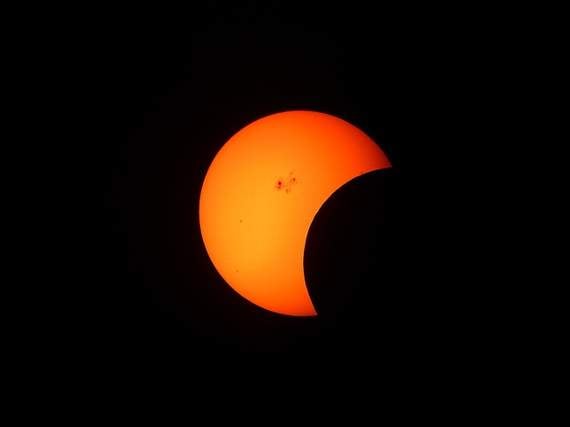
This century’s longest eclipse is set for this Friday and promises a spectacle to be unseen for another 82 years.
The longest eclipse of the 21st Century will grace the skies shortly after 9pm on Friday, July 27.
The spectacle will see the planet Mars shining its brightest for 15 years, joining the near eclipsed moon around half an hour later.
Mars will rise around half an hour after the eclipsed moon, making for a wonderful sight and a must for all space photographers, as the red planet makes its closest approach to Earth.




“At 9.10 p.m. the moon will rise just short of being totally eclipsed, with a distinct redness to its appearance. The redness is due to the sun’s rays passing through the Earth’s atmosphere and being refracted so that we only see the red portion of the spectrum,” said astronomy expert Jonathan Powell.
“In the past, the redness has been enhanced at times, with others colours also observed, with the moon turning blue in colour following the eruption of Krakatoa in 1883.
“But that’s not all. The moon will be positioned at its further point from Earth, (apogee), making it a micromoon, as opposed to a supermoon,” he added.
The moon will enter two parts of the Earth’s shadow, the lighter less noticeable penumbra, and the darker shadow, the umbra.
To catch a glimpse of this spectacular occurrence, look toward the southeast around 9.10 p.m. with the moon, (in the umbra part of the shadow), rising near to being totally eclipsed at around 9.12 p.m. Totality will take place at 9.22 p.m., with totality finishing around 10.15 p.m.
The moon then leaves the umbra shadow, entering the light part of the Earth’s shadow, the penumbra, clearing the penumbra at 12.29 a.m.
Comments
This article has no comments yet. Be the first to leave a comment.