
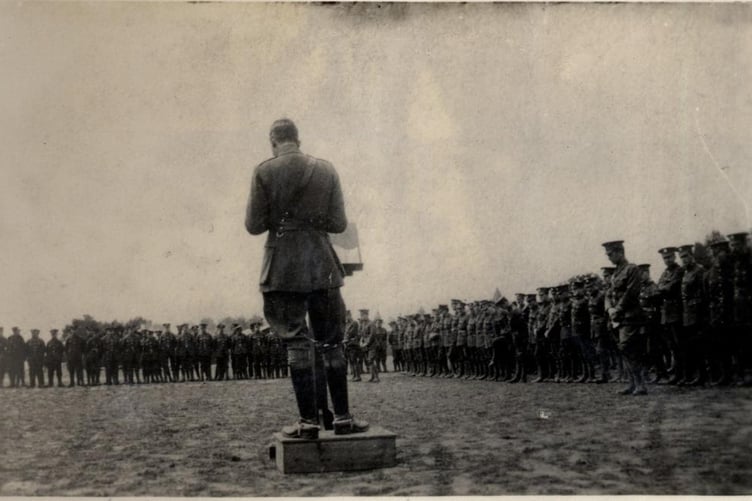
Randle-Barnett-Barker was the second occupier of an imposing mid-Victorian house on the Monmouth Road, Abergavenny called Cae-Kenfy.
Originally built in 1860 by a local solicitor, William Forster Batt, on a leasehold arrangement with the Coldbrook Estate. William had married one of the grand-daughters of the Crawshay family from Merthyr Tydfil in 1854 but his young bride did not live long enough to see the house completed.
William Forster Batt died in 1878, aged 65. The house remained in the family until its eventual sale to Randle Barnett-Barker.
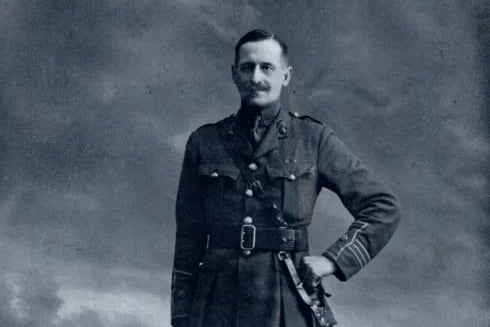
Born of a military family in London in 1870, Randle joined the militia before moving to the regular army in 1891. He served time in India before marrying Elinor Gertrude Hobson in 1897.




Her father and grandfather were both in the Manchester cotton trade. Elinor's father, Richard Hobson, married into a wealthy family and they lived a very comfortable lifestyle in North Wales.
In 1879 her father inherited a house and £80,000 from a paternal uncle with which he bought a large Victorian house called “Marfords” in Bromborough, Cheshire.
This house came with stables for eight horses and needed ten gardeners to look after the grounds. Then in 1896 Elinor's uncle died and left an estate of £500,000 (over £20,000,000 in today's money) of which £125,000 went to Elinor's parents. Marfords become a Dr. Barnardo's home from 1937 until its closure in 1962 and has since been demolished.
In 1900, Barnett-Barker was the adjutant of the Denbighshire Volunteers who were being sent off to the Boer War in South Africa. The commanding officer wanted his volunteers to have more comforts than the regular soldiers as they were making huge sacrifices in their ordinary lives to go and fight for their King and country.
Barnett-Barker was put in charge of receiving donations of extra clothing and money into the Yeomanry and Equipment Volunteer fund. By the end of March over £107 had been received into the fund. In 1902 Randle Barnett-Barker was instrumental in getting the Cheshire Brigade, of which he was Brigade-Major, to come and hold their summer camp at Abergavenny for a couple of years in a row.
Nobody had risen, in this district, as rapidly as Barnett-Barker and he had a record to be proud of. In 1906 Randle Barnett-Barker left the army and settled in Cae-kenfy sometime afterwards.
Shortly after the outbreak of the First World War he was put in charge of a Prisoner of War camp at Frimley. He then helped the Mayor of Kensington to raise the Kensington 22nd battalion of Royal Fusiliers and he took them to France in October 1915.
By now he had been promoted to Lieutenant-Colonel. Under his command the regiment fought in six large battles on the Western front that included Vimy Ridge,
The Somme, Ancre and Arras. Barnett-Barker was mentioned in despatches several times and was awarded the Distinguished Service Order (DSO) in connection with capturing and holding Deville Wood on the Somme.
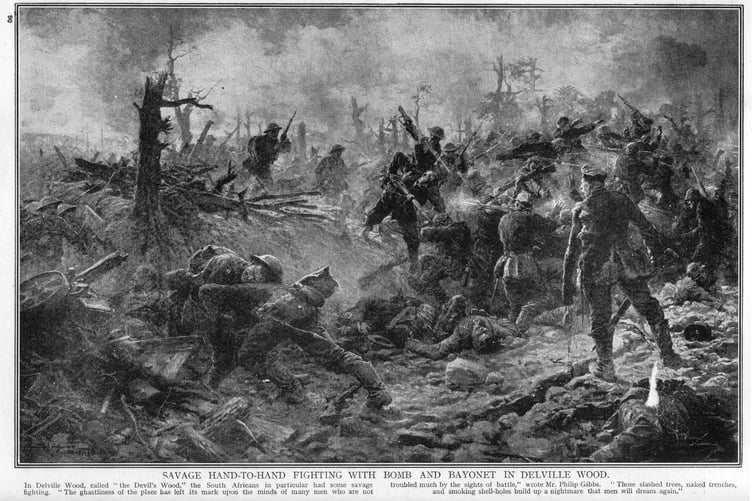
He had taken over the defence of the wood after making a personal reconnaissance of the whole area under shell and machine gun fire showing great personal bravery.
In April 1917 he was awarded a bar to his DSO for gallantry when his battalion was forced to withdraw from its objective owing to heavy casualties and a lack of support.
At this critical moment, he reorganised and rallied his men and by his promptitude and fine leadership won back most of the lost ground and held it until relieved.
He was subsequently promoted to the rank of Brigadier-General of the 1st Brigade of the 99th Division. After 15 years in a peace time army, he had only reached the rank of captain but his promotion during three years of war had been rapid.
He was now becoming war weary and in May of 1917 he wrote a letter home and said: “I am sick and tired of these bloody battles and everything connected with them.”
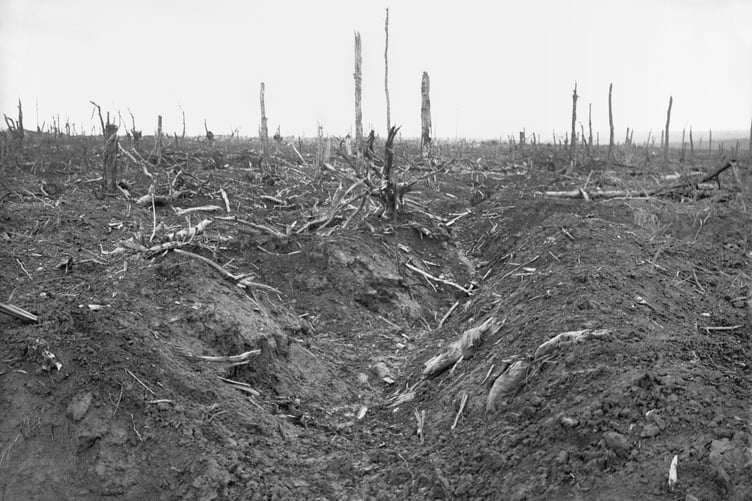
A year later the German army began the 1918 Spring Offensive. Revolutionary Russia had come to terms with Germany and had pulled out of the conflict enabling nearly a million German soldiers and 3000 guns to be transferred to the Western Front for one final attempt to overrun the allied armies before the Americans could make an appearance in force on the western front.
The allies were aware of what the enemy were up to but they did not know when or where the attack would come. It began on the 21st of March 1918 with a barrage of 10,000 guns firing over a million shells in five hours.
Stormtroopers had been trained to move forward with all possible speed and bypass any potential resistance.
By the second day the British 5th Army was in full retreat. Field Marshall Haig issued his famous order of the day: “There is no other course open to us but to fight it out. Every position must be held to the last man, there must be no retirement. With our backs to the wall and believing in the justice of our cause each one of us must fight on to the bitter end. The safety of our homes and the freedom of mankind alike depend upon the conduct of each one of us at this critical moment.”
But the Germans had not made any allowances to supply the troops that had moved many miles in front of their own lines and so the offensive lost its impetus but not without huge losses on both sides. Barnett-Barker was in the thick of the severe fighting of the offensive and was killed by shell fire on the 24th of March.
Contrary to the popular belief that generals only ever stayed at the rear of the battlefield, Barnett-Barker was one of the 57 generals killed on the front line.
The news came to Abergavenny in a letter from his orderly, Lance Corporal Ivor Peake, to his parents, but Mrs Barnett-Barker had to wait nine days before she was officially told of the death of her husband.
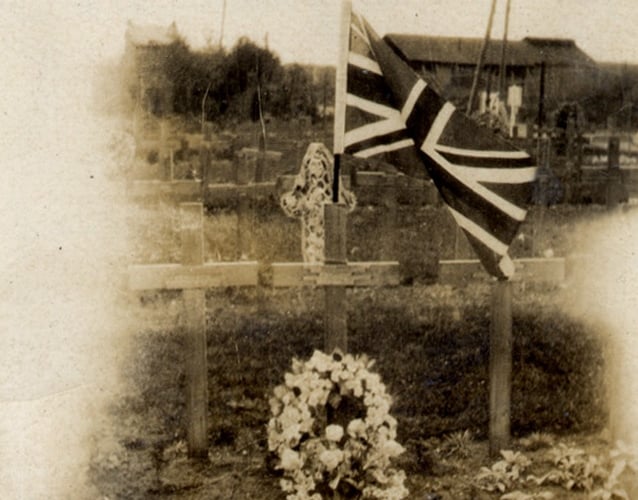
The deceased general was idolised by his men. His coolness and fearless courage earned him the respect and admiration of all those who served under him. Brigadier-General Randle Barnett-Barker is buried in one of the many battlefields on the Somme and his headstone is mysteriously engraved with the words: “believed to be buried in this cemetery.”
The Abergavenny Chronicle of 16th of May 1919 reported that the question of a war memorial in St. Mary's Church, Abergavenny has been considered by a committee, who have adopted a scheme for a reredos to be placed behind the holy table, together with a mural tablet containing the names of the fallen. This will cost a minimum of £400. The committee also proposed to restore the East window to its original shape of a Norman arch and this would cost a considerable sum.
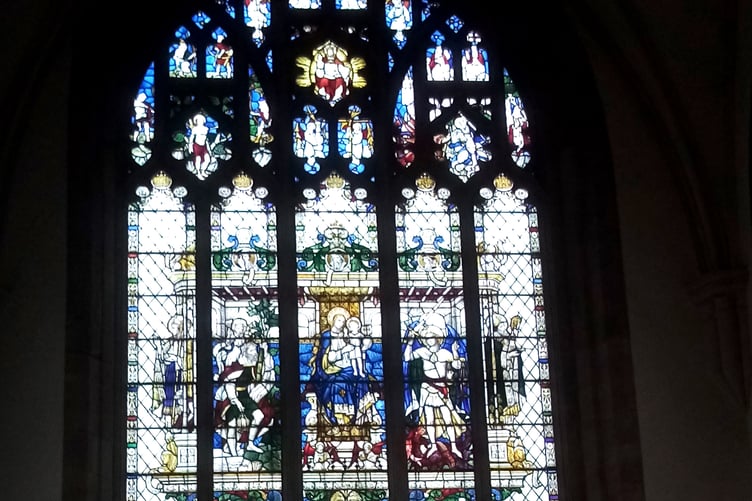
Mrs. Barnett-Barker offered to pay for the stained-glass window and tenders were invited for the stone work. The window was duly completed in 1922 and covers the whole of the wall above the altar.
There is no dedication to her husband on the window but there is a small brass plaque next to the choir stalls that is in his memory. It reads: “To The Glory Of God and to the most dear, most honoured memory of Brigadier- General Randle Barnett-Barker, DSO and bar of the 99th Brigade, 2nd Division, who fell at GUEUDECOURT during the 2nd Battle of the Somme on March the 24th, 1918 and buried at ALBERT….. He was four times mentioned in despatches and for his services was awarded the Distinguished Service Order and bar. The East window of this church is the gift of his widow and his two sons, a lasting memory of his valour and their love.”
An earlier article in the Abergavenny Chronicle of 16th of October 1914 had the headline: “Belgian refugees of the professional class.”
It went on to say that there was an urgent need for hospitality for members of the professional classes who have been obliged to flee from the German invasion.
Mrs. Barnett-Barker was among the local “well-to-do” families who had kindly received some of this class into their homes as guests.
A week earlier, the Chronicle reported the arrival of Belgian refugees at Abergavenny Monmouth Road railway station. There were seven women and five children who were greeted on the platform by the Mayor of Abergavenny, Zachariah Wheatley. Mrs Barnett-Barker and the Misses Morgan of Brooklands had kindly sent their motor cars to convey the refugees to their temporary homes in Castle Street.
A snippet from the Abergavenny Chronicle dated 30th of January 1914 said that 30 children from the Abergavenny workhouse were treated by Mrs. Barnett-Barker of Cae Kenfy to a cinematograph entertainment. And again, on the 22nd of February 1918, the Red Cross hospital at Maindiff Court received a donation of 6 pigeons from Mrs. Barnett-Barker. On the 21st of December 1917, Mrs. Barnett- Barker paid the expenses of an evening entertainment at the Town Hall when the well-known Mr. Alfred Capper gave a clever and amusing performance in thought transmission and other mysterious phenomena. (In 1912 he had travelled 50,000 miles on a world tour but his life was tragically cut short in 1921 when he was knocked down by a taxi in Paris).
Elinor Barnett-Barker never re-married and went on to live until 1963 and died in Oxfordshire aged 92.
Comments
This article has no comments yet. Be the first to leave a comment.