
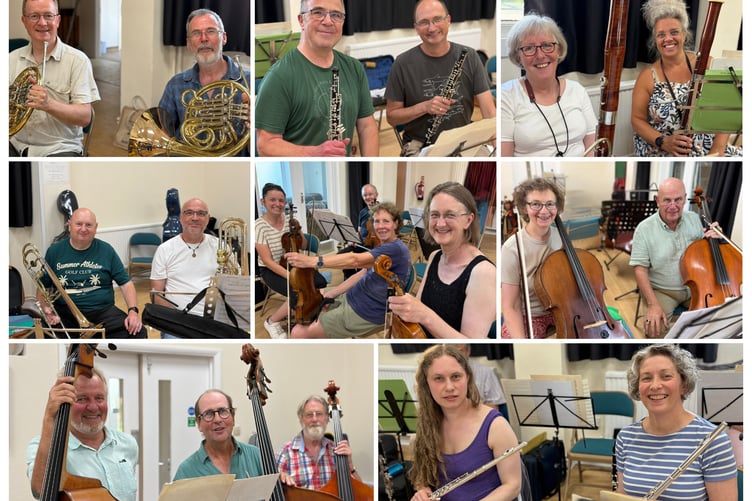
A steel worker, a teenager, a baronet and a hospital consultant walk into a room ... not the beginning of a joke, but what happens at 6:20 on a Sunday evening when they and other members of Abergavenny Symphony Orchestra gather for the weekly rehearsal. We have 14 educators, 12 medics, six IT specialists, a lawyer, vet, architect, police officer, composer, and many more occupations between us writes Bethan Barlow.
Back in 1886, when it all began, membership of the orchestra was quite different. I have searched through newspaper articles, trawled through many census returns and also birth, marriage and death records to learn about the 15 men who played in that first concert. I hope that the following descriptions are correct, but please email the orchestra if you spot any errors or have any information that would help me complete the ‘jigsaw’: [email protected]
The leader of the orchestra (the principal violinist) in 1886 was Mr Charles Thomas Busher who was aged 25 and was a railway accountant by day. He and his wife became well-known and well-respected in the town. They lived at 2 Mina Villas and then Rock House, St. Helen’s Road. Charles taught the violin and conducted small orchestras for amateur drama productions. The youngest of his three children, Denis, was killed in action in World War 1. Denis Busher’s name is on the war memorial in Abergavenny and also on the war memorial in Aberystwyth University. Charles remained in Abergavenny all his life, dedicating himself to the cultivation of alpine plants in his retirement.
Mr. Albert Percy Howells (violin) was a 20 year old who advertised regularly in the Abergavenny Chronicle as a ‘Master of French and Violin’ having studied both in Antwerp, Belgium. Born in Abergavenny, his father was an organist and music master and his mother a dressmaker. He gave violin lessons from 7 Westgate Terrace, but had moved away to Margate by 1896, where the census shows he was a ‘Professor of Music’ living with his, wife, their three children, a domestic cook and a domestic housemaid. If only teaching still paid this well!
Mr. Edward Baker (violin), could be one of two people of the same name living in Abergavenny at the time – Edward Baker was a glass and china dealer in town and Edward James Baker was a bank manager. The former was born, lived and died in Abergavenny. He resided over his shop at No. 2 High Street before moving to ‘Glendower Lodge’ on Monmouth Road, then ‘Riverdale’ on Brecon Road, settling finally at ‘Ashbrook’ on Windsor Road.
Sadly, he was widowed twice by the age of 55, but he had three daughters and was affluent enough to retain at least one servant throughout his adult life. Edward James Baker, on the other hand, was born in central London. At the time of his marriage to Maria in 1859, he was living in Cardiff and by 1871, the census shows them living near Bristol. However, just one year later in May 1872, when the Gloucestershire Banking Company announced that they were opening a branch in Abergavenny with him as manager, an article in the Usk Observer wrote that he “may be considered almost a local man”, so he must have had local connections. He would have been aged 60 and widowed by the time of the first orchestral concert.
He retired to Hereford and lived to the grand age of 88. He and his wife are buried in Llangattock. Edward James Baker’s father was a comedian and stage manager at the Olympic Theatre on Drury Lane, so maybe this Edward is more likely to have been the violinist in the orchestra.
Frederick H. Hinksman (violin) was a 23 year old who worked as an “asylum attendant” at Pen-y-Fal Hospital. He lived at 2 Asylum Cottages, Lower Monk Road until his retirement, when he moved to 101 North Street. He and his wife had six children who stayed in Abergavenny to work as labourers at a paper bag printing works.
James Arthur Evans (violin) was 27 and a railway clerk. He was from an affluent background – his widowed mother had an “income derived from houses” and as well as his own family, he financially supported his sister and employed a servant. He lived first at 12 Brecon Road, then ‘Western House’ on Western Road, and finally ‘Plas Winton’ on Avenue Road. He was promoted the Chief Staff Clerk, South Wales Division, London & North Western Railway Co. before retiring to Worcester.
Rowland Addams-Williams (violin) was the gentleman who ‘assisted’ at that first concert. He was from Bristol, the son of a magistrate and landowner. After graduating from Cambridge University, he became a solicitor, deputy coroner and insurance agent. Around 1886 he was lodging at Tower Street in Crickhowell, appearing in local concerts as a tenor, violin player and viola player in his spare time. By the time he was 40, in 1891, he was retired and living back in Clifton, Bristol ... presumably living off his family wealth, the family estate including Trerug Castle in Llangybi.
.jpeg?width=209&height=140&crop=209:145,smart&quality=75)

Mr. J.E. Edmunds (viola) is somewhat of a mystery. I can’t find anyone of that name living in Abergavenny at the time, so he may not have been local. He played in the 1886, 1887, 1888 and 1889 concerts but is not mentioned after that.
The other viola player was Henry Osmond Way, the eldest son of Mr William Henry Wilson Way, who played double bass. Mr Way senior was 48 at the time and had moved to 13 Market Street from Hammersmith, London in 1879 with his family – a wife, one daughter and 3 sons. He worked as a journalist ... possibly for the Abergavenny Chronicle!
Henry was 19 at the time of the first concert, still living at home and working as an umbrella manufacturer. However, music was to become his profession. Abergavenny Chronicle articles from 1898 mention that Henry started up ‘The Abergavenny Court Minstrels’ and that tickets for their first concert could be obtained from “Mr. H.O. Way’s Music Warehouse, Cross Street, Abergavenny”. By 1901 he had moved to Fulham where he worked as a piano tuner and later managed a piano and furnishings shop.
Frederick Thomas Angle (flute) was aged 31 and was a Railway Station Master. Fittingly, he was born and raised in Paddington, London where he began working as a railway clerk. After GWR Station Master posts in Caerleon and possibly Middlesex, he moved to Abergavenny where the youngest two of his seven children were born. He lived in Station House on Station Road with his family and a general domestic servant. He became secretary of the orchestra but his influence went deeper than that. In 1893 and 1894 his brother Percy, a talented cellist, played in the concerts. Another brother, Arthur Angle appeared as the violin soloist in the1887 concert and had been appointed as conductor by 1888. More about him in my next article!
James Berry Walford, aged 37, was the other flute player. Born in Ramsgate and starting his career as a solicitor there, he married the daughter of a local brewery owner. The Thanet Advertiser describes their wedding as a sumptuous affair, with a cake that “weighed nearly one hundredweight” (around 50Kg)! James moved to Penypound Chapel House, Abergavenny in 1877, where he lived with his wife, two children and three servants. He became a partner in the firm Gabb and Walford, was Clerk to the Magistrates for 39 years and District Coroner for around 20 years. After retiring, he moved to Folkestone, Kent with his wife. When he died in 1928, he left over £48,600, a huge sum of money in those days.
Robert William Bigg played the French horn and was an older member of the orchestra at the age of 57. He had spent most of his life in Gloucestershire and Somerset, assisting his father with their farm and tobacco business. By 1881, he and his wife Martha had moved to ‘Laurels’ on Merthyr Road in Llanfoist, with his brother-in-law and wife, living on their own means and employing servants. His last concert with AOS was in 1892, although he was still living in town in 1984 when he was sworn in as a member of the grand jury for the Monmouthshire Quarter Sessions. He retired to Christchurch in Hampshire, naming his house ‘Gwent’, and then moved again to Bournemouth where he died in 1912.
Two Mr Hills played in the first concert: Mr W Hill (clarinet) and Mr J H Hill (cornet). I assume that both are part of the Hill family that owned ‘The Brooks’ which was sold off and renamed Nevill Court (later Nevill Hall) in 1890. The Hill family were the owners of ironworks in Blaenavon and Cwmbran and had huge fortunes which were largely lost when the cost of converting to modern steel production financially devastated the business. James Charles Hill (AKA Captain Hill) played the cornet and is named in reports of musical events in the 1850s, but he died in 1879 so my research continues.
Alone one the cello in that first concert was the Reverend Alexander Ferrier Hogan, vicar of St. Teilo’s Church, Llandeilo Bertholau (Llantilio Pertholey). Himself the son of a vicar, he was born in Tintern and moved with his parents to County Londonderry. After graduating in Divinity from Trinity College, Dublin, he was ordained at Llandaff Cathedral and appointed curate at Llanfihangel Crucorney in 1859. By 1886, he was married with three daughters and a son. They would have had a comfortable life as the 1881 census records that his household included a governess, a cook/domestic servant, a house parlourmaid and an outdoor servant/general labourer – quite a different lifestyle to the modern vicar!
Rev’d Hogan himself applied for the patent of ‘The Kneeler Chair’ in 1898. His son must have inherited the inventing gene as he became a mechanical engineer. The two younger daughters became teachers. Mina (later known as Nina) was one of the first female students of the University of Wales, Aberystwyth and she also studied in Germany. The last 13 years of her working life were spent as principal of St. Teilo’s Prep School in Harrow Garden Village – presumably a school which she founded herself as it is named after her father’s church and former home. Rev. Hogan was 51 when AOS gave their first concert and he appears to have remained a member until he retired as vicar of St. Teilo’s and moved to Teddington to live in the same street as his son and close to his daughters. He died in 1915 aged 80. When Nina and her sister retired to St. Mary’s Bay in Kent, they named their new home ‘St Teilo’, so they kept the Abergavenny connection right to the end!
All of the 1886 players were male and almost all from professional homes. They were probably all privately educated and their music lessons would have been paid for privately, as schools didn’t offer instrumental tuition. Jumping back to 2026, our membership paints an interesting picture. A few of our members had a private education, but the vast majority attended state schools and are of an age when most education authorities supported extra-curricular activities such as music. We benefitted from being able to try playing an instrument at no cost to our parents – instruments were lent to pupils and weekly lessons were provided free of charge. Many of us also attended Saturday morning youth orchestras which were subsidised or free of charge. Orchestral music provides us in our adulthood not with a salary, but an escape from stressful occupations, the feel-good factor of creating something which is more than the sum of its parts, and a circle of friends from very different backgrounds. Our younger members benefit from all the same things but it has come at a cost as only those eligible for free school meals can now access free instrumental tuition. How this will affect the future of the orchestra remains to be seen.
Comments
We've recently changed our login process. If you have an account for commenting, you will need to re-register on the login window.
This article has no comments yet. Be the first to leave a comment.