

By Pamela Mason
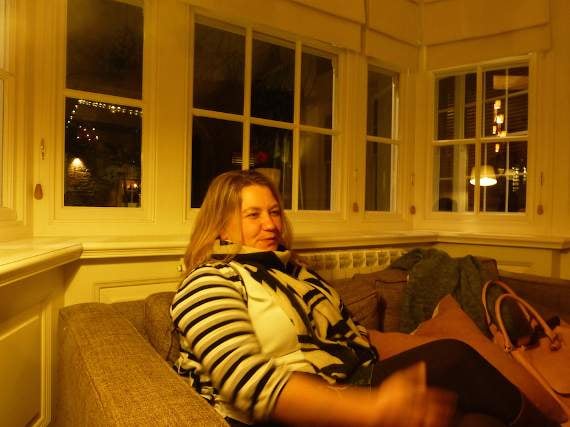
If you’ve been to the Abergavenny Food Festival, you may well have bumped into the new Chief Executive, Aine Morris. She’s been a regular visitor for several years, so she comes to her new role with the experienced eye of a punter.
“It’s a fantastic event with a great reputation,” she tells me over a cup of tea in The Angel.
She’s already had a busy afternoon - meetings with the festival team, and a briefing from Monmouth County Council on ‘agri-urban’, a Europe-wide project, which for Abergavenny, as one of eleven participating towns and cities, involves looking at the potential to improve the supply of local food.


No newcomer to working in the world of food, Aine joins the Festival with twelve years’ experience in the food and events industry. Most recently, she has been Festival Director for Bristol Food Connections, a city-wide food festival, where she clearly relished the opportunity to develop the festival’s strong connections with local communities and local producers.
You have only to be with Aine a few minutes to sense her passion for food, and her determination to communicate that in ways that are fun and educational, with the aim of getting everyone on board. She smiles when I mention the strapline of the Incredible Edible community food growing network of which Abergavenny is a member – “if you eat you’re in!”
Clearly, that’s what she believes the food festival should be about too. With that very much in mind, she’ll be encouraging community-led events over the festival weekends to encourage what she believes is so important – that a food festival should engage visitors and locals alike in telling the local food story.
Aine’s own food story began at her grandmother’s country farm in the north of England. Born in London, Aine grew up in Sheffield with very busy parents who had little time to make food and cooking a priority. But in her grandmother’s farmhouse kitchen, food was very definitely centre stage.
Aine tells me of the huge wooden table where she learned to cook - brown bread ice cream and marmalade cake – then fed the chickens. “You don’t realize the impact these things can have, but for me I learned very early on that food was important.”
But her real life journey in food began when she was 21 and had her daughter, Caireann. “Having a child was really significant, being responsible for another human being. Thinking about what to feed my daughter got me really interested in food. Before that it was a matter of choosing between a supermarket finest range and a basic. We’d eaten out a lot and not cooked so much at home. But working out how to feed Caireann meant I got into organics, pesticides, nutrition and food in general.”
Now with two children, Aine says the passion for food has definitely permeated down to both of them. “They are both great eaters, and enjoy a really broad range of food. Caireann is particularly aware of issues around food and is interested in where food comes from. They both spend a lot of time on farms and have a good understanding of animal welfare issues. I would say my son, Fionn is the most passionate about food. He absolutely loves to taste and smell everything. He’s very keen on sour or spicy food, and he loves to be in the kitchen. He’s always on hand to help, and is particularly keen on cracking eggs!”
About a year after Caireann was born Aine was looking for a new challenge, so she came up with a scheme to deliver organic lunch boxes – “the little blue lunch box”. She also worked with other catering projects including one delivering lunches for GP practice staff meetings. At the age of 22, she remembers this as her first attempt at doing something on her own with food. “I just knew there had to be a better way of getting food into people than expecting them to go to the supermarket,” she adds.
After that early experience, she knew that she wanted to continue working in food. But the question was how to do it. She knew what she didn’t want to do – be a food scientist, a chef or a restaurant manager. Running a food festival was not in her sights back in 2004 and in any case she hadn’t got the experience.
What she knew she needed was a real flash of inspiration. Her lucky break – though it’s not entirely fair to call it that – came in the shape of an opportunity to do a degree in gastronomic science at the first and still only Slow Food university in the world.
The Slow Food Movement, set up in Italy as a response to fast food chains, supermarkets and large scale food production business, had been on Aine’s radar for some time, so she was quick to spot that Carlo Petrini, founder of Slow Food, had just set up a brand new University of Gastronomic Sciences in northern Italy.
About 30 miles out of Turin in the north-west region of Piedmont, this ground-breaking school was the first in Europe to focus on the relationships between food and culture.
The School mirrors the mission of the Slow Food movement—which asserts that an understanding of food involves a range of disciplines from economics to environmental science, history, biology, and anthropology, as well as taste and quality.
Petrini’s aim was to train students for employment in the food and tourism industries, food-related government departments, or food-related journalism.
The problem for Aine was finding the university fees of 19,000 euros a year, but not to be outdone, she applied for a scholarship and got it. She makes the next bit sound easy, though I’m sure it wasn’t - putting Caireann in her backpack and setting off for Italy.
As study often can be, it was to be a transforming experience. Italy was far removed from the culture she had grown up in. “It taught me that food is at the centre of interaction with people,” she says. Having studied food policy, I could identify with that. The transformation for me was very similar - learning that food is about how people relate to each other and the planet and is not just a bag of protein, fat and vitamins.
Slow Food is a global movement, but struggles in countries like Britain where a strong food culture has not been evident. Thanks to being our early industrialization, and having an empire, we developed an industrial food system with a heavy dependence on imported and manufactured food.
Go back a 150 years and the railways in Britain were transporting sugar from the West Indies to supply cheap energy to workers in the towns and cities, while the French railways, by contrast, carried vast quantities of fruit and vegetables to the urban markets.
Slow Food with its emphasis on fresh, local food and re-connecting people with where their food comes from is often considered elitist in our culture, a view that Aine well understood when she set foot in Italy. But living in Italy and encountering Slow Food first hand took her away from the idea that good food is about elitism.
And as anyone who has been to Italy knows, get off the tourist trail, and good food made from fresh, local ingredients, can be eaten very cheaply in an ordinary café and alongside people from every walk of life.
Having become absorbed with Slow Food as a movement, Aine decided to complete her doctoral thesis on the subject of communicating a food movement and the role of social media in driving the movement forward.
“Social media is great,” she says - and if you follow Aine (@aine_morris) on twitter you’ll learn lots about her thoughts on food and farming, not to mention some great meal ideas – “but if you’re not networked into a wider group it’s no good,” she adds. I couldn’t agree more. As she says, food is always about communication. It’s about communicating a story. And there’s no point in telling a story no-one listens to.
After five years in Italy, Aine returned to the UK in 2009 to work as Communications Manager for the Soil Association’s Organic Food Festival.
The Director of the Soil Association was at that time Patrick Holden who has a 135-acre family farm at Bwlchwernen Fawr near the Ceredigion coast.
This farm is the longest-standing organic dairy farm in Wales. Patrick has 65 milking Ayrshire cows, small by modern standards, but he feels this is the most the farm can support without relying heavily on bought-in feed.
When Patrick moved became CEO of the Sustainable Food Trust, he employed Aine to develop the communications side of things. Aine remembers this as a great learning experience for putting technical agricultural issues across in a way that people could understand.
After a few years working in communications, Aine began to hanker after a role where she could engage people more directly in food.
To tell the story of good food through events and activities. So, while joining Bristol Food Connections to direct a food festival might have seemed a slightly odd career move, Aine was beginning to sense she could achieve more to change people’s views on food through running a food festival than through writing copy on a web page.
It’s plain to see how much she enjoys organizing a food festival and how she wants to build on the success of our festival in Abergavenny.
Having run Bristol’s festival in 2016, where she worked with Martin Orbach, co-founder with Chris Wardle of Abergavenny Food Festival, she is well placed to lead the Abergavenny team.
She tells me she feels privileged to be joining a supportive team. “The people round the table are more important than anything else. If these are right and the vision is right, then you are ten steps ahead.”
So what is Aine’s view of a food festival and what does she think a food festival can achieve going forwards?
“Food Festivals are an interesting opportunity to engage people in a meaningful way that is fun,“ she says. “They can communicate something substantial without overtly educating people. Food is about more than the environment - carbon, transport, food miles. Food is democratic, everyone is in, because we all eat, and unlike almost everything else we consume apart from medicine, food has direct impact on the human body. Food Festivals offer a means to reach people in a very powerful way.”
Aine saying this reminded me of a conversation I had several years ago with a local farmer’s mum. When I said I thought the food festival was expensive, she, who made good food on a very tight budget, countered my view by saying that the food festival could make people see what was possible, that food could be more than packets on a supermarket shelf, that people could be inspired to buy ingredients and cook from scratch.
Aine agrees. In her view a food festival is a catalyst. “People come, and the festival takes them outside of their normal life for a day, where there is an opportunity to communicate an educational message and pass on skills, through practical demonstrations, cooking, growing your own vegetables and so on. Festivals have role in food education, food culture inspiring exciting collaborations. I am lucky in that I have a lot of support here in Abergavenny to do just that.”
Engaging the local community is vital for making any food festival a success, she continues. “It can help to get the local community together, to tell their stories around food, to express what they do – through shared meals, conversations and debates – and to showcase local food. If a Food Festival does its job right, it should be good at signposting people to opportunities to get involved in local food activities on a year round basis. The food festival is an opportunity not only to showcase and promote food to national and international visitors, but also to support the local community of which it is a part.”
She thinks that the Abergavenny Food Festival, despite its high reputation, has the opportunity to position itself as something even more substantial. To that end she is proposing a working group and the development of a Festival manifesto, which should stand for good food – good, fair food for people and the planet and fair for those who produce it.
It’s a big job and whilst we should not expect huge change for this year as the plan for the programme was already well in place by the end of last year, it is fair to say a key aim of the new CEO is to better integrate the food festival into the town, something that many locals would agree is much needed.
This is an event that we should all take pride in. It brings in more than 30,000 visitors and a great deal of business but local people can feel excluded. To that end, she wants to bring back the community feast that once took place on the Friday night before the festival in the market hall. She wants more farmers and young people participating, and to build on last year’s FarmYard event to connect people more to food & farming issues.
Above all, the new CEO wants the whole town to feel the festival is truly their own, with more local co-ownership. “It must not be about the food festival imposing itself, but rather an expression of what goes on here already.”
Therein lies a challenge to Abergavenny too – to better showcase and improve what we do around food. Though the Food Festival can be a catalyst, it can’t do it all. Helping to make better linkages between town and festival is also up to us. In the words of Incredible Edible, If you eat, you’re in!
Comments
This article has no comments yet. Be the first to leave a comment.