
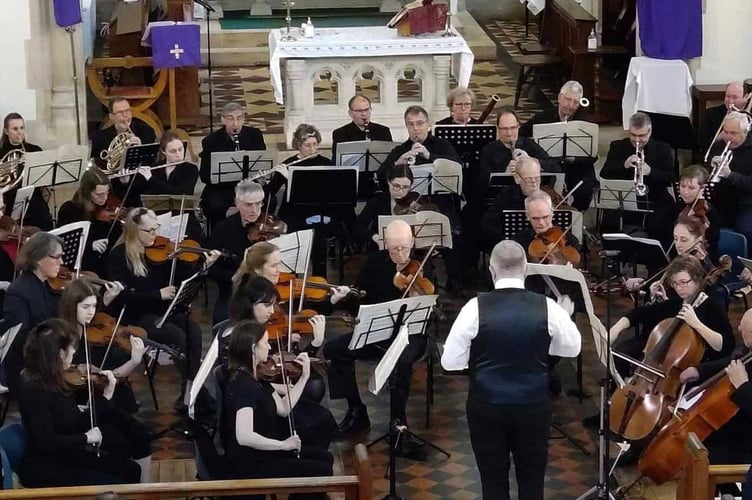
Abergavenny Symphony Orchestra, formerly known as Abergavenny Orchestral Society, has been rehearsing and performing in the town for many decades, but until recently no-one knew exactly how old the orchestra was. Minutes of committee meetings and AGMs date back to 1955. A scrapbook of old posters and programmes took us a little further back to 1948. However, there was no evidence to support the claims of previous conductors that the orchestra was “around 100 years old”.
As secretary of the orchestra from 2014 – 2022, I was intrigued and made it my mission to find out more. Hours of deciphering the newsprint from old newspaper articles online and days of research at the National Library of Wales in Aberystwyth have provided some answers, although not filled all the gaps.
On 14 May 1886, a person identified only as ‘C’ wrote a letter to the Abergavenny Chronicle to say that it was a disgrace that Abergavenny had no orchestra of its own when much smaller towns had at least one of quality. My research has uncovered mention of an ‘Abergavenny Orchestral Band’ in the 1850s but it had long since disappeared by the 1880s. ‘C’ then set a challenge: “Is there nobody in the town around whom the present disintegrated musical members would rally?” For there were musicians in the town, teaching music or playing as amateurs in a variety of events.


This was well before the days of television, radio, and cinema. Even the gramophone had not yet been invented, so all music was live and your presence was required to hear it.
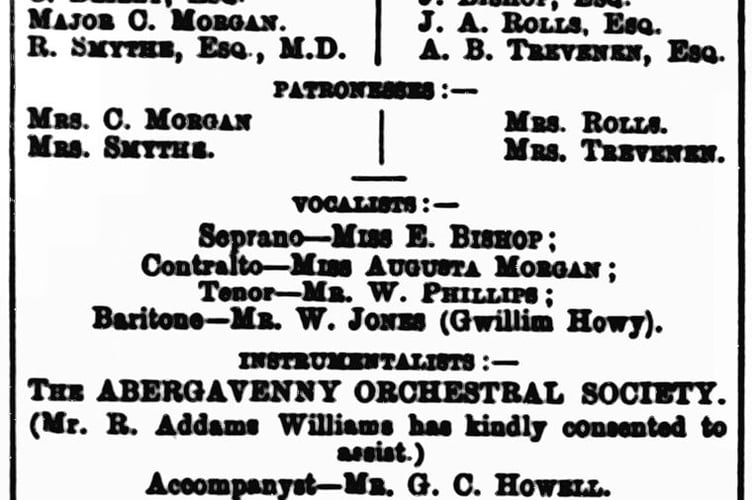
Whether it was as a direct response to this letter, or for some other reason, by the autumn Abergavenny Orchestral Society was formed and they gave their first ‘Grand Evening Concert’ on Thursday, November 4 1886 in the Town Hall. The concert was advertised in the newspaper as commencing at 8 o’clock with the instruction that “carriages may be ordered for 10.15”. At this time, the concerts were not purely orchestral – there would be songs too, so a soprano, contralto, tenor, baritone and their accompanist are named in the publicity.
A review of the concert appeared in the Chronicle the following day and it was hailed as “an unqualified success” with “frequent applause of an enthusiastic nature” by the audience who had filled the hall. The orchestra performed “‘The Grand March’, (Mendelssohn), ‘Stephanie Gavotte’, ‘La Dame Blanche’, and selections from ‘Patience’”, indeed, the vocal items seem to have outnumbered the orchestral ones. Invaluably for my research, the review not only names the conductor, but also the players in the orchestra and which instruments they played.
Mr Charles Claggett Caird conducted that very first concert, and I wonder if he was the mystery “C” who wrote the letter to the newspaper in May 1886. He was born and raised in Scotland, and then moved to Bristol with his parents, where he began his career as a church organist. He came to Abergavenny as Organist of Llanddewi Skirrid Church and Private Organist to Crawshay Bailey (Junior) Esquire. He was married with five children and they lived in ‘Monson Cottage’, Mardy before moving to ‘Holly Croft’ in Llandeilo Bertholau, and later to ‘Clinton Villa’ on Brecon Road. From his home he gave “lessons on piano, organ, singing and [music] theory.” He remained in Abergavenny and when he died in 1918 aged 86, his obituary stated that he had been a church organist for 70 years – some feat!
I will write about the members of the orchestra in a future article. Sufficient to say for now that in that first concert 140 years ago, there were only 15 players ... and one of them was “assisting”! In all, there were three first violin players, three second violins, two violas, one cello, one double bass, two flutes, one clarinet, one French horn and one cornet. The set up sounds rather random, especially as cornets normally feature in brass bands rather than orchestras, but they were making the most of the musicians who were available at the time.
One of the requirements for calling yourselves a symphony orchestra is to have enough members to perform symphonies – something that was not an option for that first group of players. But from small acorns, mighty oaks grow. As Abergavenny Symphony Orchestra, it would now be unusual for us not to include a symphony in one of our concert programmes. Having a strong brass section and regular timpani and percussion players means that we can not only perform symphonies from different musical periods, but also works by composers such as Rachmaninov, Vaughan Williams, Sibelius and Tchaikovsky, which all require large forces.
We are an orchestra of mostly amateur players who play with passion and pride each week in rehearsals, whilst striving to provide performances of the highest standard, four times a year. Three of these concerts are traditional in style and then in December we offer a themed family concert when we mix it up with shorter excerpts and music from popular films.
We also hold an annual ‘Come and Play Day’ where we invite musicians from further afield to join us in tackling larger or more challenging repertoire. This February, seventy three players came together in Crickhowell’s Clarence Hall to work through Rachmaninov’s sumptuous second symphony under the expert guidance of our Musical Director, Michael Bell MBE.
Our next concert will be at 2:30 pm on Sunday, March 22 at Our Lady and St Michaels’ R.C. Church, Abergavenny when we will perform the popular Karelia Suite by Sibelius and Mendelssohn’s Violin Concerto, as well as the lesser-known second symphony of Charles Ives.
The violin soloist will be Marisa Riordan, who graduated from Cardiff University in 2010 where she was awarded the Elizabeth Griffiths prize for outstanding contribution to the department. She now teaches at Monmouth Comprehensive School and has been Leader of our orchestra since 2022.
We advise that tickets are purchased in advance, either from Abergavenny Library or online via our website: abergavennysymph.org.uk.
Comments
This article has no comments yet. Be the first to leave a comment.