
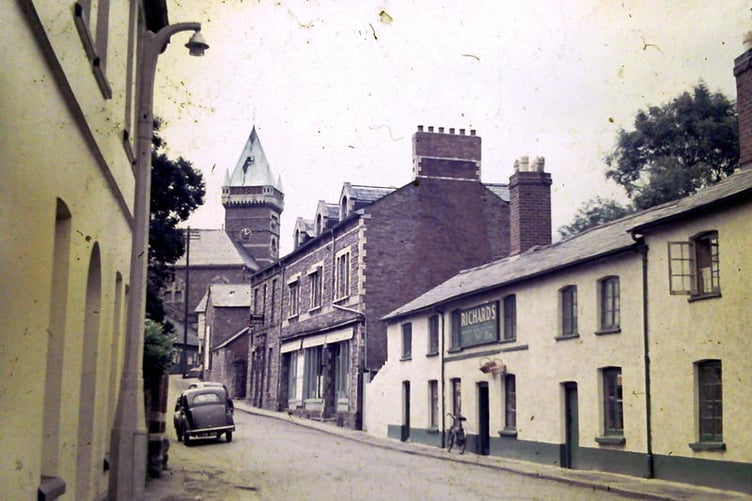
AN appeal has recently been launched to raise £150,000 to restore the chimes of the Town hall clock and to overhaul the mechanism. This is by no means the first time there has been a public appeal.
Back in May of1984 the Town Hall clock needed attention and Monmouth District Council set aside £2400 in their budget for essential repairs. But pressure on the Council’s finances made them change their mind and a local newspaper started an appeal to raise the money.
Albert Lyons, an amateur local photographer and historian, was among the first to respond to the appeal. Albert once described himself “as well-known as the Town Hall Clock” and his idea was to appeal for pennies to be donated to the fund. It was estimated that a tower of pennies, enough to pay for the repairs, would be ten times the height of the clock tower itself!

.jpeg?width=209&height=140&crop=209:145,smart&quality=75)

Albert collected £5 worth of pennies to start the ball rolling and an anonymous businessman donated £100. Local singer, Bryn Yemm, offered to stage a show at the Town hall and he asked the Mayor, Raymond Hill, to make the necessary arrangements.
A month later, Gordon Smith (the Town Hall caretaker) and his son David, decided to clean out the clock tower of 100 years’ worth of pigeon droppings and they suggested that if anyone needed fertilizer for their garden then bags of droppings were available in return for a donation to the clock fund.
In 2002 Rob Westall of the Abergavenny Chronicle went up the clock tower to see how the clock was kept ticking over. There he met local businessman, David Butler, who runs a clock and jewellery shop in Monk Street. David had been winding the clock every week for over twenty years.
There were three large ‘bolts’ in the clock mechanism, one for the clock, one for the hourly strike bell and one for the quarter chimes. Each bolt was wound up around 450 times with a crank type handle. Each winding raised one of three solid steel cylinder weights, the size of barrels, to the top of the tower and this took 15 minutes.
David also keeps the clock oiled to ensure it runs smoothly and he said the condition of the clock is excellent and basically as good as it was when first installed 130 years ago. The only change that has been made is that the clock faces are now lit by electricity rather than gas.
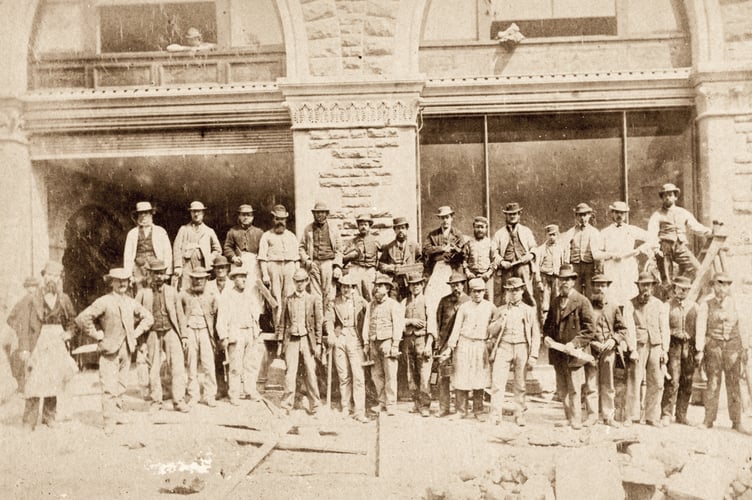
The installation of the clock in the new Town Hall goes back to May of 1872 when the Chronicle reported that the chime bells had arrived and were being fixed into place. The clock itself arrived three weeks later and was being installed by the contractors. The clock was the gift of that great promoter of commerce, not only in this town, but in south Wales, the late Crawshay Bailey Senior of Llanfoist House. The cost of the clock was in the region of £400 and was set in motion on the 30th of May by the grand-daughter of the noble donor.
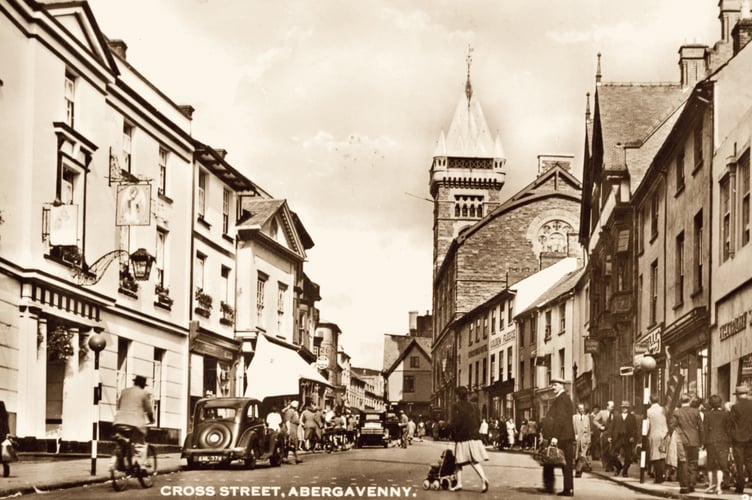
The manufacturers of the clock were Messrs. Gillett & Bland from Croyden, Surrey. It had an eight-day mechanism and struck the hours on a 14-cwt bell and the four quarters on two smaller bells. Each of the four clock faces is six feet in diameter and three of them are illuminated and the one facing down Market Street has a black background. It has cost altogether £450.
The old town clock, which was in the tower of King Henry VIII’s grammar school, was now surplus and proposals were made to move it to St. Mary’s church and Messrs. Gillet & Bland were asked to give a quote for the work. The old clock had been installed in 1835 as a joint venture between the Abergavenny Town Improvement Commissioners and public subscription.
The matter was brought before a meeting of the Commissioners and a decision was asked to be delayed pending further enquiries. In February of 1873 the Board of Commissioners were advised that a representative of the Bedgworth Charity was laying claim to ownership of the clock as they had contributed most of the money for the original purchase.
What happened after this is not recorded but I don’t think the old clock was ever moved to St. Mary’s church. It was also brought to the attention of the Board that thanks should be given to the donor of the new clock, the late Crawshay Bailey Senior, and also to Crawshay Bailey Junior.
The cost of the clock was £437 but there were extra expenses of £75 attending its fitting which was not foreseen in the first instance. Mr. Bailey had sent off a cheque for all the money making a total of £512. It was suggested that thanks were not only due to the late Mr. Bailey for his kindness, but also to the present Mr. Bailey for his kind heartedness in the matter.
The Commissioners should thank them personally and that a public demonstration of thanks, such as a public dinner, as a memento of their kindness with respect to the donation of the clock. The Board agreed wholeheartedly to this suggestion and a vote of thanks would be sent to Mr. Bailey immediately and a committee should be formed to plan the dinner.
When Mr. Bailey was told about the proposed celebration he replied that he had only carried out the wishes of his late father and did not wish an ovation of the kind proposed. The Commissioner’s chairman then suggested that a portion of one of the stained-glass windows in Llanfoist Church, where Crawshay Bailey Senior was buried, should be devoted for that purpose and it was thought that ten guineas would cover the cost.
This motion was carried by the Board. One of the Commissioners, Dr. Smythe, wanted to know why the original price of £472 needed an extra £75 over and above the contracted price and why the installers had made use of the Commissioner’s workforce without them being paid. As all the finances of the clock had now been settled amicably the Board thought that this train of thought was unnecessary and the matter was deferred to a future meeting.
The black face of the clock, that faces Market Street, is usually thought of as being a commemoration of Queen Victoria’s consort, Prince Albert, who had died ten years ago in 1861. It seems more likely to me that it should be in memory of the late Crawshay Bailey who was the donor of the clock, and completed by his son Crawshay Bailey Junior. The face was planned to be black from the start and not a subsequent alteration.
A final word on the new Town Hall and Market Buildings must go to the clerk of the Board of Commissioners at a meeting in March 1873. “In accordance with a resolution passed at the last Board Meeting, the clerk read a statement of the cost of the erection of these buildings, viz.;- Expended to December 1872, £13,022, since that time £211. Total £13,233. Dr. Smythe had taken an average of the old market place for the years of 1865 to 1867, and found they produced a clear profit of £423, which if deducted from the present income of the new buildings which was £907, would leave a sum of £414. Let them take the sum of £13,233, borrowed at 4.5%, which would amount to £595 and the capital to hand in 50 years would make annually the sum of £860. Towards this the town had an extra income of £195, which left them in debt nominally £664 or equal, according to the rateable value of 11 pence in the pound.” The matter was then formally dropped!
The future of the Town Hall and indoor market came under scrutiny sixty years ago when Abergavenny Borough Council commissioned a report on the existing buildings and how they could be improved. It was noted that the town would greatly benefit from the recently opened Heads of the Valley Road, in 1965. The report suggests that the population of Abergavenny will increase by half in the next 15 years. The present retail market was erected in 1870 and is joined to the Town Hall civic building and it was the first market building in Abergavenny to have a roof.
The report describes the market part of the building as in poor condition and deteriorating rapidly but the Town Hall itself is in a good state of repair. Both the roof and floor of the market need major reconstruction work as a matter of urgency. Furthermore, the original design is no longer appropriate for today’s traders and do not meet the provisions of new Acts of Parliament that lay down minimum standards for health, safety and hygiene. The only vehicle access to the market is through the archway off Cross Street and this is where the Council have their offices.
The report goes on to say that experience has shown that renovating an old building, such as the retail market in Abergavenny, is almost as great as demolition and building anew. It was further pointed out that if refurbishment of the building took place now, it would need further attention every ten years or so while a new building would not need any remedial work for twice that period and general maintenance would be easier and cheaper overall.
The report strongly recommended that the existing market building should be demolished and replaced with a modern design that would incorporate a mezzanine level within the market hall and a row of lock up shops along the very important shopping frontage of Market Street. This would provide additional revenue that would contribute to the construction costs of the project.
The area at the back of the building would be changed to allow vehicle access for the traders and services such as refuse collection. The report goes on to say that the new market complex could be designed as a multi-purpose hall and it should be possible to re-introduce boxing and wrestling contests, concerts and a large number of other activities which will help to bring life to the town centre after the shops have closed for the day and this of course will generate extra income for the Council.
The report also recommended that the existing Council offices on Cross Street should be moved elsewhere in the building and the vacant space converted into further retail outlets as they had been previously. Once completed, the streets around the market and Town Hall should be pedestrianised and a multi-storey car park could be provided above the rear access area for customers of the market.
It was also suggested that a new canteen facility should be provided at the end of the new row of shops in Market Street and positioned such that it could be accessed from the market and the street which would create business for six days a week once the pedestrianisation had taken place. They also suggest that this could be the position for a little rest area where mothers can sit down or old people can rest themselves, or shoppers can meet by arrangement.
An extension of this idea would of course be the provision of a little amusement area for small children such as can be seen in very successful operations at Coventry and Birmingham, and we feel that this is slightly a gimmick but something which would certainly be appreciated by mothers who have to carry a shopping bag in one hand and look after a toddler on the other.
The report goes on to say that it would not need much extra thought to design the new market hall in such a way that it could on occasions be converted to a theatre and this would be better accessed by the public and a larger number of seats so that the public could enjoy the excellent productions which are put on at the present time.
These are perhaps long-term prospects but certainly should, in their opinion, be borne in mind. The planners were asked to consider the possibility of a second floor in the hall but they suggested that additional space would be better served by digging out a basement and this would add an additional cost of £72,000 to the project.
Luckily for Abergavenny the new proposals were never acted upon but renovation and improvements were carried out in due course and the market and Town Hall buildings were ‘grade 11’ listed in 1971.
Comments
This article has no comments yet. Be the first to leave a comment.