
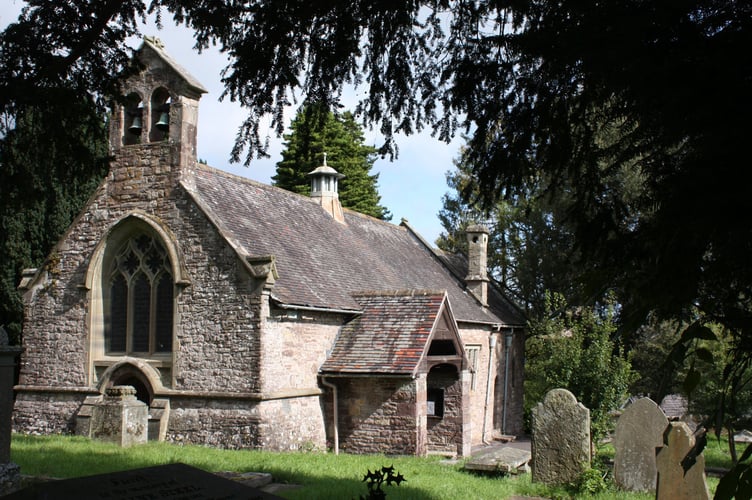
The oldest building in Llanfoist is St Faith’s Church. It was originally a simple wattle structure established by St Ffwyst in the sixth century. He had studied at the monastic college of St Seriol at Penmon on Anglesey, and when his training in Holy Orders was complete, he set forth to spread the faith.
Travelling south, he reached the Usk Valley, and built a simple church beside the stream which flows down from the Blorenge Mountain. We can only guess how long he stayed there, but in due course he moved on to settle in Armorica (Brittany), and is remembered in the small village called Lanfeust, to the south west of St Renan.
.jpg?width=209&height=140&crop=209:145,smart&quality=75)

.jpeg?width=209&height=140&crop=209:145,smart&quality=75)
His original church at Llanffwyst was later rebuilt in stone and some of the present fabric dates from the 12th or 13th centuries. At some time in its history the name was changed to Llanfoist in order to represent Welsh spelling more or less phonetically. The present dedication to St Faith would appear to be nothing more than a guess at identifying ‘Foist’ with St Faith, who was a 3rd century martyr under the Roman Empire in France (Roman Gaul). In medieval times several English churches were dedicated to her, and the nearest example is at Bacton in the Golden Valley, Herefordshire, about ten miles away.
Unfortunately, we do not know how many times Llanfoist Church has been rebuilt, but we do know that a major restoration took place in 1872. It was generously financed by Crawshay Bailey Junior, in order to provide a memorial to his father, who is buried in a corner of the churchyard. He had established the world’s largest ironworks at Nantyglo and after amassing a fortune, decided to retire to Ty Mawr (Llanfoist House) )where he died at the age of 83 in 1872.
His funeral in January 1872 was meant to be a strictly private affair, but between 3,000 and 4,000 people arrived to pay their respects and it was without doubt the biggest attendance of any event in the history of Llanfoist Church.
While the rebuilding work was being carried out, the church was closed for nine months and then reopened on 24th October 1872. This was certainly an appropriate date for it was the birthday of the late Crawshay Bailey Senior. It is also of interest that it was the first church in this district to be restored.
The wealthy ironmaster wanted an heir and his wife had failed to provide one, so he solved the problem by having an affair in 1841 with Sarah Baker, who was a servant in his house at Nantyglo. His only son and heir was just three years old when she died five years later at the age of 46.
Sarah was buried in the churchyard of Llandewi Skirrid, which Crawshay Bailey Junior subsequently rebuilt in her memory at a cost of £2000. When Crawshay Bailey Senior died in 1872, his son had decided not to live at Llanfoist House, but built Maindiff Court, just outside Abergavenny on land that his father had purchased from Philip Jones. He died at the age of 46 in 1887, and was buried near the grave of his mother at Llandewi Skirrid.
The restoration of Llanfoist Church in 1872 was undertaken by the well known architect John Pollard Seddon who also designed new furnishings inside the church. These included the circular stone pulpit, an octagonal stone font and much of the interior timber work. The stained glass windows are particularly fine and were mostly designed by Charles A. Gibbs.
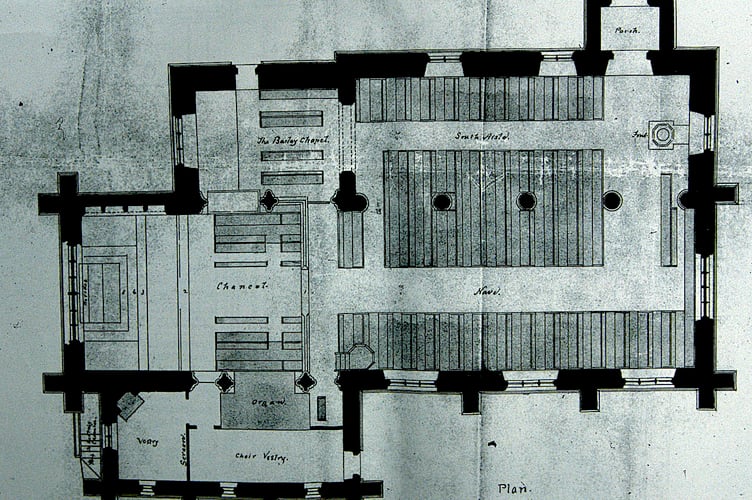
In 1885 so many people were attending services at the church that it was decided to make it much larger, and ambitious plans were drawn up by John Pollard Seddon. Today not many people are aware of these proposals for the church to be substantially enlarged. It came to my notice about thirty years ago when I came across the original drawings in a file at the Gwent County Record Office. Unfortunately, the work was not implemented due to the premature death of Crawshay Bailey Junior, who would have funded the scheme.
There are numerous wall memorials inside the church and these include commemorations to Crawshay Bailey Senior, his wife Ann Bailey, Thomas Ellwood, (Agent to the Brecon Boat Company), members of the Chambre family of Upper Llanfoist House, the Hanbury Williams family of Nantoer and a brass to the Rev James Pugh who was rector of this parish for 30 years. Recently a plaque was installed in memory of John Pritchard who worked as a lay minister.
Of special interest in the south porch is the remains of a sepulchral slab, which dates from the late 16thcentury. It depicts an Elizabethan or early Stuart lady. She has clasped hands, and wears a long skirt, tight bodice and a big ruff. Above her head is a wheel cross with two shields, and beside her is a big shovel, while below are the heads and shoulders of two ‘weepers’ with their hands held in prayer. These may have been two of a number of children whose effigies spread across the base of the shaft before it was broken. Her feet under a front view are curiously turned to the left , but who she was is not known.
Also in the porch is a stone recording the death of a certain Calap James on 17th Day of April 1697. Who this man was is also a mystery, and I wonder if the letters in Calap have been carved without a space. Should it be Cal ap James (Cal son of James) ? These two interesting stones are still in very good condition because they were placed in the porch a long time ago, and have been protected from acid rain.
In the churchyard is a fine example of a medieval churchyard cross with four steps rising to a broached base. The head was no doubt destroyed during the Civil War period in 1643, when Parliament issued an order for the destruction of all such crosses.
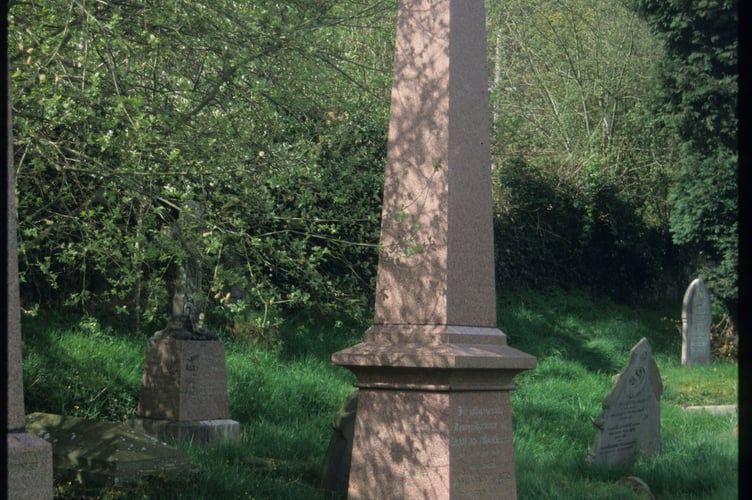
Most people who come to explore the churchyard are mainly interested in the tall polished red granite pillar marking the last resting place of the ironmaster Crawshay Bailey. But it is amazing how many of them mix him up with Crawshay of Cyfartha Castle, and expect to see a massive grave slab inscribed ‘God Forgive Me’. However, this famous grave is at Vaynor church near Merthyr.
In November 2000 the World Heritage Committee meeting at Cairns, Australia, inscribed the Blaenavon Industrial Landscape as a World Heritage Site. The northern boundary of the 33 square kilometre site is just below Llanfoist Church, which has been included because of its associations with Blaenavon and the history of ironmaking. Numerous people of that time are buried in the churchyard, and they are remembered largely through the inscriptions on their grave stones but due to the problems of acid rain, most of them are now unfortunately impossible to read.
Comments
We've recently changed our login process. If you have an account for commenting, you will need to re-register on the login window.
This article has no comments yet. Be the first to leave a comment.