
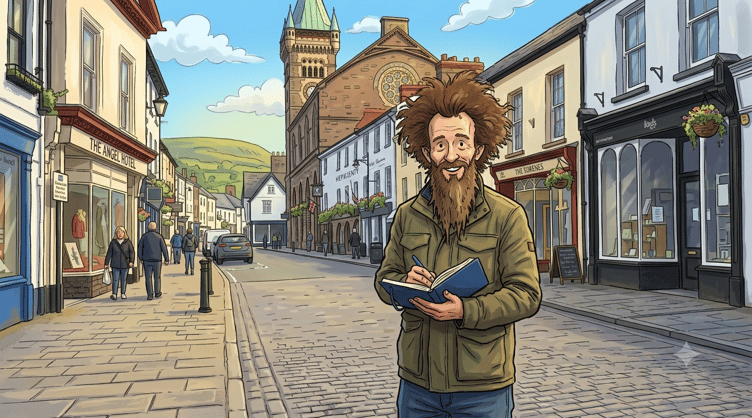
The rain in the Usk Valley doesn’t fall so much as it settles into your marrow, turning every hedge into a wet sponge and every lane into a streaming gutter. On morning like this, down at the bottom of the garden behind the cottage on Hereford Road, Johnny Turnip was leaning on the shaft of his fork, contemplating a row of winter brassicas that looked as disheartened as the weather.
Johnny wasn't his name on his birth certificate, of course. In the ledgers down at St Mary’s Priory Church, he was logged as Jonathan Davies, but nobody in Abergavenny had called him that since the Great Frost of ’82, when he’d single-handedly supplied half the town with swedes after the veg shop on Frogmore Street froze solid. To the locals, he was just Johnny Turnip: local allotment philosopher, chronicler of weather patterns that defied the Met Office, and undisputed master of the mid-week gossip.
He tapped the mud off his right boot against the tines of his fork and pulled a damp stub of pencil and a worn blue notebook from his waxed jacket pocket. Every Thursday, his dispatch went into the Abergavenny Chronicle office on Nevill Street—a modest square of newsprint tucked between the livestock market report and the classifieds for second-hand sheep dip.
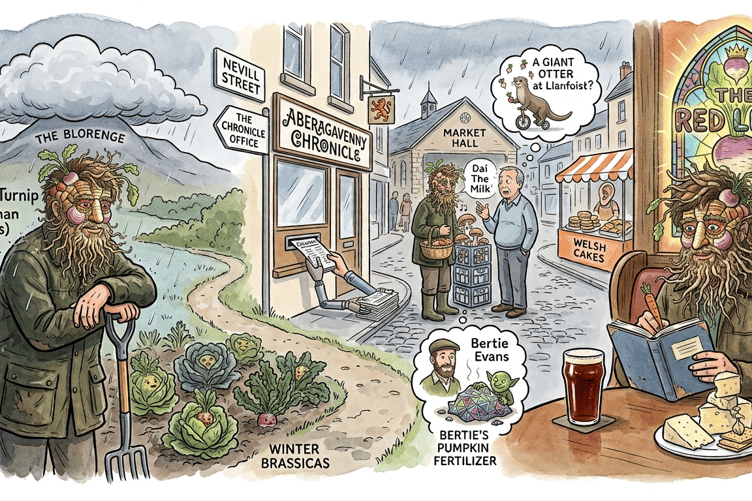
“The Blorenge has got its cap on this morning,” he wrote, his handwriting as knobbly as a winter parsnip. “Which means three days of mizzle, or else Mrs. Pritchard’s laundry is going to freeze on the line again.”
He paused, looking up towards the mountain. The top of the Blorenge was buried in a thick, woolly fleece of cloud. Down in the town, the chime of the Town Hall clock shivered through the damp air, striking ten. That was the signal. Johnny pocketed his notebook, wiped his fork with a handful of wet rye grass, and set off towards town.
Abergavenny on a Tuesday morning was a living mechanism, powered entirely by gossip, cheap tea, and the vague threat of rain. Johnny’s route took him past the old Market Hall, where the smells of Welsh cakes, toasted crumpets, and wet wool blended into that particular aroma unique to the Marches.
His first port of call was the counter at The Angel Bakery, not for the fancy pastries, but for a word with Dai 'The Milk', who was leaning against the doorframe looking like a man carrying the state secrets of Gwent.
"Morning, Johnny," Dai muttered, lowering his voice despite there being no one within twenty yards. "You seen the river?"
.jpeg?width=209&height=140&crop=209:145,smart&quality=75)


"The Usk?" Johnny adjusted his flat cap. "Not since yesterday. Rising?"
"Rising? It’s practically having a look in the window of the Rowing Club. And that’s not the half of it. Young Glyn from Llanfoist swears he saw an otter the size of an Alsatian down by the old stone bridge."
Johnny scribbled in his notebook: Otter reported near Llanfoist. Likely just Glyn’s vision after three pints of Rev James, but keep an eye on your ducks.
"Any word on the flower show categories for August?" Johnny asked.
Dai sniffed. "They’re bringing back the Heavyweight Pumpkin. Bertie Evans has already got three sacks of horse manure soaking in a tub behind his shed. Smells like a battlefield down Mill Street."
"Bertie always starts too early," Johnny pronounced wisely. "His vine will rot before the August sun even thinks about showing its face. Mark my words, the prize is going to a dark horse this year."
Leaving Dai to his milk crates, Johnny strolled down towards Cross Street. Abergavenny was full of dark horses, most of them over seventy and armed with hand-trowels. The annual competitive gardening circuit in the Monmouthshire hills was notorious for its cutthroat rivalries. Sabotage was rare, but strategic misinformation was an art form. Last year, someone had started a rumor that diluted cold tea made fuchsias bloom twice as large, resulting in half the window boxes in Chapel Road smelling like Earl Grey for a month.
He popped his head into the hardware shop, where old Mr. Powell was arranging a display of galvanized buckets.
"What's the forecast according to the joints, Mr. Powell?"
Powell winced as he reached for a high shelf. "Left knee says frost by Friday. Right hip says wind from the east."
"I'll split the difference and bet on sleet," Johnny said, jotting it down.
By mid-day, Johnny had gathered enough intelligence to fuel three columns. He took his usual seat in the corner of the Red Lion, ordering a pint of bitter and a cob of Caerphilly cheese that had enough bite to strip paint. He laid his blue notebook open on the scarred oak table.
The magic of the Johnny Turnip column was never the big news. The Chronicle had proper reporters for the council meetings, the magistrate's court, and the endless debates over parking charges near the castle. Johnny’s domain was the small, quiet tapestry of the Valley—the things that mattered when you took the time to stand still in a doorway out of the rain.
He began to draft the final piece for the printer:
“Notes from the Plot: The scarlet runners are sulking this week, refusing to climb the sticks until the temperature hits double figures. Can’t say I blame them. Over in Llanwenarth, the wild garlic is coming up thick enough to smell from the main road—a sure sign that spring is coming in through the back door while winter is still leaning on the front gate.
Spoke to a man near the Bus Station who claimed he heard a cuckoo near Sugar Loaf on Sunday. Told him it was more likely Mrs. Davies practicing her choral soprano with the window open, but he wouldn't be told. Keep your seed potatoes chitting in the dark, mind. Don't be fooled by a sunny Tuesday afternoon; February always has one last kick in its heel.”
He finished his pint, closed the book, and gave the paper a crisp fold.
Walking up Nevill Street to the newspaper office, the rain finally eased, leaving the cobbles slick and reflective under a grey, pearlescent sky. The Blorenge was slowly shaking off its cloud cap, revealing the dark, bracken-covered slopes above the town.
He handed his handwritten sheet over the counter to the young receptionist, who smiled and pinned it straight to the editor’s board.
"Good week, Johnny?" she asked.
"Quiet enough," Johnny said, tapping his cap. "Just the river rising, Bertie's manure, and a giant otter down Llanfoist. The usual."
He walked back out into the cool air, heading back down towards the cottage and his waiting row of brassicas. The sun was breaking through over the Skirrid, casting a long, pale beam of light right across the valley floor. It wouldn't last, of course—rain by four o'clock, if his left boot was anything to go by—but for now, the garden was quiet, the town was gossiping, and the turnip crop was holding its own.
This article was created entirely by the AI programme Gemini.
Comments
This article has no comments yet. Be the first to leave a comment.