
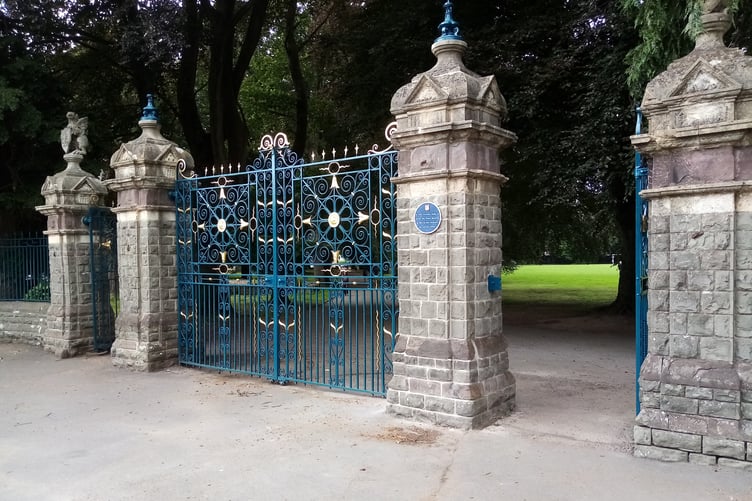
THE new park was formally opened by Mr. Edwin Tucker in accordance with the wishes of Crawshay Bailey. He said that the grounds would be properly laid out for a number of sports of all kinds and this, together with the mountain drives that they had been on this morning and the castle with its beautiful grounds, to all of which Mr. Crawshay Bailey had largely contributed, would render Abergavenny a most attractive place.
Mr. Crawshay Bailey had requested him to name the beautiful enclosure in which they now stood, “The Bailey’s Park” and he called upon the crowd to give three cheers for Mr. Bailey and his family. After many more plaudits, Mr. Basil Jayne called for cheers for Messrs Tucker Brothers. These were given and the band played “For they are jolly good fellows.” A programme of sports then followed for the rest of the day.
Sadly, Edwin tucker died 6 months later at the age of 58 and his brother Thomas proved his will. Edwin’s personal effects were valued at £6984 which is over £900,000 in today’s money. The Tucker Brothers business continued but went bust in 1903 when the Horsington brothers took over their premises in Lion Street which subsequently became known as Horsington’s Yard. Edwin’s house in Chapel Road, Derrystone, went on to become the home of E. A. Johnson, the architect of the park.
-COLLAGE.jpeg?width=209&height=140&crop=209:145,smart&quality=75)
.jpeg?width=209&height=140&crop=209:145,smart&quality=75)
E.A. Johnson
The second person that Crawshay introduced was Mr. Edwin Arthur Johnson, FRIBA, architect and surveyor.
Mr Johnson then outlined his plans for the formation of a public recreation ground. A portion of the park would have a low stone wall with iron railings. There would be a grand lodge entrance from the Hereford Road with a gateway that was wide enough for the passage of a coach and 4 horses with side gates for pedestrians. He went on to outline some of the facilities that would be features of the park. There was also the possibility of providing a swimming pool at a later date as there was an existing supply of water in the field.
After the park had opened, the minutes of the Board of Improvement Commissioners (5th of November 1884) recorded that Edwin Johnson, on behalf of Crawshay Bailey, applied for a gas supply to be laid on to the top of the two central pillars of the principal entrance to the park. Two gas lamps could then be installed and they would be lit on occasions of fetes and matches. The Improvement Commissioners had by then become the owners of the gas works and carried out the work as requested and the two gas light fittings can still be seen on top of the pillars.
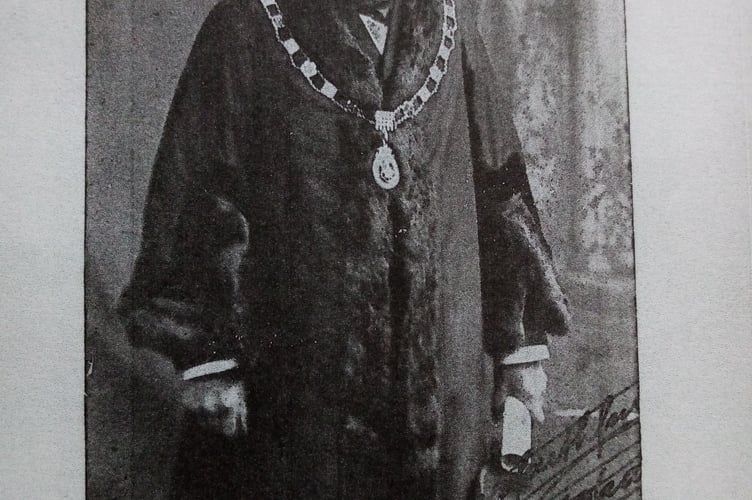
James Straker (1845-1916)
Alderman James Straker, JP, CC was born in 1845 at TY Cenol Farm, Llanvapley. The local church parish registers can trace his family back to 1656. One of his ancestors, Thomas Straker, was involved in the building of the Monmouthshire and Brecon Canal back in 1795 and became one of the first members of the Abergavenny Improvement Commissioners Board.
He was followed by his son James Straker in 1806. Then in 1812 our James’s grandfather, William Straker, became a Town Commissioner. John Straker, James’s father, was present at the Westgate Hotel during the Chartist rebellion of 1840 and applied on the spot to become a special constable. It was almost inevitable that James Straker would follow their example and become involved with local government matters.
He was twice elected Mayor, 1903/4 and 1912/13, and worked hard to get the Welsh National Eisteddfod to come to Abergavenny. He was appointed chairman of the Eisteddfod committee in 1910 and was awarded the bardic title of Maer-y-Fenni for his unstinting efforts that brought the event to Abergavenny in 1913.
The Gorsedd stones were erected in a field called The Grove, which belonged to his home at Plas Derwen on the Monmouth Road. This meant that the bardic procession had to make its way through the town for a mile and a half before arriving at the stone circle. (Other sources say that the stones were on land that belonged to the Herbert family of the adjacent Coldbrook estate who wanted their name to be associated with the Eisteddfod.)
James Straker was also one of the founders, and secretary, of the Abergavenny Building Society and was instrumental in developing the Long Barn, Hereford Road and Cae-Pendre areas. In addition, he had been the secretary of the Abergavenny Horse Show since 1875 and numerous other organisations in both Abergavenny and Monmouthshire.
He was also a generous supporter of sports of all kinds and held positions on many of their committees. He was appointed a magistrate in 1906.
James Straker married Sarah Ann Oliver in London in 1871 and they had 6 sons and 4 daughters. They lived at several properties during their marriage. First of all, they had a home in Frogmore Street, Abergavenny, then at Llanthewey Court before taking up residence at Linda Vista in Byefield Lane just off Tudor Street in Abergavenny. They moved to Plas Derwen, on the Monmouth Road, sometime in the early 1900’s. Whilst at Llanthewey Court in 1886, James won a five guineas prize at the Abergavenny Agricultural Association’s competition for: ’the farm under the neatest and best general state of cultivation, and with fences, roadways and ditches in the best condition.’
In 1872 he opened his own business as an auctioneer and estate agent that is still going strong today as Straker and Chadwick. His premises in Market Street, known as Market Street Chambers, was also the Estate Office for Crawshay Bailey. By 1882, James Straker had started regular auctions at Abergavenny cattle market. James himself was in business for over 40 years as well as having his own farm.
James was a very popular figure in the town and he was equally at home with the highest and lowest of society and was known for his lavish hospitality during his first mayoral term. In addition to the princely Mayoral banquet, he gave dinners to the corporation employees, to local agriculturists, to patrons of the cattle market besides entertaining the workhouse inmates and the whole of the 2000 school children of the town and adjoining parishes who were treated to a tea party. During his second period of office, he gave another memorable treat to the school children, and on the occasion of the Eisteddfod week Plas Derwen was literally a “free house” to all visitors.
His life was not without controversy. In 1900, he was taken to the High Court in London by Mrs Mary Jane Heir Evans as she had accused him of undervaluing her holding of 1963 £10 shares in the Parkend Navigation Colliery Co. Ltd. that he had subsequently bought off her. The judge found in his favour and the case was dismissed.
On another occasion in 1910, he was sued by a farmer for wrongful distraint on some of his animals. James Straker had levied a distress for unpaid rent on the farmer’s father but as well as taking his father’s goods, James had taken some of his animals to sell at auction to settle the debt. There is no mention in the report as to how much was owed but the sale realised £45. When cross-examined, the farmer admitted that he had suggested some of his animals could be sold to help his father out. The judgement was therefore given in favour of James Straker.
James Straker had a younger brother, Edgar Capel Straker, who started his working career at the offices of the Abergavenny Chronicle in 1879.
This local newspaper had been founded in 1871 by Edwin Morgan. Edwin died in 1888 at the age of 50 but Edgar Straker went on to marry his daughter, Emily Jane Morgan, in 1890 and he took over the family business. Sadly, Emily died 10 years later at the age of 37 leaving Edgar to bring up a young family as well as run the Abergavenny Chronicle.
After 60 years of service to the newspaper, Edgar died in 1939 and his family took over until they sold out to Berrow’s newspapers in 1965.
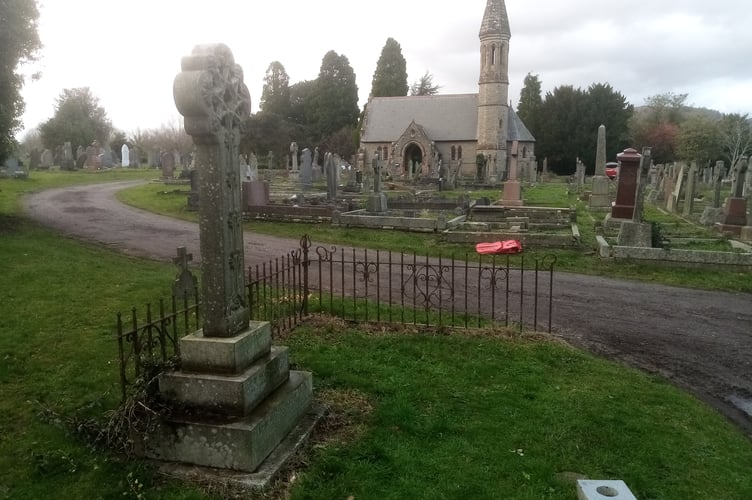
James Straker died at his home, Plas Derwen, on 13th of April 1916 aged 70 and was buried in the Old cemetery in Abergavenny. (Three of his sons could not attend as they were on active service: Quartermaster Sergeant Ernest J. Straker was in Salonica, Sergeant Edgar Straker was in Egypt and Lieutenant Charles Straker was with the 3rd Mons in France. Charles had also volunteered to go off to South Africa to fight in the Boer War. Two of his other sons were now living in Canada). His estate was valued at £78, 385 and he made numerous personal bequests to family, friends and other business people. This amount is just under £7 million in today’s money.
In his obituary, published in the Abergavenny Chronicle dated 14th of April 1916, it says: “Many people do not know that James Straker was largely instrumental in getting Bailey park for the town through the generosity of Crawshay Bailey Junior.”
His wife went on to live until she was 95 and she died in 1942 at yet another imposing home, Fairlea in Belmont Road. Her obituary in the Abergavenny Chronicle said she played an active part in her duties as Mayoress and she leaves 4 sons and 4 daughters.
One of her daughters, Edith Emily Straker, reached the grand old age of 99 before she died in 1974. Fairlea is a fairy-tale looking house that was built in 1861 by the father of Abergavenny’s well-known author, Ethel Lina White. His name was William White and besides being a local builder, he also invented and patented a compound, known as Hygeia rock, that was used extensively to line the tunnels of the London underground.
Bailey Park has seen many attractions in its long life ranging from circuses, carnivals, National Eisteddfod, steam rallies and sports days, but probably the most impressive was the visit of “Buffalo Bill’s Wild West Show and Congress of Rough Riders of the World” on the 3rd of July 1903.
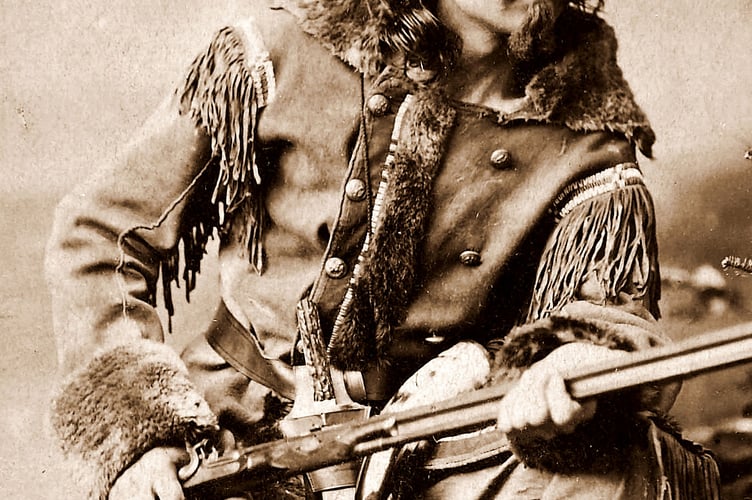
Four separate trains pulled into sidings at Monmouth Road railway station and their contents of 800 people and 500 horses were transported by wagon to Bailey Park.
The first to arrive was the cookery wagon and its staff. A mess tent was then erected and within 20 minutes everybody would be sat down to enjoy their breakfast.
Buffalo Bill had searched the world for men whose presence and co-operation were essential to the perfection of their history being depicted in order to leave a legacy for future generations.
The 100 native-American Indians are representative of the various tribes of North America. Every soldier seen in the arena had served in the army represented by the flag under which he rides. Every Cossack, Vaquero, Ruralie, Lancer, Artilleryman, Cavalryman and foot soldier have been engaged in savage warfare somewhere in the world. Such a mixture of different nations under one tent was a memorable sight.
Once assembled, the whole arena measured 500 by 325 feet and seating around three sides would accommodate 14,000 spectators. The ticket price varied between one shilling and seven and sixpence. There would be two shows of 2 hours each and as soon as the last performance had taken place, everything would be dismantled and put back on the trains waiting at Monmouth Road station and they would be off to the next location on their schedule.
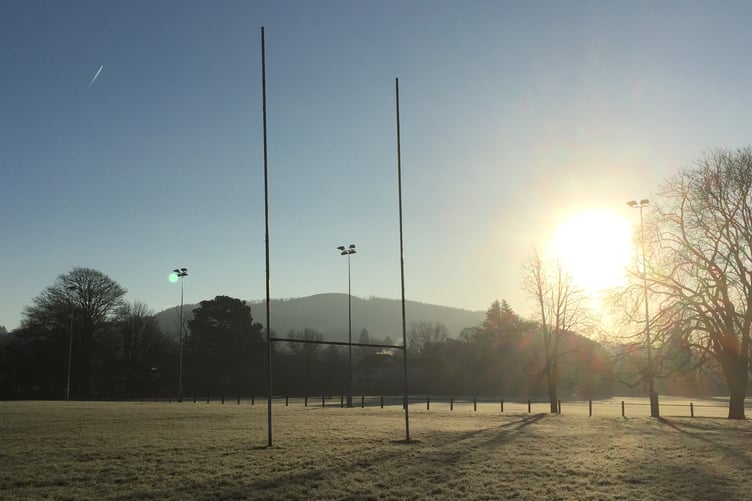
The story of Bailey Park has been a bit of a rollercoaster over the years but now remains a much-loved asset for the people of Abergavenny.
Comments
This article has no comments yet. Be the first to leave a comment.