
Planting potatoes in harmony with the cycle of the moon sounds like the sole prerogative of a lunatic, but in recent years, a growing number of experienced gardeners have become adamant that lunar gardening really does yield bumper results.
Michele Civil and her partner John Tinklin, who tend to the organic kitchen garden at Skenfrith's The Bell, are keen advocates of the ancient system, which insists crops can benefit from the correct use of a lunar gardening guide.
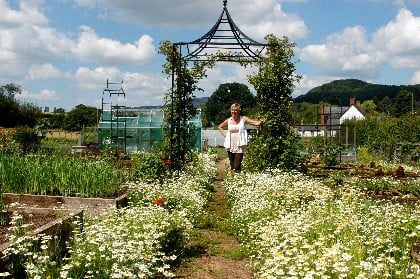
"The ancient Egyptians swore by it and a lot of old gardeners still posses a lot of knowledge when it comes to bio-dynamic gardening," explains Michele, as she proudly stands in the centre of her pretty, yet functional garden, which supplies the Bell's tables with "lunar grown" vegetables and fruits.
Michele, who originally hails from Yorkshire, is quick to admit, "When you tell people that you plan your garden to a certain extent by the lunar calendar, they look at you as if you're barking mad, but in my experience, it really does work.




"Planting by the moon does have an effect on the growth and quality of plants," insists the experimental gardener.
The Chinese, Greeks and Romans all studied how the cycles of the moon affected both the female menstrual cycles and the tides of the seas. The ancients applied this knowledge to agriculture, and the modern variant of this application is bio-dynamic gardening - a term coined in 1924 by the bio-dynamic founder Rudolf Steiner.
People who practice bio-dynamism in the garden believe that while plants receive their energy and growth from the sun, the moon's ever changing rhythms and gravitational pull affects everything you grow in a more subtle fashion.
The philosophy underscoring it argues, that if a sailor will only put to sea when the tides are right, why would you plant a tree without taking into account the lunar cycles?
It has been proven that both soil and plants possess a different moisture content at the time of the new moon and the full moon.
Systematic experiments in the Twentieth Century broadened the general understanding of a plant's response in terms of metabolism, growth and development to the lunar influence, and you can now buy a book which will give you a whole year's worth of information on what date to plant what.
"Michele explained, "In a nut-shell, the essence of bio-dynamic gardening is to plant when the moon is waxing and the soil is moist, and to harvest when the moon is waning. As someone once said, 'a time to plant, and a time to pluck up what is planted.'"
Michele added, "Crops are split into different categories, such as root, flower and fruit, and a bio-dynamic calendar will tell you what dates are ideally suited for each category. For example, if you plant a root on a fruit day, it will still grow, but not to its full potential.
"I would say from my own experience, flowers planted on flowers day return more colourful, and fruit planted on fruit days, seems to taste better."
Interestingly enough, in the Planting by the Moon almanac, there are even days when the gardener is advised to stay out of their garden altogether.
Michele recalled , "The Bell's head chef Rupert Taylor finds this aspect of bio-dynamic gardening hilarious, and told me once how he had just got a book called bio-dynamic cooking, which told him he could not set foot in the kitchen all week."
Nestled in stunning countryside, it's hard to imagine anything but the best growing in The Bell's garden, which was started four years ago to supply the kitchen with delicious fresh herbs, a good variety of vegetables, a diverse selection of salad leaves, delicious spring and summer fruits and an array of picking flowers for the tables in the restaurant.
Now stretching to nearly five hectares, the garden is completely chemical free and only natural methods such as the sprinkling of egg shells and the cultivation of frogs in the newly-dug pond are used to deter common pests such as slugs.
The whole garden is irrigated with water from a natural spring and has been certified organic by the Quality Welsh Food Certification system.
Michele told the Chronicle, ""It's a big compliment when people eat at The Bell and make a point of telling you how nice they thought the vegetables and fruit were.
We grow over hundred different tomato plants and we are very proud of our Heritage variety, which always seem to go down well with the customers.
"We have a lot of positive feedback on the strawberry sorbet served here. The chef will tell you it's the way he makes the sorbet, but the real secret is how we plant the strawberries."
Comments
This article has no comments yet. Be the first to leave a comment.