
THE Gallipoli campaign of the First World War is regarded as one of history’s biggest military disasters.
The numbers of deaths on both sides is simply staggering. This was industrial carnage on a horrific scale.
About 58,000 allied soldiers were killed during Winston Churchill’s ill-fated plan to put an end to Germany’s ally - Ottoman Turkey.
Lieutenant colonel Mustafa Kemal, who would later become the founding father of the Turkish Republic, famously told his men of the 19th Turkish Division, “I don’t order you to attack, I order you to die.”


And that’s exactly what they did, in huge numbers. Before the bloodbath was over 87,000 Ottoman Turkish troops also lost their lives and at least 300,000 more on both sides suffered serious injuries.
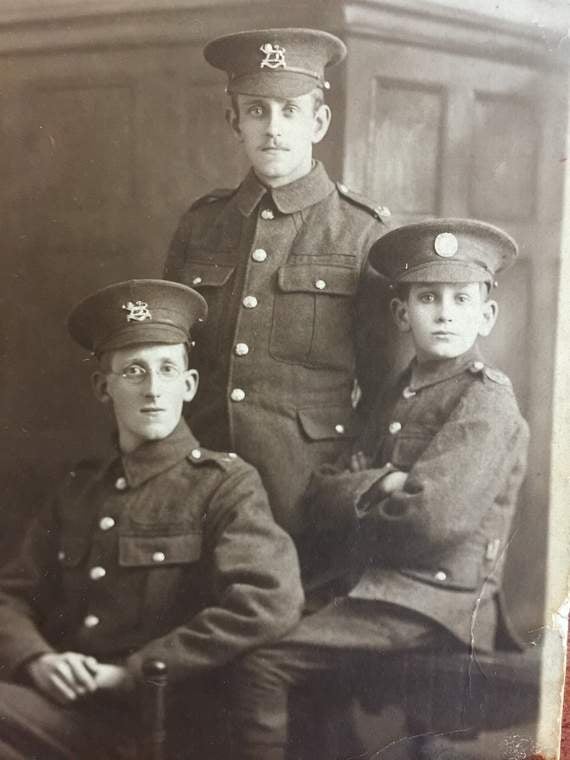
Abergavenny man George Denis Davies was one of the many fresh faced young men who landed on Sulva Bay on the Gallipoli Peninsula in August of 1915.
He was serving in 8 Platoon B Company of the 1/1st Hereford Regiment.
The Herefords were embodied in the 158th Brigade which with three others formed the 53rd (Welsh) Division.
The plan was to land a force of 20 000 men on the shores of the bay. They were the second wave of the attack. The men who landed remained unopposed and inactive for a whole day. This fatal delay allowed the heavily diminished Turkish forces to rush up reinforcements and establish almost impregnable defensive positions.
When George was sent with the Herefords into action the next day to support a company of Sherwood Foresters they were met with a wall of Turkish artillery and well concealed snipers. It took a heavy toll. A lack of leadership and hopeless inertia shown by senior generals entailed that the Herefords would not leave the Gallipoli Peninsula until December.
By that time, disease and exposure had also conspired to decimate the ranks of the Herefords.
When they finally left the same bit of beach they had landed upon four months previously they were a shadow of their former strength.
Captain Ashton wrote in his diary, “By a strange coincidence we left from identically the same bit of beach as we had landed on just 18 weeks before. It was impossible to help noticing the contrast - that brilliant August morning the battalion full of fight and endeavor, 750 strong - this dark December night slinking away, under 100 strong, weary, dirty and disillusioned.
George Davies was one of the few who survived, but only just. He was invalided home, unconscious with rheumatic fever.
George made a full recovery, and after the war he moved to Abergavenny and became the Goods Agent on the Railway for the LMS at Blaenavon where he met his wife Dorothy. They married in 1922 and started a family.
George’s second son Donald kindly allowed the Chronicle to see a speech George made not long after the war detailing some of his experiences of the conflict. It makes for interesting reading.
George who enlisted a few weeks after the outbreak of war together with about a dozen friends recalls, “I often picture the early days of the war, parading the streets of our native town led by a band who could play one tune only and rather badly. It was a good time but we were soon to be disillusioned.”
George notes that business commenced in earnest when they arrived in Aberystwyth, and explained, “I was always a fairly good walker but never bargained for a march of 85 miles in five consecutive days, carrying a kit as heavy as myself and in warm weather. It may be good for stout people but I did not relish it.”
George explained that in the early days of July 1915 there was a sense something of import was going to happen as they were issued with clothing suitable for the tropics.
Upon setting sail George said, “We embarked and pursued a zig-zag course in the Mediterranean. I did not envy the Skipper his job. For he was responsible for a cargo of 4000 men.
“I sometimes think now of the high spirited lads who set out on the perilous expedition. Hundreds never to return, only as cripples and invalids.”
George remembers how they docked for a few days in Egypt next to a Russian warship where both sets of troops sang to one another at night, “Creating an almighty din”
Recalling his experiences of Gallipoli, George explained, “It is not a cheerful story. Suffice to say that I lost more than one personal friend. Not only had we the Turks to fight but also thirst, hunger and disease.”
George also explained how remarkable it was that the boys on the front line’s chief concern was to stop people worrying about them back home.
“I was shown a post card which I wrote the second day after landing at Suvla Bay. It read, ‘Keep smiling. All quite safe. Everything lovely.’
“I well remember writing that card in ghastly company, my lips cracking for a drink of water and my younger brother and some pals were missing. The din at the time was appalling and the very earth was trembling with concussion.”
George recalls how insects were yet another thing to contend with at Gallopoli.
“We were terribly plagued by flies, millions of them, and no doubt they were largely responsible for the various diseases so prevalent. It was nearly impossible to eat without also partaking of flies as well.”
Food shortages were such that when George left Gallopili he weighed only six stone and two pounds. A far cry from the healthy recommended weight for a man who was six foot tall.
George said, “For nearly five months I only ate about two loaves of doughy bread and I sustained myself nearly a week on a crust. Needless to say I have never valued bread more than since my return.”
Not wishing to sound afflicted with self-pity, George added, “I am not in any way mentioning mine as an isolated incident, it is but one in thousands and my experiences are perhaps not so bad as theirs. It’s just I can find nothing in that unfortunate expedition but what is too sad to relate.
“Yet I consider the greatest catastrophe of all was the terrible storm of that November which was felt by us all in its severity.
“We were all very poorly nourished and the sudden changing of the temperature from almost tropical heat to intense cold played havoc with the men.
“Our regiment had been in the firing line for over five weeks when water rushed down from the hills, transforming our trenches into rapid rivers, washing men and material out to sea. Breast high in water we spent that night, and the next day when frost set in, worn and exhausted after months of terrible hardship, brave men succumbed before our eyes.”
An eye witness to the roll call of George’s regiment the next morning recalls, “Remaining was a mere handful of men, mostly with frostbitten feet or hands, while the road from the trenches to the beach was scattered with men. The helpless living with the dead.”
George was one of the fortunate ones. He was found frostbitten and unconscious on the beach. He did not regain consciousness properly until reaching the port at Alexandria. After three months of hospital care in Egypt he was invalided home to Britain and discharged.
After the war, George reflected, “I am happy in the knowledge I have done my duty, but I must say I look on life from a very different standpoint now.”
Comments
This article has no comments yet. Be the first to leave a comment.