
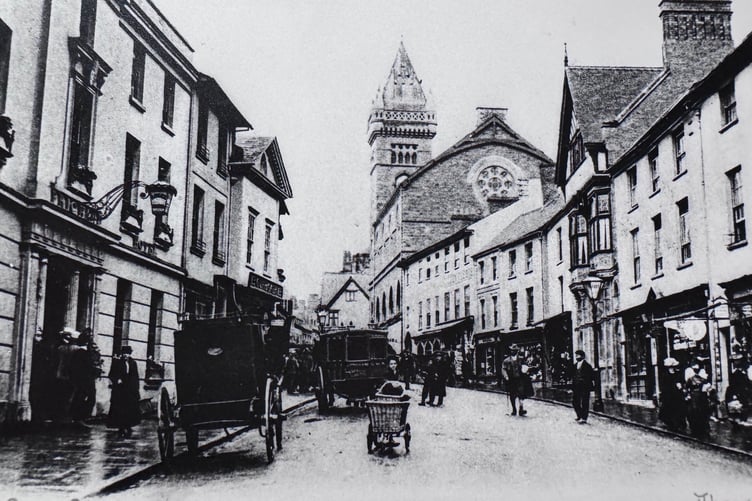
SAMUEL Deverall was one of 13 children born to William and Lucy Deverall and lived in Frome, Somerset.
His parents were retired teachers and were running a grocer’s shop and delivered produce to their customers in a pony and trap.
In 1886 Samuel, aged 22, married Georgina Goodman who was a 28-year-old dressmaker.
Samuel joined his father in the grocery trade. Five years later, his parents were out in their pony and trap delivering groceries and somehow William fell off and died from his injuries.
.jpeg?width=209&height=140&crop=209:145,smart&quality=75)

Samuel and Georgina moved to Abergavenny and set up a grocer’s shop at 44 Cross Street. They had two sons, Albert Edward (1887) and Edmund Percy Deverall (1895).
Since coming to Abergavenny, Samuel involved himself in local politics and he stood as a candidate for the Priory Ward in 1899 (this was the year that Queen Victoria granted Abergavenny a new charter as part of her Jubilee celebrations). Samuel must have been disappointed as he came last in the election.
His widowed mother, Lucy Deverall, also moved to Abergavenny with two of her sons, Herbert (born 1871) and Edwin Arthur (born 1877). Edwin was her youngest son and he died in 1897, aged just 20, from enteric fever (also known as typhoid fever) caused by limited access to clean water and poor sanitation. Herbert worked as an assistant with Samuel in his grocery store in Cross Street.
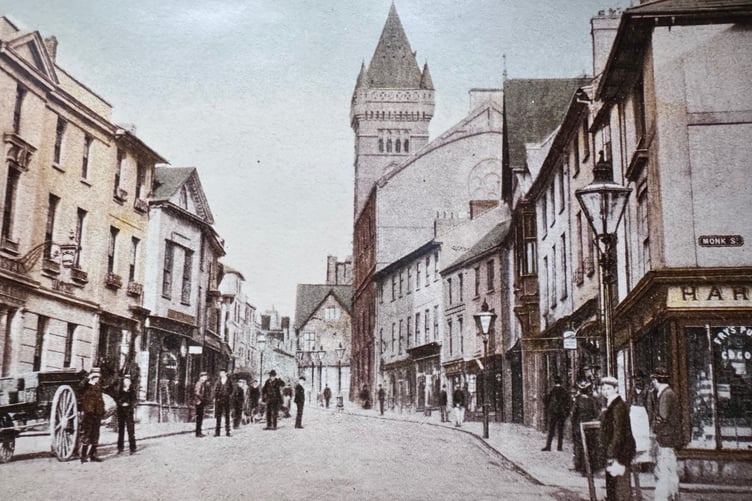
Samuel eventually won a seat on the Town Council in 1902 and was unanimously proposed for the position of Mayor in 1907.
A week later, a newspaper headline stated “An old lady in flames – pathetic burning fatality”.
The article goes on to report that an inquest was held in Abergavenny as to the cause of death of Lucy Mary Deverall, widow of William Deverall formerly of Frome in Somerset, and was the mother of Councillor Samuel Deverall, who on Monday last was selected as Mayor for the coming year. Mrs Deverall, aged 77 years, was living with her son, Herbert Deverall at 12 Trinity Terrace. She had gone to bed as usual in a room that was next to her son. Herbert was woken up by screams coming from his mother's bedroom in the early hours of the morning. He rushed into her room to find her enveloped in flames and coming towards the door. Herbert tore the burning clothes off his mother but she died 8 hours later from extensive burns to her body and shock brought on by her injuries.
Samuel somehow managed to overcome the trauma of his mother's death as he carried on his grocery business which had expanded to include a shop at Pengroesped, between Llanover and the village of Goytre.
His other interests included the Congregational church in Castle Street, where he held many positions, and he was president of the Abergavenny & Monmouthshire Liberal Association. He was also President of the Eisteddfod in 1908 as well as being a member of the Free Library Committee. At the end of his term of office as Mayor in 1908, Samuel lost his seat on the Town Council but this did not seem to bother him.
Two years later, the Abergavenny Chronicle of 5th of August 1910 reported the headline: “An ex-mayor of Abergavenny commits suicide”. Evidence was given at the inquest to say that on the morning of the tragedy, Samuel had ridden his bicycle from Abergavenny to his shop in Pengroesoped known as Pant Glas Farm. On the way he called at several houses to look for orders before reaching his destination.
The shop was part of a small farm with various outbuildings and he had visited the previous week to check on the harvest. A local pensioner, Mr. Aaron Prosser, was walking towards the shop when he noticed a body swinging from a beam in the French barn.
He ran to fetch the shop manager, Mr. Wallace Woodward, and together they cut down the body of Samuel Deverall but he was already dead. It seemed that he had jumped off a hay rick that had only just been stacked up.
One witness, Mrs Margaret Bowen, said Samuel had called on her on his way to Pengroesoped and he had appeared to be not quite his usual self. She had done business with him for the last 20 years. In the course of their conversation, Samuel had drawn his hand across his forehead and said “I have a dreadful pain this way”.
Samuel also appeared to be in an excited state and was in a hurry to get on his way. The shop manager, Mr. Wallace Woodward, said that Samuel often visited his shop but he did not see him that morning until the alarm was raised by Mr. Prosser.
He also mentioned that Samuel often complained of pains in his head. Doctor Lloyd, who had known Samuel for a number of years was next to give evidence. He said that Samuel was in general good health except for recurring bouts of epilepsy which gave him severe headaches. Doctor Lloyd went on to say that this often resulted in suicidal tendencies in sufferers.
One of Samuel's brothers, Percy Deverall, was asked if Samuel had any money worries and had he left a note to say what he was going to do? Percy replied that he was financially secure and they had not yet found a note of any description. The Coroner, in summing up, said it was exceedingly sad that Mr. Deverall's life should have terminated in the way it had done. There was no doubt that his lifelong complaint of epilepsy had affected his head, and it seemed that while suffering from temporary insanity he took his life.
To all appearances Samuel Deverall was in a prosperous position, and he was known to be an exceptionally shrewd and capable man of business. All things considered, he was perhaps one of the most unlikely persons to have taken his own life, and the circumstances had come as an utmost surprise. The jury returned a verdict of “suicide during temporary insanity”.
Samuel did leave a will and his estate was valued at £3703, around £375,000 in today’s money, and he left all his property to his wife expressing himself as “having a perfect trust in her, and, therefore knowing she will do that which is just and right for our son”.
The census of the following year (1911) shows that Georgina Deverall, Samuel’s widow, carried on the grocery business at 44 Cross Street and her two sons were living with her, Albert’s profession was a bank clerk and Edmund was a dental student. But The Abergavenny Street Survey shows that the shop changed ownership in 1914. By the 1921 census she has gone to live with her son, Edmund, in London. Georgina Deverall went on to live to the age of 91 and died in Woking during the severe winter of 1947. She was buried at Brookwood cemetery in London. Her estate was valued at £3018, around £100,000 in today’s money.
Edmund completed his dental training and moved to London. He joined the army at some time as a private in the 28th London Regiment but was later transferred to a new service and became an army dental surgeon with a promotion to Captain.
At the start of the First World War the army was using civilian dentists, as and when required, but soon realised that the vast numbers of serving soldiers in France would need dental care whilst on duty.
Altogether around 850 dental surgeon posts were created. In 1916, on leave from the front, he married Mary Love in London and after the war, he set up a dental practice in London. He died in 1962, aged 67, of bronchitis.
By contrast, the elder brother had trained as a bank clerk and had married a local girl, Gwendolin Thomas, at St. Mary's church, Abergavenny in 1913.
I can't say for certain if he went off to war as there are several records of soldiers with that name and with no way to confirm the details. Sometime later, Albert and Gwendolin moved to Church Stretton in Shropshire where he took up the position of deputy manager at Lloyds Bank that he held for 8 years.
In 1931 everything came to a head with Albert as he found himself in financial difficulty. He had siphoned off money from the bank but was now afraid that he was going to be found out.
Early one Friday morning, Albert wrote a letter of confession and gave it to his hand-maid to deliver to the bank manager in person. The manager, Mr. Graham Miller, must have had a severe shock on reading the following: “My head won't stand any more. By the time you read this I shall have crossed the line and taken Gwen with me. Telegraph my mother and brother... You will find two passbooks, my mother's and one marked “duplicate”... I have forged nearly £500... Have been going mad for years”.
Mr. Miller immediately telephoned the police and a police sergeant raced to the Deverall home. He found Mrs Deverall with a bullet wound to the head and Mr. Deverall was on the floor with a bullet through his heart.
The bank manager identified the pistol found in Mr. Deverall's hand as the property of the bank and he also verified the statement in Albert's letter in regard to money matters.
At the inquest, a verdict of “murder and suicide while temporarily insane” was recorded. Local people who knew Mr. Deverall were at a loss to account for his action that day. The Deverall's left a 12-year-old daughter to become an orphan on that fateful day in 1931.
In a strange twist to this story, Albert's wife Gwendolin, came from a wealthy family in Abergavenny.
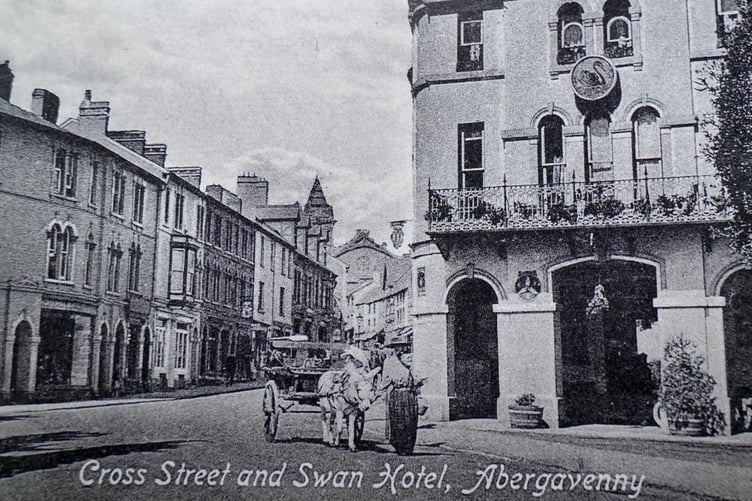
Her father, David Francis Thomas, ran a very successful draper’s shop in Cross Street known as “The Golden Fleece”. An advert in the Berrow's guide to Abergavenny for 1903 says: Thomas & Sons, general drapers and carpet warehousemen, the noted house for costumes and millinery, funerals completely furnished and special attention is directed to our celebrated Nevill Tweeds. The Abergavenny Street Survey shows that the property had been associated with the drapery trade since at least 1822 and with the Thomas family since 1879.
A note from the Abergavenny chronicle of 28th of October 1884 says: “A ram, seeing a reflection of its companions, jumped through the window of The Golden Fleece into a magnificent display of millinery and drapery”.
Another note says that, “During the 1920's and probably before that, the first floor was occupied by about 10 women making hats from rabbit skins and about 200 rabbits were kept in the garden to provide the material!”
Gwendolin's father, David Francis Thomas, had just finished his business for the day in “The Golden Fleece” on Tuesday 16th of September 1913 when he had an apoplectic seizure and although medical assistance was called in, he never recovered. He was just 51 years old. The value of his estate was £9000 which is just over £1,000,000 in today's money. Albert and Gwendolin both attended his funeral which was undertaken by his own business. Surely some of his legacy would have found its way to Gwendolin and her husband?
Comments
This article has no comments yet. Be the first to leave a comment.