
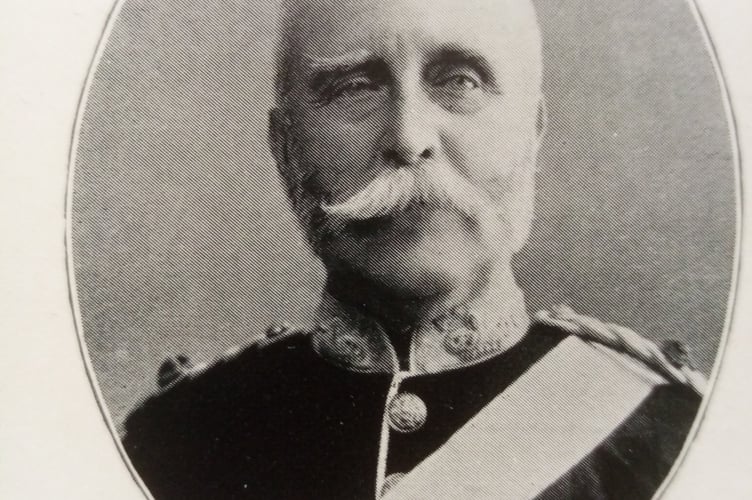
AT a meeting of Abergavenny Town Council on Monday the 1st of August 1924 the Mayor (Major J.R. Jacob) announced the death of Colonel William Williams on the previous day at the age of 87 years.
Colonel Williams had been Mayor of Abergavenny on three separate occasions: 1900,1904 and 1908 and had served the town to the best of his ability in many capacities for a great number of years and he had given more time to public duties than any man.
William Williams was born on May 10, 1837, a son of the late William Williams, J.P., of Castle Street. He was educated at the Priory school under the late J. R. Rutherford.
His teacher would go on to apply for the position of Town Clerk in 1861 and would become a key figure in William’s public life for over 40 years.
I have been unable to link William with any form of employment as his obituary simply says that he served in the 4th Volunteer Battalion South Wales Borderers for many years before retiring in 1896 with the rank of senior major.
This unit was first raised on the 9th of September 1859 as a direct result of the Orsini affair in 1858. This had been an attempt to assassinate Napoleon III in Paris and Britain had reacted by creating The National and Constitutional Defence Association.
This was a pressure group for a voluntary military rifle corps designed to resist invasion. The original formation was re-designated the 4th Battalion SWB in 1885. A new Drill Hall was built for them in Baker Street, Abergavenny and completed in 1896, the same year that William retired. The Battalion never saw active service until the Boer War and this resulted in an historic event for the town.
William’s chief distinction was that he had been the Mayor of Abergavenny on three occasions over an eight-year period. During his first year of office, The Marquess of Abergavenny was made the first Freeman of the Borough. In the same year, the Marquess laid the foundation stone of the Victoria Cottage hospital in which Major Williams took a very keen interest and had done much to bring the project to Abergavenny.
Just by chance, Major Williams happened to be the Mayor (1904/5) when the second honour of the Freedom of the Borough was bestowed on Lord Roberts. In August 1905, Abergavenny was geared up for the visit from Lord Roberts, VC.
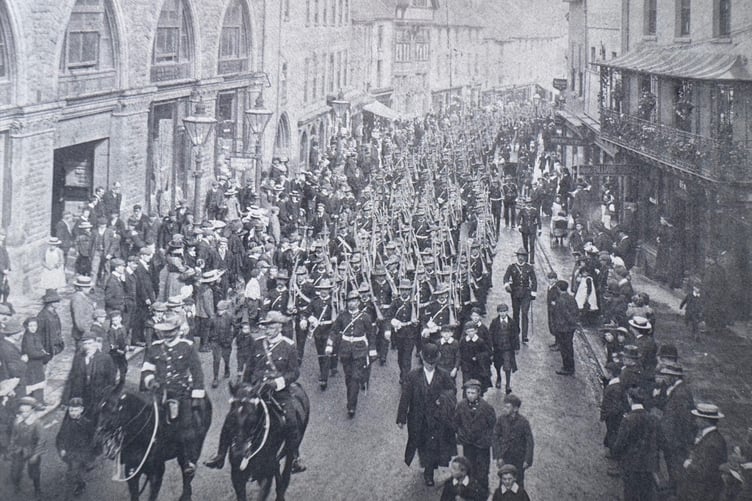
Lord Roberts was the hero of the Boer War and he was asked to unveil a memorial tablet in St. Mary’s church, Abergavenny that had been erected to honour the local heroes of the South African war.
The tablet was inscribed with the names of 30 officers and men who had volunteered to go to South Africa to fight for their country.
Lord Roberts arrived at Brecon Road station where there was a huge crowd waiting for him. Major Williams and the rest of the Corporation were standing on a reserved part of the platform, the approach to which was through an avenue of palms. The Marquess of Abergavenny was there to welcome Lord Roberts and introduced him to the Mayor and the other councillors.
Lord Roberts and the Marquess then drove off to Nevill Hall, the country residence of the Marquess, where they would be staying for the duration of the visit.
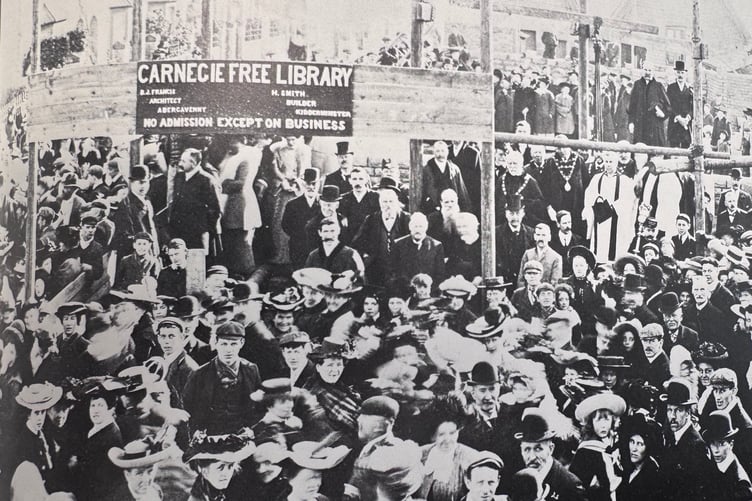
Earlier in the year, Major Williams had laid the foundation stone of the Carnegie Free Library in Baker Street, Abergavenny. He had been pressing the council to approve the provision of a free library despite a strenuous opposition.
Major Williams exhibited the qualities of a real Abergavenny “bulldog”. He often experienced defeat, but never acknowledged surrender and pressed on until January 1900 when the “Free Libraries Act” of 1892 was finally adopted by the council.
He immediately set to work and for the next 20 years was the chairman of the library committee that saw the Carnegie library come into being.
But to start with, Major Williams established a reading room in the Corn Exchange part of the Town Hall. He himself collected nearly 3000 books to start off the library and he no doubt had a good deal to do with the magnificent donation of books by the late Mrs Attwood-Matthews.
In December 1902 Andrew Carnegie was petitioned with a view of obtaining a purpose-built library for Abergavenny that resulted in an offer of £2000.
The site chosen was the old school playground of Trinity church in Baker Street. The foundation stone was laid on 6th of April 1905 by Major William Williams and the library was formally opened on 8th September 1906.
Andrew Carnegie was not able to come to the official opening but he did pay a visit to Abergavenny in June of 1907 on the occasion of him being presented with the Freedom of the Borough.
He was met in the Town Hall by the Mayor, W. D. Woodward, and they proceeded to the library in Baker Street where he met with Major Williams, chairman of the library committee, who thanked Mr. Carnegie for his gift on behalf of the townspeople of Abergavenny.
Most of Mayor Williams' time was taken up with public duties. He was an Alderman of the Monmouthshire County Council and was active on many committees there.
He took a keen interest in two schools in Monmouth as well as King Henry VIII Grammar School in Abergavenny. He was also an Alderman of the borough of Abergavenny and served on many of their committees as well as numerous other bodies in the town.
Major Williams was also an active Freemason and was a past Master of the local Lodge and a Past Provincial Grand Warden for Monmouth as well as serving the offices of steward on the Freemason’s charities. He was appointed a justice of the Peace in 1902. He was also appointed warden and lay elector to the vicar of St. Mary’s church.
Shortly after the outbreak of the First World War in August 1914, the Chronicle of the 11th of December reported that:” Departure of the 3rd Mon. Reserve Battalion. Over 800 strong was paraded at 7:15 AM in Bailey Park. Major William Williams was in attendance with the Mayor, Zachariah Wheatley. Colonel Williams addressed the troops and said he hoped they would have a good time and would give a good account of themselves. He felt sure they would uphold the dignity of the town and would follow the noble example of the old 24th regiment. The town regretted their departure because they had conducted themselves in a very soldiery and becoming manner. He hoped it would not be long before another battalion was recruited at Abergavenny, which would receive as hearty a welcome from the townspeople. Abergavenny will continue to be a recruiting station.”
Back in August the Chronicle reported that: “Major William Williams was instrumental in the recruitment of a civilian Volunteer Corps based at the Drill Hall and there was a constant stream of volunteers. Each new recruit had to sign a pledge: ‘I, the undersigned, do hereby pledge myself to faithfully carry out the duties of as a member of the above corps, to the best of my judgement and ability, for the protection and good government of this borough, and obey the lawful orders of the responsible officers appointed for that purpose.”
In the middle of the First World War, the 4th of February 1916, the Abergavenny Chronicle reported that: “Monmouthshire Cadets – A Second Battalion: Major Williams promoted to Lieutenant Colonel. The cadet movement in Monmouthshire, which owes so much to Major William Williams of Abergavenny, has been remarkably successful, and it has now been found possible to form another Battalion for the county. It is fitting that the work which Major Williams has done should be suitably recognised, and he has this week received from the lord Lieutenant his promotion to the position of lieutenant Colonel in command of the Second battalion.”
Major Williams became Mayor for the first time in 1904 and took part in the traditional Mayoral Sunday.
The following year Mayor Williams, celebrated St. David’s Day by inviting about 800 of the people of Abergavenny to an evening concert at the Town Hall, where a well-arranged programme of Welsh music was carried out.
During his time as a JP several cases were reported in the local newspapers such as: “Elizabeth Clifton made her 27th appearance at Abergavenny Magistrates Court for using obscene language and was fined five shillings. William Thompson, a Militia recruit, was charged with sleeping out without visible means and was let off on condition that he left the town at once. William MacBean, a mechanic, was charged with having a motor trailer without an index plate in Cross street, Abergavenny. He pleaded not guilty. A police constable said that he saw the defendant riding a motor cycle behind which was an ordinary bicycle on which there was no index plate. There was a man on the bicycle who was holding on to a rope and was thus being ‘towed’ along. The defendant said that he had been doing this for a long time and had never been stopped before and he held that as the bicycle was not attached to his motor cycle, he had not committed an offence. He was ordered to pay the costs of five shillings.
In June 1916 the Chronicle reported: “THE VETERAN ALDERMAN – Colonel Williams entertains past and present colleagues. There was a pleasant little gathering at the Priory Hotel on Saturday when Colonel Williams (who presided) started the ball of conversation rolling and indulged in some interesting reminiscences. He had invited them there out of a friendly feeling in his old age, and he wanted to live at peace with everybody. He had no doubts he had faults, but at the same time he had at heart a love for his old town. He was what they called an ‘Abergavenny Bulldog.’ He was born in the High Street (1837) and he went on to remember the days before the railways came and the beginnings of the town council by the Board of Improvement Commissioners.
"During elections for the Commissioners, candidates would look over the shoulders of electors to see who they had voted for. He then spoke at great length to mention the improvements that had been made to the town, some of the local characters (including the story of Ben Hale, the man who had been hanged twice), the time that Abergavenny had been noted for the manufacture of peri-wigs and the building of the drives around the mountains.
"Councillor W. J. Tong responded by saying that mention had been made of Colonel Williams’s public life – he himself remembered him as a public man 38 years ago – and also of his hospitality and interest in military matters, but one thing had been overlooked. It had been a matter of great surprise to him, during the 13 years he had lived in Abergavenny, that Colonel Williams was a bachelor, because without doubt, he was a ladies’ man. He had heard it contradicted many times, but if they wanted to prove it, they had only to stand as a candidate for the Town Council in the Cantref ward. Whenever an election comes round, added Councillor Tong, the Colonel is on the warpath. If he is for you, you have the ladies on your side; but if he is against you, God help you.”
In the same year, the Chronicle received many letters addressed to Colonel Williams from soldiers who were fighting for their country on the continent. One such letter dated the 21st of January 1916 from Harry Cox read: “Dear Major, I now take the greatest pleasure of answering your most kind and ever welcome letter which came to hand a few days ago. I am glad to know that you are keeping so well in regard to health. I am in the pink of condition. Thanks very much for the tracts: they interested me very much, and I have handed them over to my chums who are sleeping with me in this cold old barn. I shall be glad when the warmer weather comes, so that we shall be able to keep ourselves dry, and with a bit of luck, shift the ‘square-heads’ back to their homes, as I am fed up with it, but still smiling, like a brother scout should do under all circumstances. Wishing you a happy New Year, from one of your old scouts, Harry Cox, 2nd Mon. Regt. B.E.F.”
Colonel William Williams died in July 1924 and the Chronicle honoured him with a very long obituary in the edition of August 1.
Comments
This article has no comments yet. Be the first to leave a comment.